
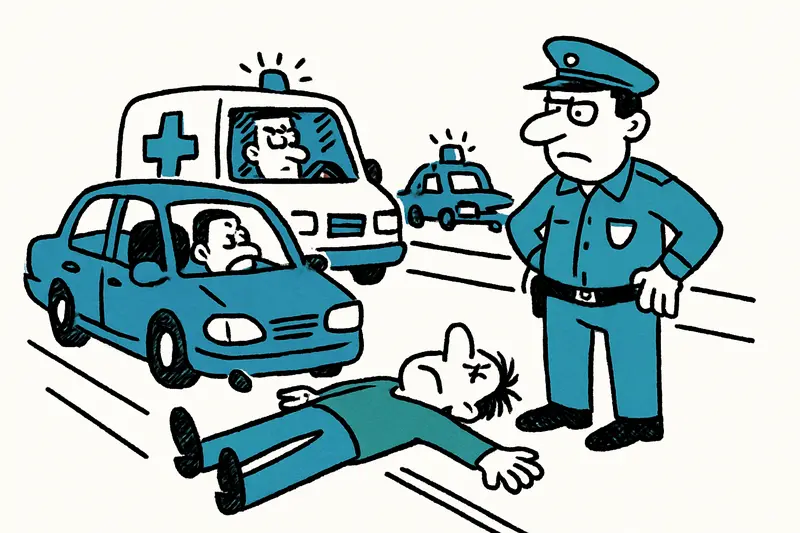
Fatality on the MA-19 near Palma: How did a pedestrian get onto the highway?
A man died last night on the highway heading to the airport near Palma — the Guardia Civil is investigating. The tragedy raises questions about safety, lighting and night-time mobility in the area.
Accident on the MA-19: One person lost their life, many questions remain
Yesterday evening at around 9:15 p.m., the busy highway towards the airport near Palma briefly turned into a scene of tragedy: a man, apparently on foot, was struck on the overtaking lane by a car and died at the scene, as reported in Fatality on the MA-19 near Palma: How did a pedestrian get onto the highway?. Emergency services, a doctor and the Guardia Civil arrived quickly, but all help came too late.
What witnesses report — sirens, headlights, traffic jams
Drivers heading to the airport at departure time recall the typical sounds of an evening drive in Mallorca: engines, the radio in the background and suddenly those sirens. The stretch known as the MA-19 became blocked; long queues formed towards Son Sant Joan. Residents from a nearby industrial area describe a cool, slightly damp evening, headlights flashing in the dusk, and how unusual it seemed to see a single person on the overtaking lane, a scenario also described in local coverage such as MA-19 at Night: Why Was a Pedestrian on the Airport Access Road?.
The central question: How did the man get onto the highway?
This is the core question occupying investigators now. Highways are not pedestrian routes — and yet people sometimes end up on the carriageway. Was it a medical emergency, disorientation, the influence of alcohol or medication? Was it intentional, or did the man use an inadequately secured access from adjacent land? The Guardia Civil is examining all possibilities, interviewing witnesses and evaluating traces and footage, as noted in MA-19 por la noche: ¿Por qué caminaba un peatón en la vía de acceso al aeropuerto?.
Aspects that often get overlooked
Public debate quickly turns to assigning blame: the pedestrian, the driver, bad luck. Less attention is paid to systemic weaknesses. In many places along the MA-19 there are poorly closed verge areas, gaps in fences next to industrial or residential zones and only sparse pedestrian routes for workers who have to walk home at night. Night-time transport — bus lines, company shuttles, taxi availability — is also patchy in some industrial and peripheral areas. Added to this are dark stretches with insufficient lighting that can make orientation difficult at dusk.
Investigation and evidence collection
Emergency personnel carefully documented the scene: photos, measurements and witness statements. For about an hour the motorway was partially closed, later reduced to one lane. Road users were asked to use alternate routes. The Guardia Civil announced it will soon provide more details on the identity of the man and the course of events; relatives are to be informed and updates may be posted on the Guardia Civil official website.
Concrete measures that would make sense now
The tragedy suggests complementing the usual reactions with practical steps. We propose:
1. Survey and upgrades: Check where fences have gaps and close them promptly. Reflective posts and improved lighting could also reduce hazards in dark sections.
2. Night transport and safe routes home: Employers in industrial areas should organise car pools, company shuttles or subsidies for taxis so that workers do not have to walk long stretches along the highway; guidance on road safety measures can be found at the Dirección General de Tráfico (DGT).
3. Surveillance and quick-reporting options: Video monitoring at accident hotspots, linked with emergency call buttons at key points, can shorten response times and assist evidence collection.
4. Prevention and awareness: Information campaigns for night-shift workers, warning signs at accesses to the highway and more patrol presence during late evening hours.
Why this is also a social issue
Such incidents touch not only on traffic safety but also on social provision questions: who is out and about at night? Commuters, shift workers, visitors without cars or people in psychological crisis — all can be at risk. A sensitive, data-based analysis of accident hotspots could help create targeted services and reach people in need more quickly, an approach discussed in reporting such as Fallecido en la MA-19 cerca de Palma: ¿Cómo llegó un peatón a la autopista?.
Appeal to witnesses and farewell
The Guardia Civil continues to ask for information: anyone who noticed anything unusual last night in the area of the MA-19 should come forward. Every small detail can help reconstruct the sequence of events and provide clarity. Our thoughts are with the family and friends of the deceased — on a night when many journeys began, one person's life ended abruptly.
Those who can help can reach the Guardia Civil via the known phone numbers or provide information directly at the nearest station.
Frequently asked questions
What happened on the MA-19 near Palma?
Why was a pedestrian on the highway near Palma?
How long was the MA-19 affected after the accident near Palma?
What should drivers do if they see a person on the MA-19 in Mallorca?
Are there pedestrian risks on the roads around Palma at night?
What safety improvements could help on the MA-19 in Mallorca?
Who is investigating the fatal accident on the MA-19 near Palma?
How can witnesses help after a serious road accident near Palma?
Similar News
Cafetería San Siro: A Meeting Place on Schinken Street Since 1966
In the middle of Schinken Street, Cafetería San Siro has been offering Mallorcan hospitality for more than six decades —...
From Ballermann to Prison: What the Verdict Against the Femina Operator Means for Palma
The Munich Regional Court convicted a German operator for subsidy fraud. What does the verdict mean for the Femina Club,...
Underpass Verge de Lluc: 19-year-old fights her way out of flooded car – a warning sign for Palma
A 19-year-old recently escaped swimming from her car after the Verge de Lluc underpass held up to one and a half meters ...
When the Floodgates Open Again: Why Palma's Floods Aren't a Coincidence
A sudden heavy downpour around 5 p.m. brought Palma to a standstill: flooded streets, full basements, panicked commuters...
Playa de Palma: Life-saving at Balneario 11 – Lifeguards Act Quickly
A German holidaymaker suffered cardiac arrest at Playa de Palma. Lifeguards resuscitated her on the beach; emergency ser...
More to explore
Discover more interesting content

Can Cap de Bou

Townhouse Lleo 72
