
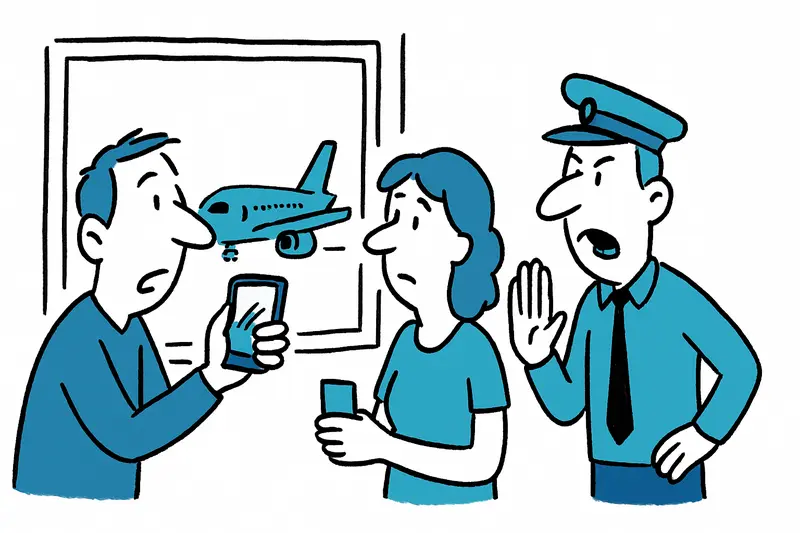
Filming at the Gate and Onboard: Why the Rules Are Confusing — and Who Decides
Filming at the Gate and Onboard: Why the Rules Are Confusing — and Who Decides
Ryanair bans recordings entirely, Eurowings allows private selfies, Condor asks for consideration. Why passengers are often left in the dark and how travelers at Palma Airport can act safely.
Filming at the Gate and Onboard: Why the Rules Are Confusing — and Who Decides
Key question
May I film with my phone at the gate or during the flight — or do I risk trouble, being removed from the flight, or even a fine? The short answer: it depends on the carrier and the situation. What is missing is a uniform, easy-to-understand set of rules for travelers.
Critical analysis
On a muggy morning at Palma Airport (Son Sant Joan) you often see it: families, couples and solo travelers press their noses against the terminal windows, photograph the aircraft at the gate amid confusing pictograms or take one last window shot over Mallorca's coast. For many, such recordings are harmless holiday mementos. In practice, however, different interests and regulations collide. Some airlines prohibit recordings almost entirely; others allow private photos as long as the privacy of others is not violated; others again make a strict distinction between private snaps and commercial shoots.
This leads to several problems: first, the rules are formulated inconsistently. Second, enforcement is often at the discretion of crew or ground staff. Third, travelers are often only informed about bans during boarding or on board — a situation in which escalation can become unpleasant for everyone involved. Such uncertainties can even lead to being removed from the plane, as shown by a carry-on dispute at the emergency exit that escalated.
What is missing from the discourse
It is often overlooked that two levels must be considered separately: legal requirements for aviation security operations and the personal rights of fellow passengers. Authorities such as the European Aviation Safety Agency and national bodies set safety standards, but they rarely regulate in detail how private recordings should be handled. Equally under-discussed is the question of information obligations: why don't airports and airlines provide clear, visible and timely information about their camera rules?
Everyday scene from Mallorca
Imagine this: in the café in front of the departure hall on Passeig de Mallorca, a quick café con leche, then a look at the departure board, German and Spanish announcements blending together, and a couple films a selfie with the aircraft in the background. An employee approaches and politely asks them not to show other guests in the recordings. A small scene, but typical — and easily avoidable with clear information.
Concrete solutions
1) Uniform, visible notices: Airports and airlines should post clear rules at gates and check-in — in several languages and with simple examples.
2) Advance information: Airlines could briefly explain on booking confirmations and mobile boarding passes whether and under what conditions photographing and filming are permitted.
3) Standardised categories: A simple system ("Private photos allowed", "Recordings showing third parties prohibited", "Commercial shoots only with permission") would reduce the grey areas.
4) Crew training and de-escalation: Staff should not only know the rules but also master techniques for de-escalating conversations. If a ban applies, a clear, friendly announcement should suffice — and hard measures should only be taken as a last resort.
5) Accessible permitting procedures: For advertising or influencer shoots there should be straightforward online application processes so it can be clarified in advance whether and how filming is allowed; discussions around new hand luggage measuring frames at Palma Airport illustrate that gate procedures can be clarified and standardised.
What travellers can practically do
Before you film: quickly check the airline's information on the website; ask at the gate; do not intentionally include other passengers in the shot; obtain permission early if you have commercial intent. Those who behave politely avoid most conflicts.
Pithy conclusion
The mix of differing company rules, security considerations and protection of privacy causes confusion. Clarity and advance information would prevent many embarrassing situations. Until then: a little consideration, a quick question and common sense protect you from stress — at Palma Airport and everywhere else.
Frequently asked questions
What is the best time of year to visit Mallorca for good weather and outdoor activities?
Do I need to bring beach gear when visiting Mallorca?
Is Palma de Mallorca a good base for exploring the island?
What’s the difference between Mallorca’s rocky coves and sandy beaches?
How warm is the sea around Mallorca and is swimming possible year round?
What are good outdoor activities in Mallorca for families?
How easy is it to get around Mallorca without a car?
What local Mallorcan dishes should I try?
Similar News

From the Reality Studio to the Pitch: Aleks Petrovic Makes Mallorca His Base
The former participant in numerous TV shows moves from Dubai to the island and launches a project with FC Germania Mallo...

When the Phone Falls Silent: Concern for Sarah Joelle in Mallorca — and What It Reveals
After days without a response, the TV personality's unreachability in Mallorca sparked concern. Shortly afterwards an al...
Ultraluxury on the Ground: Four Seasons Jet in Palma — a Reality Check for Formentor and the Island
A high-priced flight crosses Mallorca and its guests stay for days at the Formentor resort. What does the island get bes...
Death of a Witness and the Justice Backlog: Why the Kegel Brothers Trial Matters in Mallorca
A witness in the Playa de Palma fire case has died, and the trial against eight German holidaymakers has been delayed un...

Champagne Reception, Red Carpet and Mini Originals: The Pre-Nit del Art at Gallery Mensing
Almost 400 guests, champagne, pop-art feats by Tom Boston and a raffle for the Parkinson's foundation: Gallery Mensing t...
More to explore
Discover more interesting content

Can Cap de Bou

Townhouse Lleo 72
