
Tiny Symbols, Big Confusion: Ryanair Pictograms at the Gate in Palma
At Gate 12 in Palma, tiny pictograms on Ryanair seats prompted smiles — and real safety questions. Why small pictures are not the same as clear instructions.
Tiny Symbols, Big Questions: Are the Seat Pictograms Really Understandable?
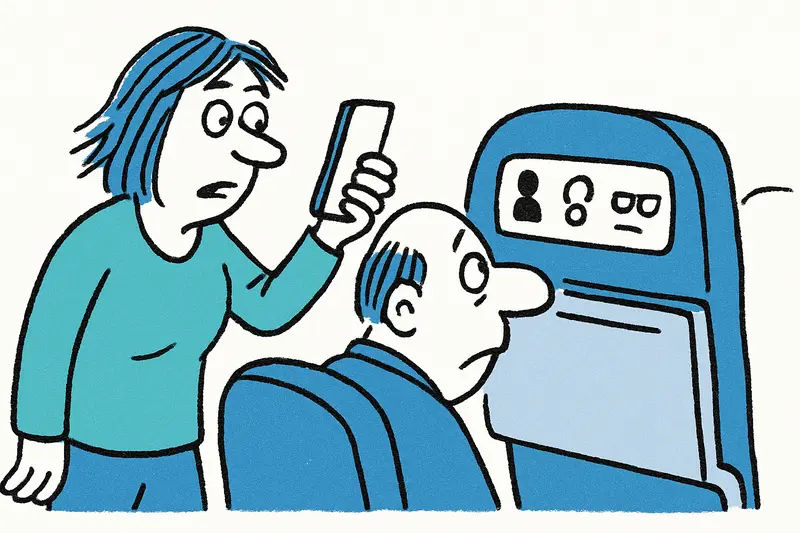
It was a Tuesday morning at Son Sant Joan, the sun slanting through the large windows, rolling suitcases squeaking across the floor, and announcements in Catalan, Spanish and English: Boarding Gate 12. At 08:40 a routine moment suddenly became a small scene that revealed more about our expectations of safety than one might think. A woman held her phone up to the seatback in front of her, zoomed in and called out, "Is that a sandwich or a person?" Several passengers laughed, but the laughter overlooked a serious problem: Ryanair's seatback pictograms were confusing.
What the symbols are supposed to show — and why they are often misunderstood
The idea is obvious: instead of thickly printed safety cards, the airline saves space by printing instructions directly on the seats. In practice, however, the pictograms are so small, stylized and low-contrast that they provide more puzzles than orientation. A sign that is described as depicting a dental prosthesis was interpreted as a roll, a toy or a small doll. Other symbols — supposedly for jewelry, earrings or large accessories — are hard to classify without context.
The less noticed consequences: usability and insurability
Less obvious but important: understandability is not a luxury, but part of the safety chain. In poor light, with stressed passengers or elderly people with reduced vision, tiny icons do not help. Psychological factors also play a role: if someone does not immediately understand a symbol, they doubt the information overall — and are more likely to switch to automatic routines instead of taking a closer look. For people with language barriers, pictograms are actually an advantage, but only if they are clear and unambiguous. If not, a vacuum forms that encourages misinterpretations.
Savings versus safety: where is the compromise?
In the short term, you save printing costs and weight — a point that matters especially for low-cost carriers. In the long term, however, the calculation can backfire: unclear instructions can lead to misunderstandings and delays if crew members have to answer questions more often or if passengers act uncertainly in an emergency. A flight attendant at the gate shrugged: "We explain many things in the safety video, but the symbols on the seats are not self-explanatory." That says something about practice: the video does not automatically replace graphic clarity on the seat. See Mallorca-Magic: Ryanair's new carry-on measuring frames at Palma airport and the related coverage of Ryanair's new carry-on rule.
Concrete improvement ideas for more clarity
What would be practical and quick to implement? Some suggestions that are neither exotic nor expensive: print the pictograms larger and with high contrast, place them additionally on tray tables or in the seatback pockets so they are visible when unfolded. QR codes next to the symbols could lead to enlarged, explanatory images — helpful especially for older eyes or travelers with visual aids. Airlines could also add short, memorable sentences in multiple languages under the symbols (e.g. "Leave dentures behind"), instead of relying on images alone. Last but not least: user tests with real passenger groups before a wide rollout would nip many misunderstandings in the bud.
What travelers at the gate in Palma can do
Until improvements arrive, two simple rules of conduct help: First: watch the safety video. The crew often mentions details that small symbols do not convey. Second: when in doubt, ask — at the gate or when boarding. Yes, that costs a few extra minutes, but it is better than a later, awkward misunderstanding. And yes, if the pictogram really does mean a dental prosthesis: leave your removable teeth on the seat if asked — it sounds odd, but it's serious.
At Son Sant Joan, among the smell of coffee and rolling suitcases, the debate about tiny symbols may seem amusing. But it touches a larger question: how much may saving cost before it goes at the expense of comprehensibility? The boarding at Gate 12 was a gentle wake-up call. The symbols may be small, but the consequences of their incomprehensibility cannot remain small.
Frequently asked questions
Why are Ryanair seat symbols at Palma airport so hard to understand?
What should I do if I do not understand the safety symbols on a Ryanair seat in Mallorca?
Are pictograms on airplane seats actually useful for travelers in Mallorca?
Do small safety symbols on flights matter if the airline shows a safety video?
Is it normal to ask cabin crew about confusing seat instructions at Palma airport?
What kind of passengers are most affected by tiny airline symbols in Mallorca?
Has Ryanair changed other baggage or boarding rules at Palma recently?
What can airlines do to make seat pictograms clearer for passengers in Mallorca?
Similar News
Mini-tsunamis in Mallorca: Harmless natural phenomenon — or an underestimated danger?
Two harbor towns in Mallorca recorded unusual water level fluctuations. An analysis: How rissagas form, who is at risk —...
Stinging jellyfish in Cala Banyalbufar: Why everyone suddenly fled the water
In Cala Banyalbufar, Pelagia noctiluca washed up in droves. A personal account of why this is no coincidence, what is of...
New low-pressure trough brings rain — and the heat remains: What's missing in Mallorca?
A short, intense window of showers hit Mallorca, yet the air remained muggy and warm. Key question: Why does rain hardly...
Klaus-Michael Kühne has died: The entrepreneur who gave Mallorca a second home
He first arrived on the island at 60; later the holiday house became Castell Son Claret – a hotel, a music venue and an ...
Buying Instead of Moving Away? Why Every Fourth Property Owned by Balearic Residents Isn't Located Here
Almost a quarter of the apartments purchased by Balearic residents are located on the Spanish mainland. A concise analys...
More to explore
Discover more interesting content

Boat Tour with BBQ along Es Trenc Beach

Private transfer from Mallorca Airport (PMI) to Pollensa
