
Fire in Son Hugo: Who protects people living in caravans?
Fire in Son Hugo: Who protects people living in caravans?
A fire destroyed several caravans in the Son Hugo parking lot. A 34-year-old was arrested. The incident raises bigger questions: How safe are people living in vehicles, and why do structural problems remain unaddressed?
Fire in Son Hugo: Who protects people living in caravans?
Arrest, destroyed caravans — and the question of long-term safety
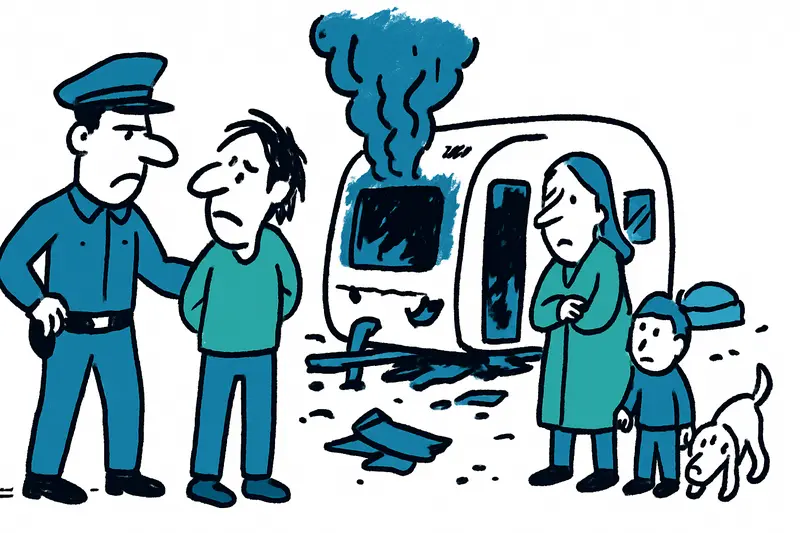
On Wednesday at midday a fire broke out in the parking lot of the Son Hugo sports center, affecting several caravans. Three caravans burned down completely, four others were damaged, and one person had to be treated for smoke inhalation. That same evening the National Police detained a 34-year-old man in Palma; according to investigators he is suspected of having deliberately set the fire. Investigations are ongoing.
Key question: How did it come to pass that people are so vulnerable on a municipal parking lot — and who is responsible for protection and prevention?
Soon after the fire the scene could be captured in small details: the acrid smell of firefighting smoke still hung in the air, some residents stood with jackets over their shoulders, children held hands, a dog whimpered. People who usually sleep between shifts looked stunned at the burned remains of their dwellings. Firefighters, who spent hours fighting the blaze, had to navigate closely along access routes because the caravans stood close together — a circumstance that favored the spread of the fire.
From the investigations so far a picture emerges on two levels: an alleged criminal act as the immediate trigger and an underlying field of problems. On the one hand, police and the fire brigade are working to clarify the facts: securing evidence, interviews, technical examinations. On the other hand, there are hundreds of people, often seasonal or casual workers, who live in vehicles for lack of affordable housing — on municipal parking lots, near busy roads, with limited supply facilities.
What has been missing so far in public discourse is the structural vulnerability of these people. There is a lot of reporting about an arrested person, but little about why municipal parking lots are allowed to become permanent living spaces, what controls exist and how quickly social services can act after disasters. It is also rarely discussed how employers, landlords and the city administration could cooperate to reduce precarious living conditions.
The local everyday perspective shows simple, concrete risks: lack of fire protection equipment in the vehicles, narrow parking gaps, improvised electrical connections, no permanent water points and often no clear escape routes. Residents tried with brought water supplies to stop the fire — against flames that spread rapidly because the caravans were so close together. This is not an abstract problem; this is Sunday breakfast, children's laughter and maintenance that are put at risk every day.
Concrete solutions that could take effect immediately:
Short term: Deployment of a mobile relief brigade (social work/fire protection), issuing at least one fire extinguisher per household, emergency accommodation for affected families with priority for families with minors, short-term financial aid for damages, clear marking and keeping access routes clear.
Medium term: Establishing safe, regulated pitches with minimum distances, central water connections and extinguishing points, regular safety checks for electrical installations, mandatory registration of residents so that aid can be coordinated more quickly.
Long term: An inter-municipal program for affordable housing for seasonal and low-wage workers, complementary rent subsidies, labor market initiatives that encourage longer stays and stable accommodation, as well as monitoring of high-risk settlements with clear responsibilities between social services, the fire brigade and the police.
An important detail: the investigations should clarify whether a personal dispute was the motive. The police have also ruled out that the incident is linked to a known domestic violence situation involving another person under a restraining order. Such separations between individual cases and structural causes are necessary — but they must not lead to the larger question being forgotten: How do we prevent people from having to live in such precarious conditions in the first place?
Conclusion: The arrest can be an important piece of the puzzle in clarifying the case. But it does not replace the duty of the city and society to reduce housing and fire safety risks. Anyone driving along Passeig in Palma or the busy access roads sees people who commute between work and overnight stays. It would be a small triumph for the island if concrete measures followed the commotion — fire extinguishers, regulated pitches and a serious plan for affordable housing. Without that, in the end there will only be ashes and the question of who will prevent the next fire.
Frequently asked questions
What happened at Son Hugo and why is it raising concern for caravan residents in Mallorca?
Who is responsible for fire safety and protection for people living in caravans on municipal parking areas?
What immediate safety steps could help residents living in caravans after a fire?
What long-term housing options could help seasonal and low-wage workers on Mallorca?
How can safety on caravan pitches be improved in the medium term on Mallorca?
Are there practical changes that could prevent fires in caravan settlements beyond reacting to events?
How does this incident relate to housing and social services in Palma beyond the immediate fire?
What is known about the motive behind the Son Hugo fire and what does that mean for safety policy?
Similar News
Crack in the Heart of Palma: Hole under the Cathedral Steps Causes Concern
A cavity of up to five cubic meters was discovered beneath the stairs to Palma's cathedral. Why action was taken only no...

S'Aranjassa, Schinkenstraße and Silence: How the 'Bierkönig' Case Must Be Reopened
Almost 29 years after the murders many questions remain. More than 100 tips came in after a TV reminder of the case – ti...
Two serious accidents in one morning hour: Why people are being seriously injured on Mallorca's roads again
In the early morning hours there were crashes on the MA-19 near Llucmajor and on the MA-5020 near Porreres. Three people...
Surprise over Palma: Saudi aerobatic team draws colorful trails
On Wednesday afternoon jets of the "Saudi Hawks" caused a stir: in white, green and red they flew over Palma and Son San...
Left Alone in Palma: What Lies Behind the Case of the 20-Month-Old Boy?
A 20-month-old child in Palma was reportedly left for hours at a time without food or supervision. Who protects the youn...
More to explore
Discover more interesting content

Can Cap de Bou

Townhouse Lleo 72
