
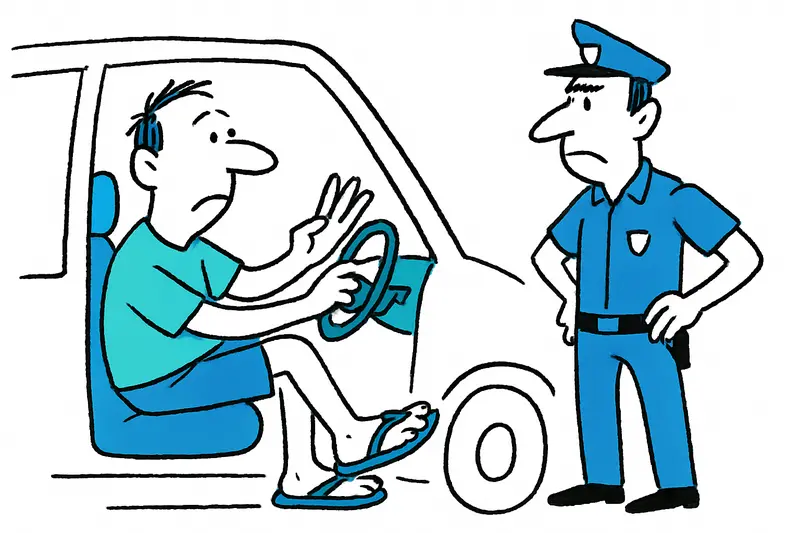
Flip-flops while driving: Who decides whether it's dangerous?
Flip-flops while driving: Who decides whether it's dangerous?
The Guardia Civil says: flip-flops are not automatically prohibited. Still, an officer can issue a fine if the footwear impairs control. A reality check for holidaymakers, rental companies and police on Mallorca.
Flip-flops while driving: Who decides whether it's dangerous?
Key question: Can I sit behind the wheel in Mallorca wearing flip-flops, or is it up to the police's discretion?
On a hot morning in Palma's airport car park you'll see them everywhere: newly arrived holidaymakers, flip-flops in hand, keys in one, suitcase in the other. The sun beats down, the loudspeakers call "Bienvenidos" — and the question hangs in the air: Do I have to take my sandals off before driving, or is it okay to keep them on?
In short: The Guardia Civil has made it clear that sandals, flip-flops or espadrilles are not automatically a violation of the traffic regulations. That's a relief for many. But there is a crucial nuance: if an officer determines that the footwear impairs pedal movement, reaction ability, or otherwise compromises road safety, they can intervene. In practical terms this means: a possible fine ranges from 80 to 200 euros, and legally this is based on the duty to maintain the necessary freedom of movement, field of vision and attention while driving (Distraction at the Wheel: Why the Balearic Islands Suffer More — and What Steps Are Needed Now).
Critical analysis: The problem is not the flip-flop itself, but the uncertainty. In practice it is often the officer at the roadside who decides — a reality reflected in More than 350 drivers without a driver's license in the Balearic Islands: Why the problem on Mallorca shouldn't exist. This leads to different outcomes: some drivers receive only a warning, others a fine. It is precisely this wide margin of discretion that is the real issue. It creates uncertainty for tourists who are only on the island for a week, and for car rental companies that wonder whether they may actively recommend wearing sturdy shoes.
What is missing in the public debate: Three things are rarely mentioned. First, the role of insurers: if an accident occurs because footwear slipped, claims settlement can become more complicated. Second, the responsibility of car rental providers: at the rental desk there is seldom a clear request to check footwear. Third: there are hardly any uniform signs on roads or car parks that would simply regulate such everyday situations.
Everyday scene from Mallorca: Imagine the coastal road MA-12, late afternoon, wind from the sea, families with child seats on board, grandma's pleated skirt fluttering in the open window. A car brakes sharply because a moped crosses its lane — a slipping flip-flop can make the difference. Scenes like this happen, and are the sort of risks covered in Cruising Safely on Mallorca: What Tourists and Authorities Should Finally Do Differently; most of the time you're left only with the memory of your heartbeat afterwards.
Concrete solutions: If you live or work here, there are practical steps. For drivers: a simple checklist before setting off: put on sturdy shoes or at least keep a second pair in the car, adjust seat and mirrors so the pedals are reached safely, briefly test pedal movement before joining traffic. For rental companies: clear notes in the rental agreement and at the counter, possibly with a pictogram; offering an inexpensive pair of canvas shoes or trainers in the trunk as a service would be a sympathetic step. For authorities: a clearly worded notice explaining the scope of discretion would provide transparency — not to expand fines, but to create a rational basis for decisions.
And what can police officers do differently? A short, standardized procedure during checks: assess whether the footwear hinders pedal operation, explain what the risk is, and only sanction if there is a concrete danger. Such an approach reduces disputes and the impression of arbitrary decisions.
Bottom line: Flip-flops are neither a free pass nor a general ban. In Mallorca the debate often ends at the police car — that's where the human decides. So: if in doubt, switch to sturdy shoes. It takes two minutes, saves nerves and can avoid an 80 to 200 euro fine. And honestly: being barefoot on the beach is nice enough; behind the wheel you need stable grip.
Frequently asked questions
Is it legal to drive in Mallorca wearing flip-flops, or can I be fined?
Who decides if flip-flops are dangerous when driving in Mallorca?
What are the possible penalties for wearing flip-flops while driving in Mallorca?
What practical steps should I take before driving in Mallorca if I wear flip-flops?
Should rental car companies warn customers about footwear in Mallorca?
What could Mallorca authorities do to reduce disputes over flip-flop safety?
Are there uniform road signs in Mallorca about wearing sandals while driving?
What should I do if a flip-flop slips while driving on Mallorca's coast roads?
Similar News

From the Reality Studio to the Pitch: Aleks Petrovic Makes Mallorca His Base
The former participant in numerous TV shows moves from Dubai to the island and launches a project with FC Germania Mallo...

When the Phone Falls Silent: Concern for Sarah Joelle in Mallorca — and What It Reveals
After days without a response, the TV personality's unreachability in Mallorca sparked concern. Shortly afterwards an al...

Ultraluxury on the Ground: Four Seasons Jet in Palma — a Reality Check for Formentor and the Island
A high-priced flight crosses Mallorca and its guests stay for days at the Formentor resort. What does the island get bes...
Death of a Witness and the Justice Backlog: Why the Kegel Brothers Trial Matters in Mallorca
A witness in the Playa de Palma fire case has died, and the trial against eight German holidaymakers has been delayed un...

Champagne Reception, Red Carpet and Mini Originals: The Pre-Nit del Art at Gallery Mensing
Almost 400 guests, champagne, pop-art feats by Tom Boston and a raffle for the Parkinson's foundation: Gallery Mensing t...
More to explore
Discover more interesting content

Can Cap de Bou

Townhouse Lleo 72
