
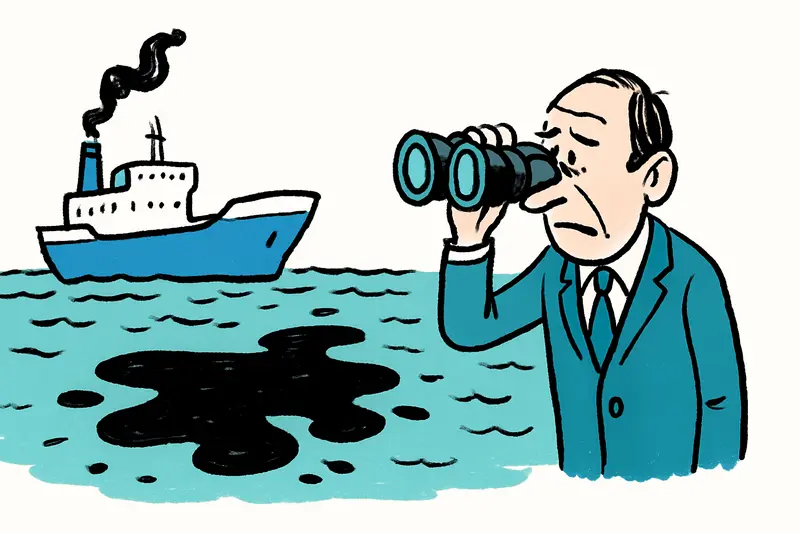
Fuel in the Sea? Mallorca Needs Reliable Answers First
When pollution is possible, what matters is not the loudest warning but a verifiable picture of the situation: Where is the ship, what is leaking—and where is it moving?
When concern travels faster than the facts
A possible fuel spill at sea is no abstract threat to Mallorca. Even the thought of a dark slick on the water is enough to prompt questions at the ports: Are fishing grounds affected? Does a beach need to be closed? Could anything reach the coast? But the first and most important question is: Has there actually been a spill—and can its path be predicted reliably?
Without confirmed information about the ship’s position, cargo, fuel on board and condition, there is no responsible way to answer that. A current map alone is neither an all-clear nor proof of a disaster. Wind, waves and changing currents affect where a substance moves; the substance’s properties matter too. Lighter fuel behaves differently from heavy oil. But “it floats” is no meaningful assessment of its environmental impact: some of it may disperse or evaporate, while other components remain harmful to wildlife, coastlines and fisheries.
What is often missing from public discussion
When warnings like these emerge, people are quick to discuss the direction of the next current. But a reliable assessment requires more than an arrow on a map. Exactly where is the ship? How deep is the water there? What material is on board? Are there visible traces, and have samples been taken? It is just as important to know who is monitoring the situation and how often the assessment is updated. While these questions remain unanswered, any forecast should be clearly labelled as provisional—not presented as a definitive statement about which beach will be affected.
Language matters, too. “Threat to Mallorca” sounds conclusive, even though several steps separate a possible leak far offshore from confirmed pollution along the coast. At the same time, uncertainty must not be presented as reassurance. Fishers can come under pressure even before any damage is visible: if buyers or restaurants avoid their products as a precaution, businesses suffer while the actual situation remains unclear. What is needed is clear information, not just forceful warnings.
Picture an ordinary morning on the islands: at the harbour, someone sorts a net; a small engine putters nearby, and someone looks at the water’s surface for longer than usual. In Sant Antoni or at a Mallorcan quay, the sea is not a backdrop—it is a workplace. Fishers may notice a change at a glance, but they cannot replace laboratory analysis. Their observations are valuable when recorded promptly and checked against measurements.
What a reasonable response would look like now
The relevant authorities should provide a concise, publicly understandable situation report: confirmed facts clearly separated from assumptions, a time-stamped map, information about possible substances and regular updates. If samples are taken, the location, time and results should be included. If there is not yet enough verified data, the report should say so. An acknowledged information gap is better than a precise-sounding guess.
At the same time, monitoring at sea and along the coast needs to be coordinated. Fishers, ports and local authorities can report unusual discolouration or smells; experts must investigate their cause. If a spill is confirmed, responsibilities and protective measures should be clear: Who arranges sampling? Who decides whether fishing restrictions or beach closures are needed? How will affected businesses be informed? Fishers also need transparent criteria for possible compensation. Otherwise, they bear the economic risk while the situation is still being described in cautious terms.
Visitors and residents should not touch suspicious residues or carry out their own “tests” in the water. Reports should be sent to the relevant emergency or environmental authorities; in an immediate emergency in Spain, call 112. This does not replace official monitoring, but it can help get information to the right people quickly.
Mallorca does not need to declare a state of emergency every time an unclear report comes in. But it would be just as wrong to dismiss fishers’ concerns as mere nervousness. Only measurements, clear responsibilities and regular updates can turn fear into a situation people can respond to. The sea does not follow headlines—and on the islands, the response to possible pollution should be more precise than an arrow showing the currents.
Frequently asked questions
What should I do if I see a fuel slick near Mallorca?
Is it safe to swim in Mallorca if fuel pollution is reported at sea?
Could a fuel spill at sea affect Mallorca’s fishing grounds?
How do wind and currents affect where a fuel spill travels near Mallorca?
What information is needed to assess a possible fuel spill near Mallorca?
What should an official update about possible sea pollution in Mallorca include?
Why do Mallorca’s fishers need clear updates about possible sea pollution?
Can fishers’ observations help identify pollution near Mallorca?
Similar News

Palma and the “Helmut” Label: When a Nickname Says More Than the Case
A catchy label can quickly turn a suspected individual incident into a story about an entire group. In Palma, it is wort...
Mallorca Feels November’s Chill: Wind, Clouds and a Cool Thursday
Thursday will be cool and unsettled in Mallorca. Northwesterly winds will make it feel even colder, though conditions ar...

A Sign on the Move: The TUI Logo Turns 25
Since 2001, the TUI symbol has united the different divisions of the travel group. Today, travelers encounter it around ...

Son Bonet Rehearses a Disease Alert: What an Airport Exercise Really Needs to Show
A medical emergency involving a possible infection risk was simulated at Son Bonet airfield. The test makes sense—but wh...
Porto Cristo and Manacor: A Referendum Is Not Yet Secession
Independence is once again being discussed in Porto Cristo. But before the town could become a new municipality, it woul...
More to explore
Discover more interesting content

Can Cap de Bou

Townhouse Lleo 72
