
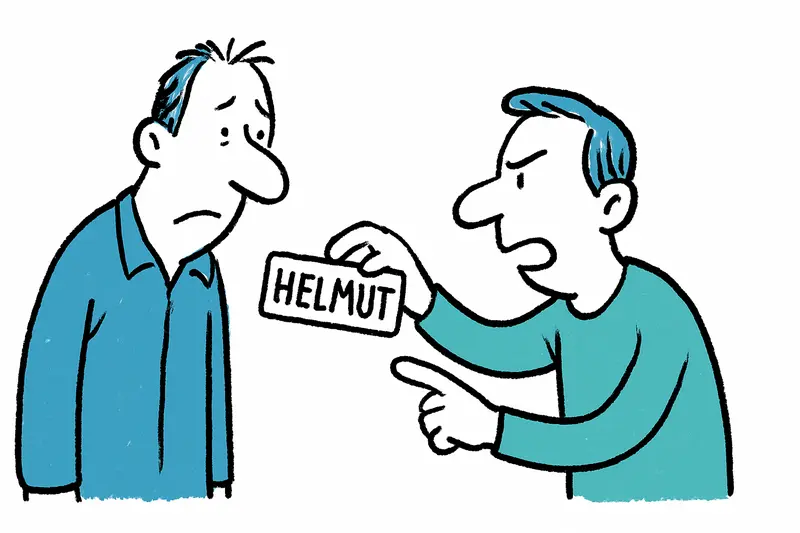
Palma and the “Helmut” Label: When a Nickname Says More Than the Case
A catchy label can quickly turn a suspected individual incident into a story about an entire group. In Palma, it is worth taking a closer look at language, evidence and everyday life on the street.
What does a nickname say about an incident—and what does it say about the way we see it?
“Helmut” sounds like something from a pub conversation: a German name that is easy to remember. But as a catch-all term for street vendors with African roots, it is not harmless folklore. It turns different people into a single character—someone to laugh at or get annoyed with without looking any closer.
That kind of label is especially powerful when a story involves allegations, drunk driving or goods suspected of being counterfeit. It immediately conjures up an image—and distracts from the question of what has actually been established. An allegation is not a verdict. Seized goods have not automatically been proven to be counterfeit. And one person’s actions tell us nothing reliable about everyone who sells goods on the street.
The headline is quick; reality is more complicated
Palma knows these kinds of shortcuts. In the heat around Playa de Palma, among tightly packed tables, honking scooters and crowds on Passeig Marítim, people are often reduced to their roles: tourist, waitress, vendor, police officer. It is convenient. It saves us the effort of looking more closely—and makes it easier to turn a single suspicion into a story about “those people.”
Anyone out in the city at night is, of course, entitled to have possible crimes investigated. Anyone who endangers others in traffic must answer for it if such an allegation is confirmed. People who offer sexual services also have the right to have their accounts taken seriously and to have possible assaults or cases of fraud investigated. The dignity of those involved does not depend on how likeable they seem to the public.
But all of this requires precision. In any specific incident, what matters is verifiable information: What was observed? What do those involved say? What evidence is there? What is still under investigation? When these things are conflated, what remains is mostly a sensational image. That is not getting to the truth; it is taking a shortcut.
What often gets lost in the debate
Public attention tends to get stuck on the punchline. People ask less often why a nickname for an entire group is treated as unremarkable in the first place. Or whether those involved are treated differently when a situation escalates: Who is seen as credible, and who is treated as mere background? Allegations involving money, sex and possible driving under the influence call for protection for those affected, careful investigations and fair treatment of the accused. One does not replace the other.
Street trading, too, is rarely just a matter of being “legitimate” or “criminal.” When people sell goods without a fixed pitch, economic hardship, rules governing public space and the interests of businesses all come into play. That does not explain every action or excuse endangering others. But it does help us avoid pretending that a complicated issue can be settled with a nickname.
Just an ordinary evening in Palma
You are standing at a crossroads near Plaça d’Espanya. A bus pulls away; somewhere, a delivery van rattles over the cobblestones. You can only make your way along the pavement in small steps. Vendors approach passers-by; some keep walking, while others pause briefly. In a moment like this, you do not see a headline. You see people at work, people on their way home and people trying to get past one another. Not every interaction is pleasant. But that does not make anyone a stand-in for an entire group of people with the same origins.
A more measured perspective can be put into practice: Headlines should not turn a suspect’s identity into a joke. In ongoing cases, allegations should be clearly identified as such; confirmed facts and open questions must be kept separate. Where genuine problems exist, the authorities and the city should explain clearly what the rules are and where people affected can turn for help. And anyone repeating a story can ask themselves a simple question: Would I use the same wording if the person involved had a name that felt more familiar to me?
This is not an argument for playing down problems. Fraud, dangerous driving and the sale of counterfeit goods are not minor matters if they are proven. It is an argument for taking allegations seriously without declaring people guilty in advance—and without turning a name into a racist label.
The reality check: A provocative nickname attracts attention, but it does not bring Palma any closer to the truth. What matters is evidence, fair treatment for everyone involved and rules that are enforced in everyday life. The punchline must not matter more than the people at the heart of the story.
Frequently asked questions
What does the nickname “Helmut” mean in Palma?
Does an accusation mean someone is guilty in Mallorca?
Do seized goods in Palma prove that they were counterfeit?
Are street vendors in Palma automatically criminals?
Why is street trading in Mallorca a complicated issue?
How should reports involving people who offer sexual services in Palma be handled?
What should happen when someone is accused of dangerous driving in Mallorca?
How can reporting about Palma avoid racist stereotypes?
Similar News
Fuel in the Sea? Mallorca Needs Reliable Answers First
When pollution is possible, what matters is not the loudest warning but a verifiable picture of the situation: Where is ...
Mallorca Feels November’s Chill: Wind, Clouds and a Cool Thursday
Thursday will be cool and unsettled in Mallorca. Northwesterly winds will make it feel even colder, though conditions ar...

A Sign on the Move: The TUI Logo Turns 25
Since 2001, the TUI symbol has united the different divisions of the travel group. Today, travelers encounter it around ...

Son Bonet Rehearses a Disease Alert: What an Airport Exercise Really Needs to Show
A medical emergency involving a possible infection risk was simulated at Son Bonet airfield. The test makes sense—but wh...
Porto Cristo and Manacor: A Referendum Is Not Yet Secession
Independence is once again being discussed in Porto Cristo. But before the town could become a new municipality, it woul...
More to explore
Discover more interesting content

Can Cap de Bou

Townhouse Lleo 72
