
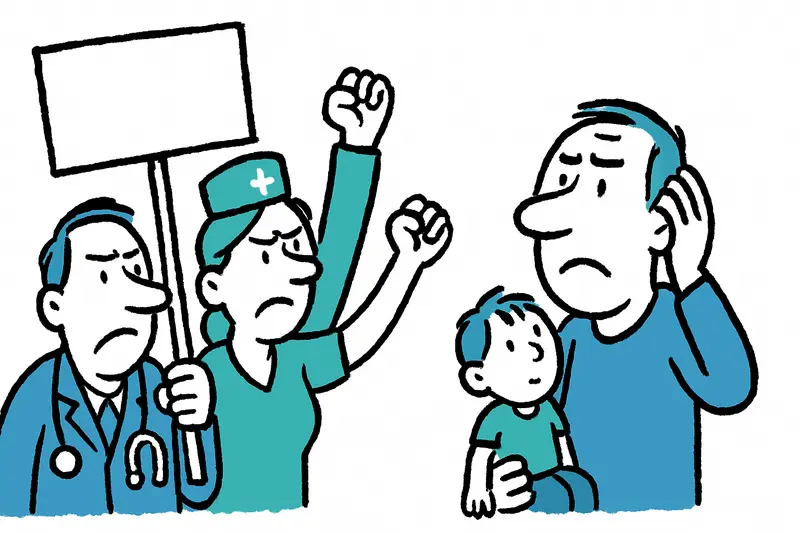
General Practitioners and Pediatricians Strike: Who Ensures Care in Mallorca?
General Practitioners and Pediatricians Strike: Who Ensures Care in Mallorca?
Since yesterday general practitioners and pediatricians at public health centers have gone on strike. Emergency services continue, but the anger is palpable. A critical assessment with concrete proposals.
General Practitioners and Pediatricians Strike: Who Ensures Care in Mallorca?
Key question: How can working conditions in health centers be changed so that doctors stay permanently, patients do not suffer and emergency care remains stable?
Since yesterday general practitioners and pediatricians in Mallorca's public health centers have been on strike, as reported in When Palma Falls Silent: Doctors Strike for Their Own Professional Statute. The most important safety line stands: emergency services remain fully staffed, and so far there have been hardly any postponed appointments. Nevertheless, the mood in the consultation rooms is different — you hear it in the short breaks, in the subdued tone in the reception hall, when parents with cold children ask whether everything is still working.
The demands are clearly stated: better framework conditions, unambiguous rules for duty hours and stronger recognition of professional responsibility. That may sound like a global slogan, but here it is concrete: many colleagues work long shifts, are often on call and see only limited prospects for relief.
Critical analysis
What the headlines show is only half true. Yes, emergency care is running — that is important and reassuring, but the surrounding structure is more vulnerable than it appears at first glance, as other reporting shows Day Two of the Doctors' Strike: Why Healthcare in Mallorca Is Faltering. If exams, home visits and vaccination appointments in suspected cases constantly have to be done on the side, the burden can shift: less time for preventive conversations, less monitoring of chronic illnesses, more pressure on hospital on-call services.
On Mallorca additional factors add up: sparsely populated municipalities require different duty models than Palma, the summer months shift staffing plans, and proximity to tourist centers causes irregular patient flows. All of this makes simple one-size-fits-all solutions hardly practicable.
What is missing from the public discourse
The debate focuses on striking or not striking, on symbolic emergency services and on headlines. Three real perspectives are missing: first, reliable numbers on scheduled hours per medical team; second, information on what should actually count as "adequate" recognition (financial? organizational? both?); third, the perspective of the staff in the health centers: nurses, administrative employees, medical assistants — they often shoulder the extra work during personnel shortages.
There is little talk about long-term staffing ratios, reliable substitution plans for holidays or illness and targeted offers for doctors who want to work in rural areas. Without these details the discussion remains too abstract and does not resolve the causes.
An everyday scene from Palma
In the morning in front of a Centro de Salud in Palma a young mother with a stroller stands under a streetlight; it is cool and the wind carries the sounds of the Avinguda past. She asks at the window whether her son's vaccination can take place today. The receptionist calmly explains that emergencies are being treated and that the normal schedule is reduced. The mother smiles, but her look reveals uncertainty — not only because of the strike, but because no one can say exactly how stable care will be in the coming weeks.
Concrete approaches
Strike action and blame alone will not get us further. The following measures could be implemented in the short and medium term:
1) Transparent duty rosters: Binding shift limits, publicly accessible, with clear rules for compensatory days and replacement staffing.
2) Pilot projects for rural models: Bundling consultations, rotating teams and mobile care units for remote villages — test for a limited time, evaluate, adapt.
3) Relief through team strengthening: Hire more medical assistants and nursing staff in the health centers to take over routine tasks and give doctors time for complex cases.
4) Binding rules for on-call duties: Clear compensation, maximum frequency of night duties and mandatory rest periods.
5) Local recognition models: Financial bonuses for particularly burdened services, continuing education opportunities and career paths anchored in the region.
6) Mediation table: A moderated forum between the medical profession, health administration and representatives of the municipalities that names binding steps within weeks and sets deadlines.
Why these proposals are practicable
They combine administrative power with pragmatic team building. Transparency reduces mistrust; pilot projects allow adaptations to local particularities; additional non-physician roles relieve medical staff without loss of quality. And a mediation table creates binding commitments instead of repeated protest phases.
Important is that measures must be visible and noticeable in the short term — an announcement without tangible change will not win public support.
Pithy conclusion
The strike is a warning signal, not a show effect. Securing emergency services is correct and reassuring, but not sufficient as a long-term solution. If the island government and the health centers now only buy time, the risk grows that chronic gaps in care will develop, as discussed in No Submission: What the four-day doctors' strike in Mallorca really reveals. Practical, regionally adapted measures and quick, visible relief are the only chance to regain trust — for the doctors, for the staff and for the people who live here. Otherwise the next escalation round threatens, and daily life at the door of the Centro de Salud will become noticeably harsher.
Frequently asked questions
Are emergency services still running in Mallorca during the doctors’ strike?
Will my doctor’s appointment in Mallorca be postponed because of the strike?
What should parents do in Mallorca if their child needs care during the strike?
Why are doctors striking in Mallorca’s public health centers?
How does the doctors’ strike affect healthcare in rural Mallorca?
What is the situation at health centers in Palma during the strike?
What changes could help improve doctor staffing in Mallorca?
Do people in Mallorca still have access to preventive care during the strike?
Similar News
Injured captain, big plans: Germania Mallorca before the away match in Consell
The newly founded FC Germania Mallorca travels to Consell on Saturday. Captain Bastian Müller is out injured, but coach ...
Palma, Palma de Mallorca, Palma‑Mallorca: What is it really about?
The debate over the city's name is more than grammar: it concerns identity, law and branding policy. A sober reality che...
Warning to Bathers: Nipping Fish in Cala Major and Other Coves — a Reality Check
In Cala Major and several beaches around Mallorca, bathers report painful “nips”. Who are the animals, why are they gett...
Rental Car Theft in El Arenal: What This Incident Reveals About Our Gaps
A teenager steals a running rental car in El Arenal, flees on foot, climbs over walls and is caught by the Guardia Civil...
Red Rope in Palma's Library: What Helps Against Selfie Tourism — and What's Missing
Palma's city library cordoned off an area with a red rope to keep selfie tourism away from reading and working activitie...
More to explore
Discover more interesting content

Can Cap de Bou

Townhouse Lleo 72
