
'Get out of Mallorca' on gates in Santanyí: What happens when hate becomes the language of the street?
'Get out of Mallorca' on gates in Santanyí: What happens when hate becomes the language of the street?
Several wrought-iron gates around Santanyí were sprayed with anti-German slogans. The incidents echo similar actions last summer. What does this say about coexistence locally — and what should happen now?
'Get out of Mallorca' on gates in Santanyí: What happens when hate becomes the language of the street?
Brief summary
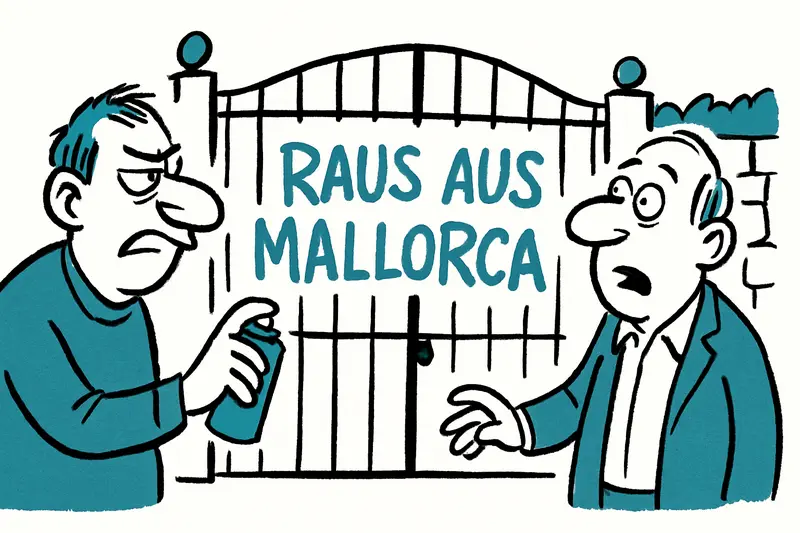
In recent days, inscriptions in Spanish have appeared on several driveway gates of upscale properties in the rural area around Santanyí that clearly target German residents. Slogans such as "Get out of Mallorca, damned Germans. We don't want you anymore" and shorter formulations were found on gates. Local political representatives publicly condemned the acts, and there are indications that similar graffiti were already observed in the area last summer, as reported in New xenophobic graffiti at Playa de Palma – How is the island reacting?.
Core question
How dangerous are such attacks for the local social climate, and are individual condemnations by politicians enough to address the roots of the problem?
Critical analysis
Such graffiti are not mere vandalism like a knocked-over lamppost. They mark a boundary: they are deliberately targeted messages aimed at people's origin. When slogans single out national identity as an attack target, coexistence becomes strained. On Mallorca this phenomenon cannot be viewed in isolation from issues such as housing shortages, rising prices, the visible wealth of some areas and the feeling of some residents that they are no longer adequately represented. The messages themselves express exclusion; whether there is an organized group behind them or individual frustrated perpetrators is unclear from the information available so far, and incidents like Scratched Cars in Santanyí: Scratches Instead of Holiday Peace show related tensions.
What is missing in the public discourse
First: an honest assessment on the ground. Condemnations by elected officials are not enough if nobody documents where and to what extent such incidents occur. Second: the perspective of those affected is often reduced to a diffuse "owners" group, a simplification discussed in Between Welcome and Wariness: Germans in Mallorca — What's Really Happening. Those affected are neighbours, craftsmen, shopkeepers and employees — people whose daily lives are unsettled by such attacks. Third: a systematic analysis of causes. It is rarely differentiated between legitimate criticism of tourism, the real estate industry or local politics and xenophobic assaults. That distinction must be made, otherwise political discourse blurs with messages of hate.
Everyday scene from Santanyí
Early in the morning, when the market on the plaça is still setting up its stalls, you hear the clatter of fruit crates, the conversation of two older women in Mallorquí and the distant hum of a delivery van. Exactly on those streets where children go to school and cafés polish their cups in the morning, the sight of defaced gates has created a different atmosphere: passers-by look more closely, some shake their heads, others step aside. This mix of the village's quiet pulse and suddenly visible hostility makes the situation so vulnerable.
Concrete approaches to solutions
1) Documentation and faster cleaning: The municipality should have a clear procedure for photographing and removing such graffiti immediately. Quick overpainting removes their incendiary power. 2) Multilingual reporting channels: An anonymously usable hotline or an online form in Spanish, Catalan and German makes it easier for those affected to report incidents. 3) Preventive neighbourhood work: Local meetings at the marketplace, moderated dialogue rounds and neighbourhood assemblies can reduce tensions if they address real issues such as traffic, noise or property prices. 4) Targeted police prevention: Visible patrols at certain times, better lighting at driveways and analysis of surveillance videos (with respect for data protection) help identify perpetrators. 5) Education against hate: Schools and clubs should promote programs that teach respectful conduct and show how diverse the neighbourhoods are.
Legal framework, briefly
Graffiti on someone else's property are not legally harmless. Property damage and insulting statements can have criminal and civil law consequences. Existing legislation allows investigations — whether and how quickly they are conducted depends on police capacity and the willingness of victims to file complaints.
Why it concerns all of us
Santanyí has changed significantly in recent decades; people from different countries are part of everyday life. If the public language of violence or exclusion gains ground, the place loses something fundamental: the ability to live side by side without instilling fear in one another. Everyone who expresses outrage must not stop at words. Otherwise narratives that polarize will solidify.
Conclusion
The graffiti in Santanyí are a warning sign. They require more than outrage on social networks or media indignation. Clear, practicable steps are needed: rapid removal of slogans, better documentation, low-threshold reporting channels, neighbourhood work and focused police action. Those who want to defend coexistence must act on several fronts at once — and do so with prudence so that legitimate criticism does not turn into hate and hate is not normalized as political language. Anyone who wants to stroll through the market in the morning and hear the clinking of coffee cups rather than slogans should speak up now.
Frequently asked questions
Why do anti-German graffiti in Mallorca worry local residents so much?
What should I do if my property in Mallorca is vandalised with hateful graffiti?
Are hate-related graffiti incidents in Santanyí linked to housing and tourism tensions?
Is hate graffiti in Mallorca a police matter or just a nuisance?
What is the best time of year to visit Santanyí in Mallorca if you want a quieter atmosphere?
How can Mallorca municipalities respond faster to offensive graffiti?
Why does hateful graffiti change the mood in a Mallorca village so quickly?
Can criticism of tourism in Mallorca be expressed without becoming xenophobic?
Similar News
Urgent Clearing of Palma's Torrents: Flood Prevention or Symptom of Short-Sighted Planning?
The city of Palma is responding to storm forecasts and has cleared several torrents. We ask: Is the short-term clearing ...

Evaneos and Mexico: A Reality Check for Sustainable Travel
Travel advertising often reads like a promise: local, sustainable, unique. But how deep do these promises really go? A c...

From Megapark to the Altar: Party Singer Now Offers Weddings in Mallorca
A well-known party artist combines partying and marriage: instead of a traditional church there are ceremonies at the Me...

The Maricarmen Case: Why an Eviction Is Forcing Spain's Housing Debate
Images of an 87-year-old woman on a stretcher have sparked a debate in Spain that also runs deep in Mallorca. Who protec...
Parking dispute in Els Hostalets: When a gap leads to violence
A parking dispute on Calle Aragón escalated into a mass brawl at night. Why do trivial conflicts here turn bloody so qui...
More to explore
Discover more interesting content

Can Cap de Bou

Townhouse Lleo 72
