
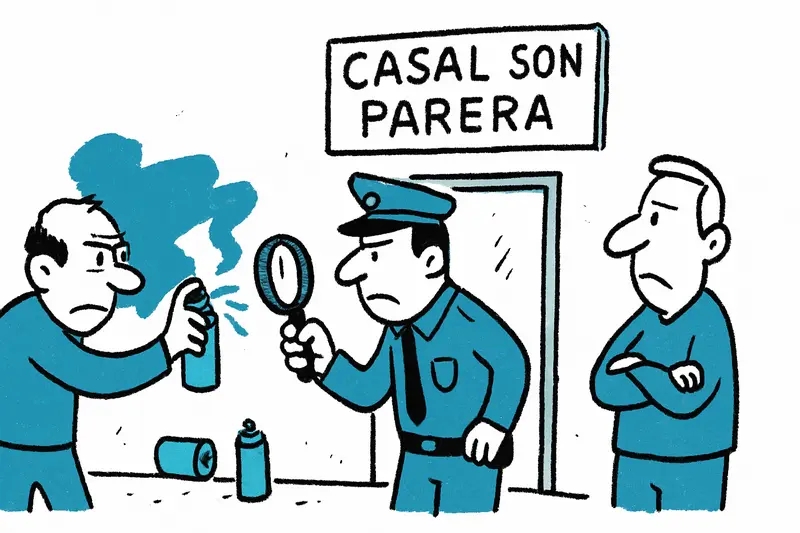
Graffiti in Es Molinar: Who's Behind the Spray Cans at Casal Son Parera?
Graffiti in Es Molinar: Who's Behind the Spray Cans at Casal Son Parera?
Recurring graffiti at the neighborhood center in Es Molinar are causing frustration. Emaya cleans them, the paint returns — the police are looking for patterns in the tags. A reality check from the district.
Graffiti in Es Molinar: Who's Behind the Spray Cans at Casal Son Parera?
Main question: Why is repeated cleaning alone not enough to permanently solve the problem in Son Parera Park?
In the early morning, seagulls scream over the harbor, bakery trucks drive along the waterfront promenade and in Son Parera Park there is a freshly washed wall again: Emaya has once more removed the scribbles at the neighborhood center, as reported in Palma Cleans Up — Who Pays, What Remains?. As soon as the white patches have dried, new tags and inscriptions appear. Residents groan, parents from the nearby playground roll their eyes — and the local police have meanwhile set up an investigation unit.
This is the sober fact: The facade of the Casal, a meeting place for courses and neighborhood work, has been sprayed several times in recent weeks. Emaya cleans, the city has it removed, and the paint comes back. The police now want to evaluate patterns, recurring signs or specific inscriptions in order to create offender profiles. So far, so familiar. This echoes other incidents such as Attack on Picornell Bust in El Molinar: Cleaning Alone Is Not Enough. But there are more questions than answers.
Critical analysis
Cleaning is reacting. It makes sense to keep rooms for clubs and children clean, but removal alone does not address the cause. If images or tags are not documented, analyzed and publicly interpreted, investigations lose momentum. Repeat offenses occur because graffiti writers see their work as a form of communication: visibility is their goal. If the wall is continuously spotless, for a group that can sometimes mean only an extra challenge — and the next temptation.
Moreover, the view of the urban space as a social system is often missing: Are these young people who feel alienated? Is there a lack of legal spaces? Are there evening lights or meeting points that are conflict-prone? The police focus on signs and inscriptions, which is important, but without accompanying social work, education in schools and contact with youth centers the measure remains half-hearted.
What is missing from the public debate
There is less discussion about what a sustainable concept could look like. It's not just about punishment or cleaning, but about prevention: legal spaces for street art, evening programs at the Casal, sponsorships for house walls by local associations. Equally rarely is the question asked of how residents can be involved — for example through reporting apps with easy operation, where photos with timestamps help to recognize patterns more quickly.
A everyday scene from Es Molinar
Imagine the street by the park: An elderly lady comes back from the market with a basket, two teenagers sit on the park bench listening to soft music, a father pushes a stroller past. A new sign is on the Casal wall that wasn't there yesterday. The father stops, points to the image and says: "Again?" The teenagers shrug. No one talks to each other. It is precisely this small distance in everyday life that makes it easier for graffiti writers to act undisturbed.
Concrete solutions
1) Systematize documentation: Emaya and the city should digitally record every removal and make photos with dates publicly accessible. This makes it possible to recognize recurring motifs more quickly and cross-reference them to investigators.
2) Create a legal wall: An authorized wall in view, supervised by the Casal, can channel creative energy and relieve pressure on illegal spaces.
3) Neighborhood program: Regular evenings at the Casal where young people explain their motifs or develop projects together. An exchange of information builds trust.
4) Preventive lighting & videos where legally permissible: The goal is deterrence, not blanket surveillance. Clear rules on data storage and transparency towards residents are mandatory.
5) Police–social work cooperation: Investigations should be coupled with offers — youth counselors, mediators, workshops in schools.
Concise conclusion
Constant cleaning of the Casal facade is necessary, but not a panacea. Without documentation, participatory offerings and clear alternatives, Es Molinar remains trapped in a loop: paint removed — new paint appears. Those who really want to keep the neighborhood clean must think beyond cleaning products and put people at the center. Otherwise, in the end there will only be the uneasy feeling that the next layer of paint is already waiting around the corner.
Frequently asked questions
What is the weather usually like in Mallorca in early spring?
Is it warm enough to swim in Mallorca in spring?
What should I pack for Mallorca in spring?
Is spring a good time to visit Mallorca?
What is Sóller like in spring?
What is Pollença like in spring?
Can you hike in Mallorca in spring?
How does spring in Mallorca compare with summer?
Similar News
When the Wallet Becomes a Danger: Attack in Peguera and Lessons for Mallorca
In Peguera, two women are said to have stolen the wallet from a 75-year-old German couple. When the victim intervened, t...
Plata stays Plata: Young people take over, Llonguets remain
A small bar on Carrer de l'Argenteria will continue: Tolo Serra hands the place over to young Mallorcans at the end of t...

Unnoticed in the Luggage Compartment: How a Boy Traveled More Than 100 Kilometers in a Team Bus
A minor traveled in the undercarriage of a team bus for more than 100 kilometers until his cries for help were heard. A ...

Cap Vermell Grand: Second Michelin Key – a Gift for the East
The Cap Vermell Grand in Capdepera has been awarded its second Michelin key. For the region this elevates the luxury off...

Eurowings lets four aircraft carry names – a friendly idea that also reaches Mallorca
Eurowings is launching a campaign: four Airbus A320s are to carry the first names of people who help others in everyday ...
More to explore
Discover more interesting content

Can Cap de Bou

Townhouse Lleo 72
