
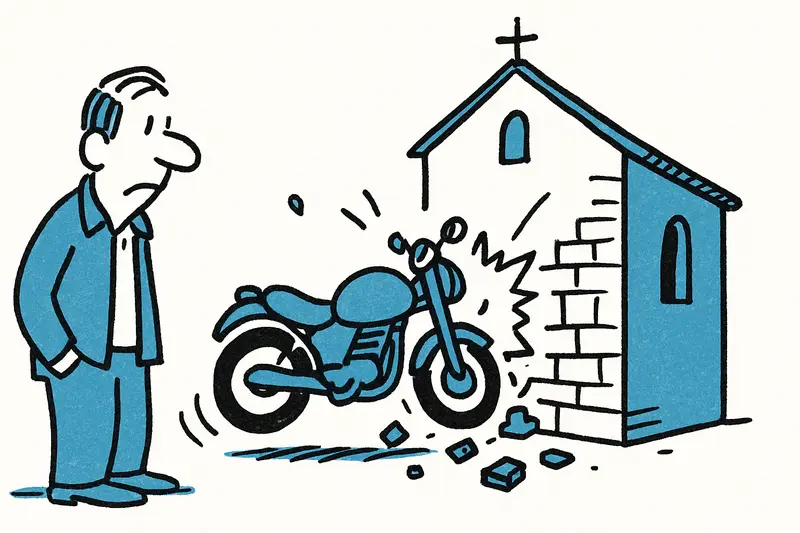
Motorcycle crashes into church wall in Establiments – what remains from the accident?
Motorcycle crashes into church wall in Establiments – what remains from the accident?
A 55-year-old motorcyclist was seriously injured in the afternoon in Establiments in a single-vehicle crash. The scene raises questions about road safety in our village centers.
Motorcycle crashes into church wall in Establiments – what remains from the accident?
Key question: Why do rides through village centres on Mallorca so often end with serious injuries, and what short- and long-term changes could be made?
On the early afternoon of May 13, the quiet Plaça de la Inmaculada in Establiments was transformed within minutes into a work site for rescue teams. Around 1:50 p.m. a 55-year-old motorcyclist lost control of his vehicle and crashed into the wall of the small village church at house number two. Palma local police closed off the square; officers from the motorized unit (UMOT), the integrated security unit (USEI) and the accident investigation unit (UVAC) were on site. Paramedics from the SAMU 061 emergency service treated the man, who suffered a severe polytrauma, and transported him in critical condition to the University Hospital Son Espases.
Those are the known facts. What is still missing are the answers: Why did the accident happen? Was it rider error, did the surface condition play a role, or is the layout of the square to blame? Such questions must not remain solely part of the reconstruction of events – they must lead to practical steps so that a square with a church wall does not become the scene of a serious accident again. Similar questions were raised after other crashes such as Serious motorcycle crash in Santa Eugènia: What needs to change at dangerous intersections?.
Critical analysis: Village centres like the Plaça de la Inmaculada are ambivalent spaces. On pleasant days guests sit in cafés, the church bells ring, delivery vans manoeuvre between parked cars, and cyclists and scooters cross the paths of motorbikes. Such a mix increases conflict potential. Added to this is that many villages retain narrow street layouts from earlier centuries that are not ideal for modern traffic volumes and for faster motorcycles. If speed, unclear junctions or lack of protection for historic buildings are added, a dangerous cocktail is created.
What is often missing in public debate is responsibility at multiple levels. It is not only individual riders or the police who are called upon. The town hall (Ajuntament), traffic planners, insurers, local businesses and the neighbourhood must think together. In Mallorca we like to talk about spectacular crashes on coastal roads – rightly so given incidents such as Fatal accident on the Ma-19 near Llucmajor: Why motorcyclists are repeatedly affected – but the small, everyday hazards in village centres are just as injurious and are less often tackled systematically. Investigations into other serious accidents, for example Serious accident near Santa Eugènia: How could it come to this?, highlight the need for cooperation.
A scene from everyday life: Anyone who walks through Establiments on a weekday knows the spectacle. The old church with its cream-coloured render, the bar with the red awning, older women sitting outside the shop sorting their purchases. Children run from the school bus across the plaza, a motorcycle passes by, a moped stops at the corner. In places like this a brief slip, a wet patch on the paving or a last-second lane change can have fatal consequences. The sounds of the sirens on the day of the accident – sharp and brief – echoed through the alleys and shattered the afternoon calm. Such images linger and demand action.
Concrete measures that can be tackled immediately:
1) Speed reduction and physical traffic calming: Clear, visible speed limits in village centres and structural measures such as speed bumps, narrowed lanes or paved zones that automatically reduce speed.
2) Protection around vulnerable buildings: Review whether historic walls and churches can be better protected by flexible bollards, crash barriers or raised curbs without completely destroying the aesthetics.
3) Visibility and road maintenance: Better markings, regular cleaning of road surfaces and controlled repairs to avoid slippery spots – especially after rain or cleaning operations.
4) Prevention and enforcement: Targeted speed checks at critical points and information campaigns for motorcyclists about the risks in village centres.
5) Improving the emergency chain: Drills and interfaces between local police, SAMU 061 and hospitals so that on-site care and transport are optimally coordinated.
In the long term we need a different view of mobility in villages. More space for pedestrians, regulated delivery times, bike lanes where possible and closer dialogue between user groups would reduce the number of serious accidents. The question is not whether we want this, but how quickly we start.
Conclusion: The accident in Establiments is tragic and a wake-up call. We should not file the incident away as an isolated fate. The combination of historic village structure, mixed traffic and occasional speed carries risks that can be minimised with targeted measures. When the bells ring again and the plaza comes back to life, we should talk less about luck and more about sensible design. Son Espases is now the place of treatment – before we receive relatives there again, the town and authorities should critically review and act on the Plaça de la Inmaculada.
Frequently asked questions
Why are motorcycle accidents in Mallorca village centres often so serious?
What safety measures can help reduce accidents in Mallorca's village squares?
What should motorcyclists in Mallorca watch out for in small towns and villages?
What role does road surface condition play in accidents in Mallorca?
Is Establiments in Mallorca considered a risky place for traffic?
Why are historic squares in Mallorca difficult to adapt for modern traffic?
What happens after a serious motorcycle crash in Mallorca?
When is a good time to drive through Mallorca village centres more carefully?
Similar News
German tourist dies in Sa Calobra – a reality check for emergencies on Mallorca's beaches
A 40-year-old tourist died at the Torrent de Pareis. The emergency call, a doctor who happened to be present, a defibril...
Deadly Tractor Accident in Bunyola: What Needs to Be Done Now
In a work accident on an estate near Bunyola, a roughly 40-year-old man lost his life. His wife and a small child were o...
Head-first dive into the shallow part of Cala Fonoll: An accident and the unresolved question of responsibility
A young tourist dove into Cala Fonoll and was seriously injured. Key question: Why are clear warning signs missing at da...
Mistaken identity with fatal consequences: Brutal assault in S'Aranjassa — what's missing in the follow-up?
At S'Aranjassa a visitor to a finca was tied up, beaten and thrown out of a van. Three men have been arrested, including...
High heel slips, car accelerates: accident on Camí de Son Hugo
A woman lost a high-heeled shoe on the forecourt of the sports facility at Camí de Son Hugo. The car accelerated, mounte...
More to explore
Discover more interesting content

Can Cap de Bou

Townhouse Lleo 72
