
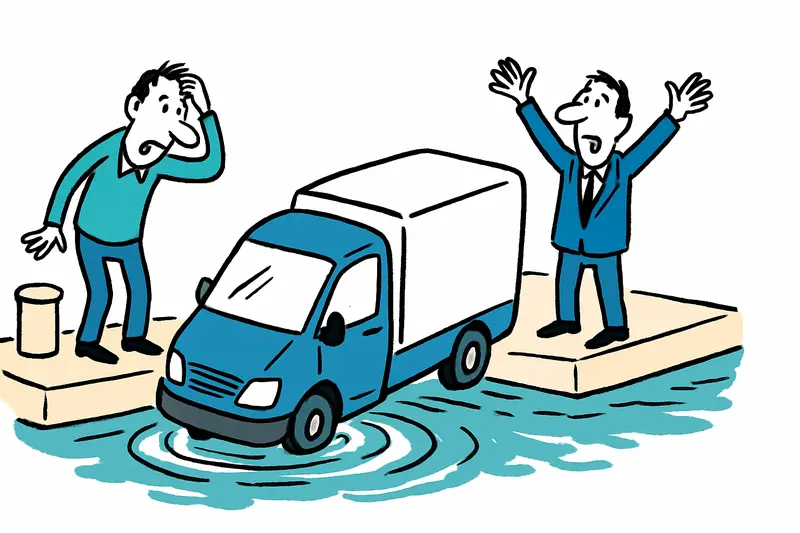
Handbrake Forgotten at Club de Mar: A Delivery Van's Unintentional Dive
A delivery van rolled off the quay at Club de Mar into Palma's harbor basin on Tuesday midday. The incident reveals not only human error but also gaps in port security and environmental protection.
Handbrake Forgotten at Club de Mar: A Delivery Van's Unintentional Dive
Around 1 p.m., in the middle of Palma's midday quiet on the waterfront, this happened: a delivery van started moving, slid over the quay at Club de Mar and disappeared completely beneath the water's surface. Bystanders, guests in street cafés and boat owners on the pontoon watched the spectacle — except that no one applauded.
Key question: How can a vehicle roll into the water so unsecured?
The simple answer is human error. But the real question goes further: why are simple safety habits apparently insufficient to prevent such incidents in busy harbor areas? A removed key, a forgotten handbrake, a brief moment of inattention — any of these are enough when there are no additional protective measures at the quay. Similar incidents on Mallorca such as Car Plunges into Ciutadella Harbor Basin: Who Could Have Prevented It? and How does a truck end up on the cloister steps? Sóller mishap reveals a systemic gap highlight the wider risks.
Critical analysis
Space in Palma's harbor is limited and the waterfront edge lies close to restaurants, walkways and boat moorings. The description of events suggests there were no physical barriers, no stop system and no ad-hoc safety measures like wheel chocks. The use of a crane to recover the van shows that the infrastructure for such emergencies is not designed for a quick, simple solution; professional salvage teams had to be called in while oil and diesel traces can spread quickly.
Then there is the human factor: delivery traffic in harbor areas often follows tight schedules. Drivers step out briefly to make a delivery, underestimate the danger — and leave the spot. Such routines quickly combine into risky behavior, especially when companies lack clear internal rules for parking at quay walls.
What is missing in the public debate
The debate usually focuses on the spectacular image: a sunken van. Three points receive less attention: First, the environmental hazard — even small leaks are a problem for the sensitive harbor water. Second, the question of responsibility: who pays for recovery, cleanup and possible damage to quay infrastructure? Third, prevention: there is a lack of concrete, locally binding rules for commercial vehicles in Palma's prominent harbor areas.
An everyday scene by the water
Imagine the scene: the fragrant coffee break in a café along the Passeig Marítim, the clinking of espresso cups, seagulls calling and the distant hum of an outboard motor. People look from the promenade, a child points at the water, someone takes out their phone. That's how this afternoon began. Those familiar sounds make the incident not only unusual but also immediately understandable — it could have happened to any of us.
Concrete solutions
There are practical measures that are relatively inexpensive and bring a lot of security: simple physical barriers at critical points along the quay; mandatory permanent wheel chocks in delivery vehicles that park in the harbor area; designated parking zones with controlled access for delivery traffic; regular safety briefings for commercial vehicle drivers; and a balance between fast delivery logistics and safety checks by the port authority and public order office.
For environmental protection, prompt measures are necessary: keeping oil absorbents and mobile containment booms in each larger harbor section, exercises for rapid salvage teams and clear responsibilities in case of damage. Insurance requirements for commercial vehicles operating in the port could also help cover the costs of recovery and subsequent cleaning.
Who must act?
Responsibility is distributed: freight companies and drivers must park securely and secure their vehicles. Port operators and municipal authorities must identify danger spots and mitigate them infrastructurally. Local politicians should make regulations binding, for example through parking bans, markings, physical barriers or obligations to secure vehicles when delivering at the water.
Conclusion
A sunken van is more than a curious image for social media fodder. It is a wake-up call: for better rules on the quay, for simple technical measures and for greater awareness at every delivery that ends on Palma's shores. A lost handbrake lever may have been the trigger — but the damage will only be reduced when the system around it becomes more robust.
Frequently asked questions
Why do vehicles sometimes roll into the water in Palma’s harbour areas?
Is it safe to swim or stand near the water after a van sinks in Mallorca’s harbour?
What should drivers remember when parking a delivery van at Palma’s waterfront?
Why are harbour quays in Mallorca considered risky for commercial vehicles?
What happens after a vehicle falls into the sea at Club de Mar in Palma?
Who is responsible when a delivery van sinks at a harbour in Mallorca?
What safety measures could prevent accidents like this in Palma?
Why does a harbour accident in Mallorca raise environmental concerns?
Similar News
When the Wallet Becomes a Danger: Attack in Peguera and Lessons for Mallorca
In Peguera, two women are said to have stolen the wallet from a 75-year-old German couple. When the victim intervened, t...
Plata stays Plata: Young people take over, Llonguets remain
A small bar on Carrer de l'Argenteria will continue: Tolo Serra hands the place over to young Mallorcans at the end of t...
Unnoticed in the Luggage Compartment: How a Boy Traveled More Than 100 Kilometers in a Team Bus
A minor traveled in the undercarriage of a team bus for more than 100 kilometers until his cries for help were heard. A ...

Cap Vermell Grand: Second Michelin Key – a Gift for the East
The Cap Vermell Grand in Capdepera has been awarded its second Michelin key. For the region this elevates the luxury off...
Eurowings lets four aircraft carry names – a friendly idea that also reaches Mallorca
Eurowings is launching a campaign: four Airbus A320s are to carry the first names of people who help others in everyday ...
More to explore
Discover more interesting content

Can Cap de Bou

Townhouse Lleo 72
