
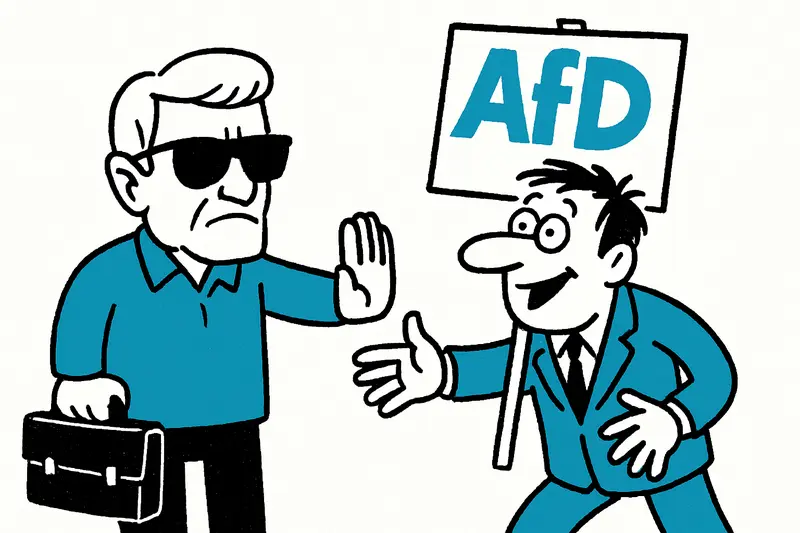
Who is allowed to campaign with celebrities? Heino sues over AfD's use of his name
Who is allowed to campaign with celebrities? Heino sues over AfD's use of his name
Schlager singer Heino has taken legal action over an AfD candidate's use of his name. Why this is about more than a social-media post — and what the real problem on Mallorca is.
Who is allowed to campaign with celebrities? Heino sues over AfD's use of his name
Key question: Is a deleted post sufficient, or do celebrities need better protection from political instrumentalization?
A quick social-media post, a screenshot, then a complaint to a lawyer: that roughly sketches the case. The fact is: the 87-year-old singer, who now also performs at the Bierkönig, as detailed in Heino returns to the Ballermann: An evening between pathos and karaoke at the Bierkönig, and includes folk songs and the national anthem in his programs, does not want to be used as an election aid for a political list. His team therefore applied for a temporary injunction at the competent court and is demanding damages of €250,000 because a candidate in a district election campaign allegedly used his name for election advertising without permission. The politician deleted the post and said he was a fan and did not mean to insult; so far no settlement has been reached.
Why this is legally relevant is known to almost everyone on the island: names, images and statements of artists are legally protected. Spreading an alleged endorsement without consent intrudes on these rights and can be exploited as an election tactic. At the same time, the size of the sum demanded raises questions — the management says it is meant to have an effect; the candidate calls it disproportionate.
The debate currently taking place in Berlin and Brandenburg is hardly abstract here on Mallorca, as discussed in No Farewell in Sight: Heino, the Bierkönig and the Ballermann Legacy. On the Paseo, in front of the Bierkönig, between palm trees and loud guitars, you can hear on some evenings exactly the songs the singer performs; visitors applaud, sing along and drink their beer. When political messages suddenly appear in this setting, it is uncomfortable for many: celebrities stand for atmosphere, not automatically for party politics. And the line between personal opinion and official endorsement can blur quickly.
Critically viewed, several points are missing from the public debate: first, there is no uniform, fast rule for the use of celebrity names in local election campaigns — parties often operate with different standards. Second, social platforms usually react only after being notified; by then a post may already have achieved wide reach. Third, there is little discussion about how artists and organizers can proactively document consent or rejection so that local candidates cannot later claim there had been permission.
Concrete proposals to make such situations rarer are practical: parties could create binding internal rules for the use of celebrity names and offer training for regional campaigns. Platforms should provide accelerated review processes for complaints about unauthorized political advertising. Artists, agencies and event organizers could keep simple, standardized declaration texts ready to make clear whether a person allows advertising or explicitly does not. On Mallorca, a small network of cultural professionals could document incidents and share legal template letters — practical when traveling from Portixol to Magaluf.
For the island's residents a simple rule applies: if a post suddenly drags a well-known voice into an election campaign, first check whether an official statement exists. Asking questions costs nothing, and reporting to the platform does not either. And for local politicians: a photo next to a well-known artist is not automatically an endorsement — written consent provides legal certainty.
Conclusion: This is less about Heino alone and more about a larger problem: how do we protect names and images from political appropriation without stifling every public discourse? Mallorca knows the close connection between entertainment and audience. If celebrities become mood indicators, clearer rules are needed — otherwise algorithms and emotional posts may decide political perception, and that is sticky for both democracy and the artists.
Frequently asked questions
Can a politician in Mallorca use a celebrity’s name in campaign posts without permission?
What should I do if I see an unauthorized political post involving a celebrity in Mallorca?
Are celebrities protected if their names are used for election advertising in Mallorca?
Why do deleted political posts about celebrities still matter in Mallorca?
What is a good way for artists in Mallorca to document whether they allow campaign use?
What does the Heino case have to do with Mallorca?
Can a photo with a performer in Mallorca be used as proof of political support?
What can Mallorca political campaigns do to avoid problems with celebrity references?
Similar News
Four goals, heart-stopping moments, a message: Germania Mallorca takes three points in Consell — questions remain
The new German club on the island won its first away game in Consell 4:3. Celebration, a 4:0 lead, then a nervous finish...
Mueller continues expanding in Mallorca: Artà in 2026, Can Picafort in early summer 2027
The drugstore chain Mueller is opening two new stores in Mallorca: a 1,400 m² shop in Artà on 5 November 2026 and a bran...
The Painter Who Lived Mallorca: Franz Taussig and His Century-Old Secret
A hundred years ago a young Viennese arrived in El Terreno, sketched the island and called himself Francis Caron. Today ...
Airport dispute: Bridge, forecasts and the question of responsibility
A video by the Spanish transport minister has ignited the dispute over DORA figures, capacities and local governance pow...
The Painter Who Invented Himself: How a Young Viennese Drew Mallorca
A hundred years ago a 19-year-old draftsman arrived in El Terreno. His diary and sheets, long known under the pseudonym ...
More to explore
Discover more interesting content

Can Cap de Bou

Townhouse Lleo 72
