
Helicopter over Cala Deià: Rescue in the Tramuntana and the Uncomfortable Questions
A helicopter operation in Cala Deià saved the life of a 70-year-old woman. But the incident also raises questions: How good are the hiking trails, the available information and the rescue capacities in the Tramuntana really?
Helicopter in Cala Deià: Fast help — and much to ponder
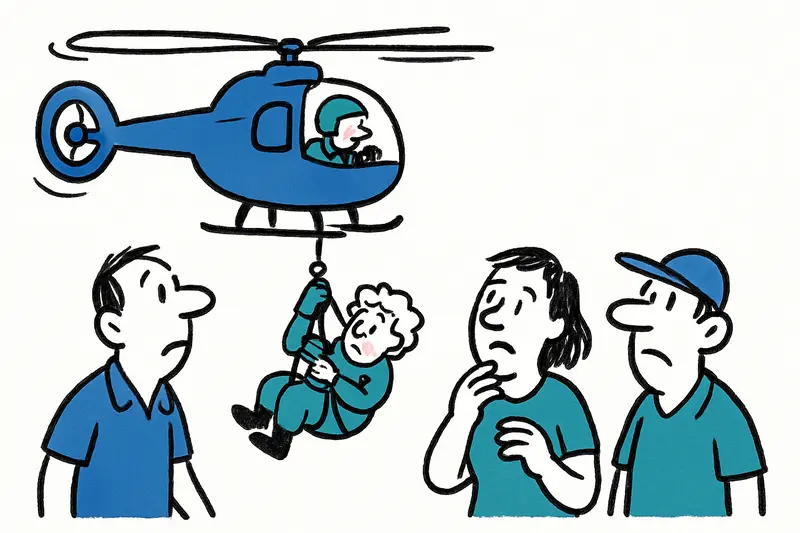
Late on Friday afternoon a loud rotor sound cut through the evening calm over the bay of Cala Deià — sunbathers, walkers and a few regulars suddenly looked up from the rocky coastal path. A 70-year-old woman had twisted her ankle on the descent and injured it so severely that she couldn't continue. The mountain rescue team from Sóller arrived, two rescuers abseiled, put the woman into a carrying sling and lifted her by crane into the helicopter. Shortly afterwards the aircraft set course for Palma, bound for Son Espases. Similar helicopter evacuations have been reported elsewhere, for example Heatstroke in the Torrent de Pareis: Rescue Raises Questions About the Safety of Hiking Groups.
The central question: prevention or repair?
Scenes like this are striking, almost cinematic: the helicopter like a metallic fish over the bay, the cry of seagulls, people filming with their phones, a few words carried on the wind. Yet alongside the drama a sober question remains: Are we relying too much on quick reaction instead of on prevention?
The Tramuntana is beautiful and rugged at once. Narrow paths, loose scree, steep descents — the old fishermen know this as do the daisy pickers from Palma. Nevertheless many accidents end in rescue operations (115 Rescue Missions, Hot Trails: Why Mallorca's Mountain Rescue Got Busier — and What Helps Now). That costs money, ties up personnel and can in some cases be an ordeal for those involved. Not every helicopter flight is avoidable. But many incidents could be prevented with better information, clearer signage and a little more caution.
What often stays in the shadows
First:
On-site communication. At many entry points there are no clear indications of difficulty level, sure-footedness required and estimated times. Hikers start out in flip-flops or thin sneakers — and are surprised when the path ends in loose scree.
Second:
Signal and orientation. In the gorges of the Tramuntana the mobile network is patchy. Those who call emergency services may have trouble giving exact coordinates. Locals and mountain rescuers therefore stress the importance of landmarks ('Cala Deià, Refugi path, small rocky cove'). In a time when many follow GPX tracks alone, that's a problem.
Third:
Burden on rescue teams. The teams in Sóller and the surrounding area often work on a voluntary basis or under regional coordination — rapid helicopter missions are expensive and logistically demanding. Incidents like Four missions in one day: How fit is Mallorca's mountain rescue? illustrate the strain. A critical question is: How sustainable are our current procedures if more visitors come improperly equipped?
Concretely: what would help now
A few simple, concrete proposals that don't sound like state debt but would have an impact:
1. Better info at trailheads. Clear signs with difficulty level, sure-footedness rating, warning of loose scree and estimated walking times. A small pictogram for "no barefoot/flip-flops" would be helpful — and gets the message across quickly.
2. Emergency signs with landmarks. Small boards that help during an emergency call: 'If you can see Finca X, you are on this section; if you see cave Y, call 112 and say: "Cala Deià, Refugi path, below the rocky cove".'
3. Local awareness-raising. Hosts, beach kiosks and bus drivers could give short reminders: sturdy shoes, water, a power bank, and when to be back. A friendly local "think about it" often works better than a brochure.
4. Equipment for visitors. Small first aid kits at tourist hubs or information about renting walking poles/equipment would prevent many minor incidents.
5. Support for rescue teams. Whether voluntary donations, municipal subsidies or better equipment — those who go into the mountains directly benefit from well-equipped rescuers.
A practical conclusion
The Friday ended like many evenings on the coast: the bay returned to its usual chirring and the sound of the sea, people chatted on the steps, some still wondered about the helicopter appearance. The woman in the helicopter seems to have been lucky — no life-threatening injury, but a long path to recovery.
The lesson remains: Respect for the Tramuntana doesn't hurt. Sturdy shoes, enough water, a simple first-aid kit and someone who knows when to be back — these are not exaggerated precautions. And a bit more preparation could help make the rotors cry over our bays less often. This echoes other dramatic missions such as Dramatic Helicopter Rescue at Puig Major: Lessons from an Afternoon in the Tramuntana.
Emergency number 112. If you need help in difficult terrain: give as precise landmarks as possible — Cala Deià, Refugi path or the small rocky cove help the teams enormously.
Frequently asked questions
Is hiking in Mallorca’s Tramuntana more difficult than it looks?
What should I wear for a walk to Cala Deià in Mallorca?
Can you get reliable mobile signal in Mallorca’s Tramuntana?
What should I do if someone gets injured while hiking in Mallorca?
Why are helicopter rescues common in Mallorca’s Tramuntana?
Is Cala Deià a good place for a casual coastal walk in Mallorca?
What are the best basic safety tips for hiking in Mallorca’s mountains?
How can visitors help reduce rescue incidents in Mallorca’s Tramuntana?
Similar News
First Day, First Consequences: What Palma's Rent Freeze Really Means
A new decree stops a planned eviction in Palma — but what really changes for tenants and landlords? A reality check with...
When Housing Becomes a Matter of Survival: Mallorca Between Rental Frenzy and Everyday Life
The case of 87-year-old Maricarmen showed that on Mallorca many people's lives are poised between affordable and uninhab...
Autumn in Mallorca: When Melancholy Gets a Window
Why autumn quietly tightens here — and how to make use of the mood: walks, culture, candles and the light from Palma to ...
Near-miss on Lanzarote: Landing Ryanair Jet and Iberia Takeoff — what really went wrong
On Lanzarote there was a dangerous incident: A Ryanair flight (FR5910) from Dublin landed on runway 03 while an Iberia E...
Eurowings introduces new Premium Business seats on Mallorca routes
From December 1, selected Eurowings flights to Palma and other destinations will feature eight particularly generous sea...
More to explore
Discover more interesting content

Can Cap de Bou

Townhouse Lleo 72
