
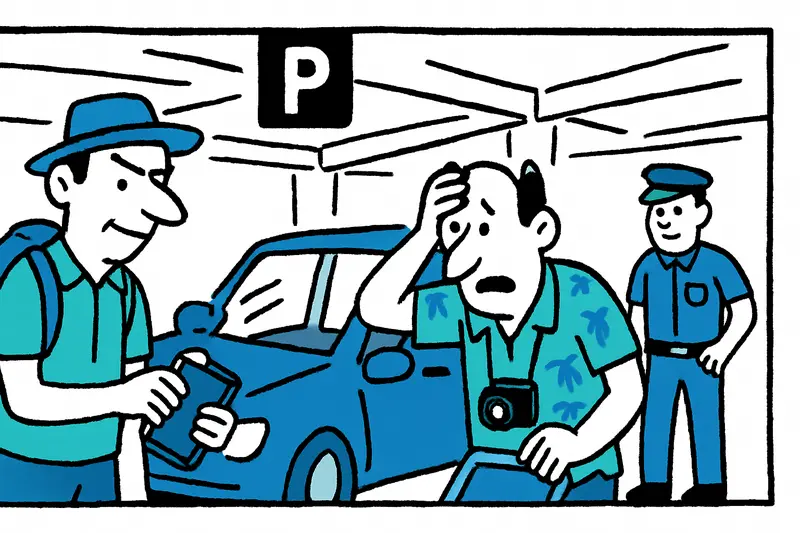
Hide-and-seek in the parking garage: How a man stole tourists' valuables at the airport
Hide-and-seek in the parking garage: How a man stole tourists' valuables at the airport
In the parking garage of Son Sant Joan Airport a man apparently used travelers' distraction to steal tablets, cash and keys. How could this happen — and what needs to change?
Hide-and-seek in the parking garage: How a man stole tourists' valuables at the airport
Key question: Why is a brief moment at the airport enough for valuables to be taken from travelers in Son Sant Joan, and who bears which responsibility?
On a hot afternoon at Son Sant Joan Airport, amid rolling suitcases and the constant beeping of the entry and exit barriers, a traveler was robbed while checking his rental car. A tablet, a wallet with ID, about 200 euros in cash, a backpack and keys — suddenly gone. Shortly afterwards, officers were able to arrest a man, a development reported in Arrests at Palma Airport: Two employees detained after alleged thefts. Those are the facts that remain; the questions are only just beginning.
Why this story concerns us: The parking garage is seen by many as a transitional zone — not a terminal, not a home, just a short action between arrival and departure. That very transition is the weak point. Opportunistic thieves exploit minutes of distraction when people are occupied with documents, phones or navigation systems, and these distraction techniques have been documented in New Tricks at Ballermann: How Pickpockets Exploit Playa de Palma — and What Actually Helps. That a suspect dresses like a tourist is no coincidence: it enhances inconspicuousness and creates proximity rather than suspicion, a tactic also detailed in Disguised as a Guest: Con-Artist Spree Hits Mallorca's Hotel Industry.
The police work here was effective: investigations quickly led to an identification and a targeted check on airport grounds. The arrest in the parking lot shows that surveillance and targeted presence have an effect. Still, that is only half the equation.
Critical analysis: Public debate often revolves around whether victims were "too careless." That narrows the view. There is a lack of systematic consideration of infrastructure: camera coverage on all levels of the parking garage, clear multilingual warning signs at exit areas, lighting in entry and exit ramps, regular patrols by security personnel at peak times — and above all better coordination between the airport operator, rental car companies and the police.
What is missing from the discourse: numbers and transparency. How many such incidents actually occur per month on airport property? Exactly where do they take place — on which floor, at which access points? Without this data, prevention remains piecemeal. It is also rarely asked whether rental car customers are sufficiently informed and whether there are safe, monitored areas for vehicle checks.
An everyday scene from Palma: On the way from the terminal to the parking level you hear shuttle drivers on their radios, feel the heat wave on the ramp's asphalt, see families with strollers navigating between pillars. In that hustle, a brief pause becomes an invitation for offenders. I have myself observed people rummaging for documents in the blazing sun while suitcases and doors stood open.
Concrete solutions:
— Audit of video surveillance: publish layout plans with blind spots and selectively retrofit cameras.
— Extra checkpoints for rental cars: covered, well-lit inspection areas with occasional presence of law enforcement.
— Multilingual information campaign: brief, action-oriented notices at rental counters, on tickets and at parking garage entrances.
— Cooperation with rental companies: staff train customers during handover and inform them about secure storage of valuables.
— Quick-report boxes and visible patrols in the evening hours; also mechanisms to ensure CCTV footage can be quickly reviewed and made available to victims.
For travelers, simple but effective rules still apply: do not leave valuables visible in the car, keep bags on your person, close doors briefly during vehicle handover and avoid distraction. A photo of the license plate and the location can help in case of loss.
Concise conclusion: The arrest shows that police can work effectively. But responsibility does not rest solely with individual travelers. Airport security begins with well-thought-out infrastructure and visible prevention. Anyone arriving or departing on Mallorca should be able to expect not to be drawn into a game of hide-and-seek.
Frequently asked questions
What is the best time of year to visit Mallorca for good weather and outdoor activities?
Are Mallorca's beaches safe for swimming, and what should I check before going in?
What should I pack for a Mallorca trip?
What are classic Mallorca experiences to add to a trip?
Should I rent a car in Mallorca or rely on public transport?
What are typical meal times in Mallorca, and how does that affect planning?
What Mallorcan dishes are worth trying?
How can I travel Mallorca responsibly and protect the natural areas?
Similar News
Fear in the Sa Teulera Forest: Youth Groups Harass Cruising Zone in Palma
In the wooded area of Sa Teulera, those affected report verbal attacks, property damage and intimidation. How safe is th...
Axa opens first health center in Palma: €3 million, 650 m² and more local access for La Vileta
In the heart of La Vileta, Axa has opened its first own health center in Mallorca. On around 650 square meters and with ...
30 Years of Nit de l'Art: What Palma's Art Night Really Shows — and Conceals
Nit de l'Art celebrated its thirtieth anniversary: full galleries, young visitors — and the quiet tensions between the a...
Hunt for Older Holidaymakers: Arrests after Suspected Pickpocketing in Port d'Andratx and Bellver
Five suspects were arrested after investigators accuse them of targeted pickpocketing of elderly tourists in Port d'Andr...
Knife stabbing in Magaluf: Why it must not remain an isolated incident
A 21-year-old tourist was stabbed in the chest in Magaluf and is in life-threatening condition. A reality check: what's ...
More to explore
Discover more interesting content

Can Cap de Bou

Townhouse Lleo 72
