
High heel slips, car accelerates: accident on Camí de Son Hugo
High heel slips, car accelerates: accident on Camí de Son Hugo
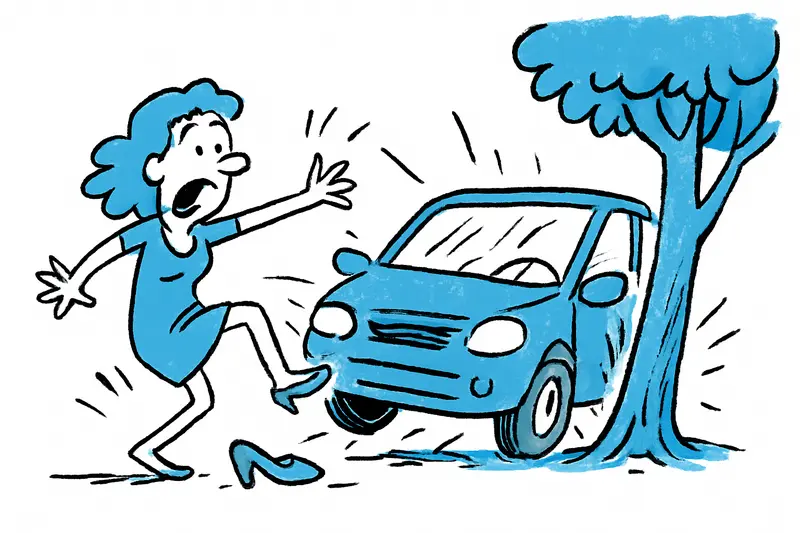
A woman lost a high-heeled shoe on the forecourt of the sports facility at Camí de Son Hugo. The car accelerated, mounted the curb and crashed into a tree. Two women were injured and taken to hospital.
High heel slips, car accelerates: accident on Camí de Son Hugo
Two women injured, alcohol test negative — and now the question: Was it just bad luck?
Early on a Tuesday afternoon — around 1:45 p.m. — a police patrol and an ambulance were called to the roundabout at Camí de Son Hugo. In front of the municipal sports facility, a car left the roadway, mounted the curb and collided with a tree. Two women were in the vehicle; both sustained bruises and were treated on site before being taken to hospital. The alcohol test administered to the driver was negative.
What lies behind the sober facts is no Hollywood stunt: a high-heeled shoe slipped in the footwell, the vehicle accelerated as a result and the driver steered sharply to the right to avoid touching a car ahead. The result: curb, tree, scrapes, shock and a hospital stay. No fatality, but enough to make you think.
Key question: Who is responsible when an item of clothing on the pedals causes an accident — the driver, the vehicle technology, the traffic layout or urban planning? The short answer is: all of the above to some extent. A single slip is enough to set a chain of factors in motion.
Critical analysis: In the confined area in front of a sports complex, everyday scenes collide: parents, teenagers, parked cars, pedestrians. If a shoe slips in the footwell, an instantaneous reaction is required — and that can have unintended consequences. Many cars today have non-slip rubber mats and well-placed pedal layouts; nevertheless accidents happen. At Camí de Son Hugo the proximity of trees and curbs increases the danger: once someone mounts a curb, they quickly lose the option to reverse, especially at a roundabout.
What rarely comes up in public debate is the design of forecourts and entrances to sports venues and other busy facilities. Trees are important and shade on Mallorca is invaluable — yet the distance between the roadway and fixed obstacles is often insufficient. As a result, the smallest driving errors are enough to crash into trees. We also don't talk enough about practical driver training for everyday situations: how should you react if something slips onto the pedals? Where should you park when changing shoes?
An everyday sketch: It's warm, the sun is high, you can hear the clack of tennis rackets and children's voices from the sports facility. Cars are parked on the forecourt, parents collect their children, someone hastily zips up a bag — and in one of these cars a shoe comes off. In a fraction of a second calm turns into chaos. This is not a distant statistic; it can happen to you or me.
Concrete solutions, without major administrative effort and without a technological revolution:
For drivers: Remove shoes that may slip while driving or swap them for flat alternatives before driving; do not leave shoes loose on the floor; regularly check footwells and rubber mats; when stopping in busy areas, switch off the engine and engage a gear where possible; if in doubt, park in a safe spot and change shoes.
For driving instructors and rental companies: Include everyday scenarios in driver training — not just motorway and parking, but also dealing with obstructing objects in the footwell; rental car firms could add brief notes about safe footwear in their handover documents.
For city authorities: Audit forecourts in front of sports facilities: check the distance between the roadway and fixed obstacles, install protective bollards or staggered planting where needed, and ease curb edges so that a single curb crossing does not immediately result in a hard impact with a tree.
Those who want more safety need practical measures rather than platitudes: a few centimeters of space, a note in the rental car, a change in driver education — all of this costs little and increases the chance that a slipped shoe does not end in a hospital visit.
Pithy conclusion: One high heel was the trigger, but blame rarely lies solely with a shoe. In Palma we stand so close to each other every day that small mistakes have big effects. A little caution and some structural adjustments at Camí de Son Hugo — and the next trip will end with applause from the sports facility, not the wail of a siren.
Frequently asked questions
What is the best time of year to visit Mallorca for pleasant weather and fewer crowds?
Can you swim in Mallorca's beaches year-round, and what should first-time visitors know about sea conditions?
What should I pack for a Mallorca trip to stay comfortable in hot summers but cool evenings?
What are some family-friendly activities in Mallorca that are easy for kids?
How should I get around Mallorca — is a rental car necessary or are public transport options enough?
Are there must-see natural spots in Mallorca for hiking or scenic views?
What should I know about swimming safety on Mallorca's beaches?
What is the local language situation in Mallorca, and will English be understood in tourist areas?
Similar News
Phone Scam: How Two Hotel Employees at Playa de Palma Lost Thousands of Euros
One morning in September, two reception employees at Playa de Palma were pressured by alleged alarm-company staff — in t...
When the Wallet Becomes a Danger: Attack in Peguera and Lessons for Mallorca
In Peguera, two women are said to have stolen the wallet from a 75-year-old German couple. When the victim intervened, t...
Plata stays Plata: Young people take over, Llonguets remain
A small bar on Carrer de l'Argenteria will continue: Tolo Serra hands the place over to young Mallorcans at the end of t...
Unnoticed in the Luggage Compartment: How a Boy Traveled More Than 100 Kilometers in a Team Bus
A minor traveled in the undercarriage of a team bus for more than 100 kilometers until his cries for help were heard. A ...

Cap Vermell Grand: Second Michelin Key – a Gift for the East
The Cap Vermell Grand in Capdepera has been awarded its second Michelin key. For the region this elevates the luxury off...
More to explore
Discover more interesting content

Can Cap de Bou

Townhouse Lleo 72
