
When Doors Are Bricked Up: Reina, Luna and the Escalating Housing Crisis in Palma
On Joan Miró Street a door was bricked up — a scene that tells more about Palma's housing market than any statistic. A look at causes, blind spots and solutions.
A hallway full of boxes, a dog and fresh cement
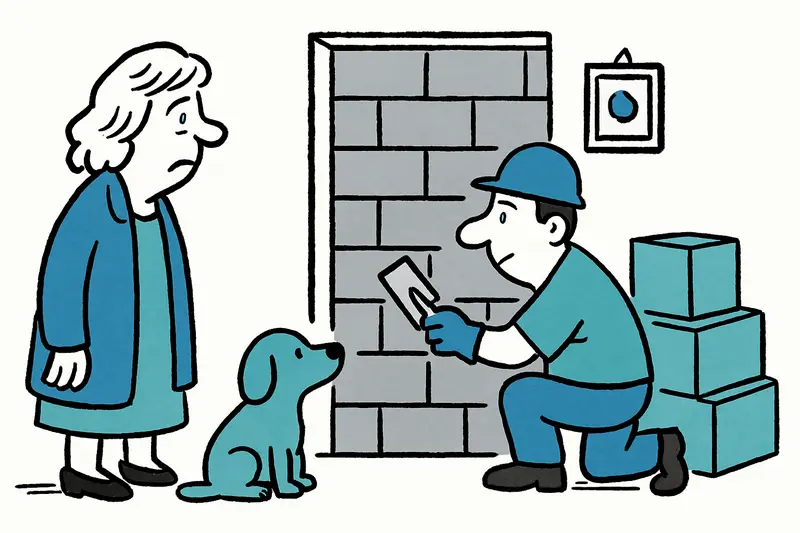
Thursday midday on Joan Miró Street: workers set the last concrete block in front of a door. The tapping of trowels mixes with the whir of mopeds, and a security company screws its sign to the wall. A woman in her sixties stands beside them, silent, her eyes glassy. Her name is Reina, or so the neighbors said, and next to her lies a basket with a small blind dog called Luna.
Reina has spent years in one of the basement rooms: a bed, a tiny stove, a wobbly table, a lampshade that sometimes flickers. Her furniture — no more than a few boxes — now stands in the hallway, smelling of cement. A neighbor picks Luna up in her arms. You can hear not only concrete, but also a soft whimper. Passersby stop, some glance discreetly, a child asks why a door is being bricked up. The situation was reported as Escasez de vivienda en Mallorca se agrava: una mujer, un perro y puertas tapiadas.
Why is this happening? The central question
Such evictions are not accidental, but the result of a system. Behind the quick sealing of the door are rising rents, a shortage of affordable housing and a legal framework that is often faster than help. Residents who work in precarious jobs — waiters in Santa Catalina, delivery drivers, care workers — lose the chance of an alternative rental contract despite their income. Locals say the court date was set on Tuesday, and on Thursday the construction company was already at the door: little time for organizing, even less for help. Evictions are rising across the islands, as explored in Living in Crisis: Why Tenants Are Now Paying the Price on the Balearic Islands.
The scarcity caused by short-term rentals also plays a role: apartments that were formerly rented long-term have become more expensive or have disappeared from the market entirely. At the same time, emergency shelters are scarce and often not set up for people with pets. Those who don't want to leave their dog behind say "no" to a place in the shelter — and prefer to wait in the stairwell, a trend described in When Living Rooms Become Bedrooms: How Mallorca Suffers from a Housing Shortage.
Aspects that rarely take the spotlight
When journalists talk about "the housing crisis", details often remain unexamined: basement rooms as a last refuge, the role of private security firms in enforcement, and the emotional dimension — pets, keepsakes, SIM cards with contacts. The presence of security guards and police turns the situation into a public humiliation; the bricked-up portal is not just concrete, but the visible message: property rights count more than life here.
Little discussed is also the speed of legal procedures. Short deadlines mean that people who do shift work have little chance to attend a hearing in time or to organize financial aid. Free, quick legal assistance on site is also often missing.
Concrete solutions — short-term and long-term
There is no miracle cure, but there are measures that could help:
Short-term: Mobile teams of social workers and lawyers who are on site immediately during evictions; emergency vouchers for interim accommodation; binding rules that pets must be accepted; temporary storage space for furniture so that property does not remain in the hallway collecting dust.
Medium to long-term: Expansion of social housing and public vacant property registers, stricter rules for short-term rentals, legal minimum notice periods for evictions, mandatory mediation by the city in cases of imminent loss of housing, special programs for workers in key sectors (hospitality, care, construction) and incentives for landlords to rent long-term.
An ambitious idea that should be discussed in Mallorca: municipal housing cooperatives or community land trusts that remove land from the speculative market and secure affordable housing. And: an emergency fund financed by a solidarity levy on excessive tourism profits could enable recurring immediate assistance.
What the city already does — and what is missing
Authorities point to legal requirements and emergency shelters. Social organizations fill gaps but are chronically overstretched. Neighbors bring water, a woman gives a blanket — gestures that are human, but don't solve structural causes. What is needed is not more symbolism or more pressure on volunteers; what is needed are systemic changes.
A call to politics and society
The scene on Joan Miró Street was neither an isolated case nor theater: it is a forecast. If another door is bricked up tomorrow, the response should not be powerlessness. Politics must set clear priorities: secure affordable housing, slow down procedures, do not count pets as collateral damage. And what can we do as neighbors? We can listen, connect, sign petitions, organize shifts, or act as temporary hosts.
In the evening the security company's sign gleamed in the headlights. A man whispered: "Tomorrow it's another one." That is not just a sentence, it is a demand: who listens — and who acts?
Frequently asked questions
Why is Mallorca facing such a serious housing crisis right now?
What should tenants in Mallorca do if they are facing eviction?
Are pets allowed in emergency housing in Mallorca?
How do short-term rentals affect housing in Mallorca?
Why is housing so difficult to find in Palma?
What happens during an eviction in Palma?
Where can people in Mallorca get help with housing problems?
What long-term solutions could help Mallorca's housing crisis?
Similar News
Release after bloody attack in Palma: Why the court's decision raises questions
An 18-year-old who allegedly inflicted a serious neck injury on a man at Plaza Gomila using a wristwatch wrapped around ...
Kidnappings in Inca: Three young men forced into car trunks and abused in the forest – a reality check
In Inca, three 18-year-old men were forced into car trunks by masked assailants at the Plaça des Bestiar, taken to a for...
Spreading Massification: The Brake That Still Has Much Work to Do
Marga Prohens announces limits on volume tourism. The measures sound harsh — but are they enough to save everyday life, ...

Through the Keyhole onto the Party Yacht: How Daniela Katzenberger Is Planning Her 40th on Mallorca
Daniela Katzenberger turns 40 and wants to celebrate it on the island — likely with a boat, cake and her mother. A relax...
By Boat Instead of the Road: Palma's Water Bus — a Reality Check
The 'Bus Nàutic' launches in two stages — but questions remain over interim operations, fares and environmental requirem...
More to explore
Discover more interesting content

Can Cap de Bou

Townhouse Lleo 72
