
When Living Rooms Become Bedrooms: How Mallorca Suffers from a Housing Shortage
More and more families are dividing apartments on the Balearic Islands. Between market stalls in Palma and crowded schoolyards it becomes clear: short-term measures are not enough. What long-term solutions does the island need now?
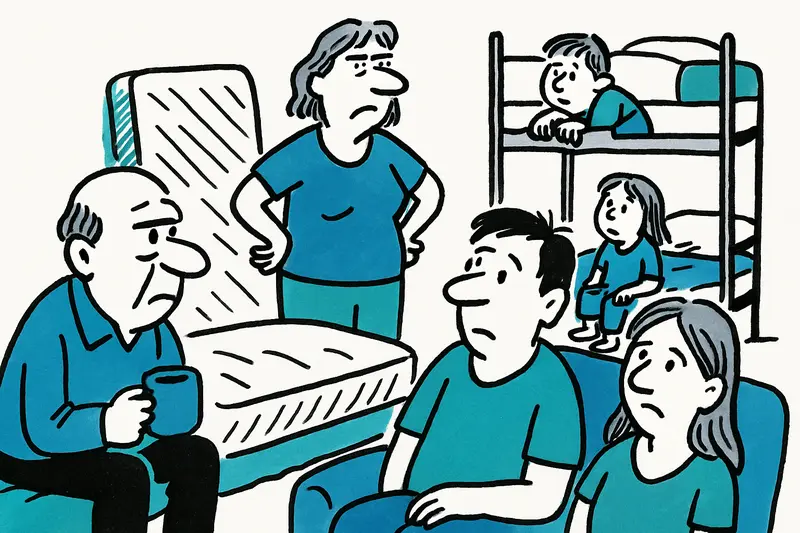
When the living room becomes a bedroom
At the market in Palma at half past eight: vendors shout, bags rustle, church bells ring — and among it all, mattresses lie in a courtyard to dry. Such scenes are no longer a marginal phenomenon, as reported in Sky-high prices, tents, empty promises: Why Mallorca's housing crisis is no longer a marginal issue. On the Balearic Islands, thousands of households no longer live alone but together with relatives or strangers because their own apartment has become unaffordable — see Balearic Islands in the Price Squeeze: Who Can Still Afford Mallorca?
The guiding question is direct: Who will find room on this island if housing continues to be converted into holiday rentals, as explained in Why long-term rentals in Mallorca are dwindling — and what could help, and rents rise faster than wages?
More than a statistic: faces of the housing crisis
The official figures speak of nearly 28,000 households currently practicing multi-family living. Extrapolated, this affects about 100,000 people. These are not just abstract numbers: they are neighbors from Carrer de Sant Miquel moving back in with their parents, single fathers on friends' couches, older people giving up familiar movement in their own homes — a trend documented in When the Shared Flat Room Becomes a Luxury: Palma Under Pressure.
The consequences are audible in schoolyards. Children who have no quiet place to study in the afternoons, teachers who explain that performance deficits are not only educational but also housing issues. In the apartments themselves there is a schedule: showering by shift, private conversations in stairwells, life rhythms that do not match. This creates stress — and health costs that are often overlooked today.
What is missing from the debate
There is much public debate about holiday rentals and vacancies — rightly so. But three aspects often remain underexposed: first, the invisible transfer of problems into private households (women after separation, seniors with falling incomes). Second, the role of small-scale property owners who not only list on large platforms but also keep unused second homes. Third, the social follow-up costs: overcrowded schools, increasing pressure on health services, changing neighborhoods and growing street homelessness, as reported in Mallorca's Streets Are Growing Longer: Why More Than 800 People Are Homeless and Nothing Solves It by Itself.
Local creativity must not be romanticized either. Community washing machines, furniture exchange markets and neighborhood kitchens are impressive — and at the same time underline how much the city administration needs fact-based action. These initiatives help and ease the situation, but they do not tackle the cause.
Concrete measures that could have an impact now
A wish list is quickly written. But what matters are practical steps municipalities can implement in the short term:
1. Reactivation of vacant buildings: Municipal funding programs for renovating empty historic buildings — combined with rent-binding agreements for a defined period.
2. Temporary but secure emergency accommodations: Not just hostels, but supervised apartments with social support for women after separation, single parents and seniors.
3. Stricter controls on holiday rentals: Consistent sanctions against illegal conversions and financial incentives for owners to rent long-term.
4. Investment in social housing: Fast, small-scale projects near the city instead of large estates on the outskirts — so people are not pushed out of their social environment.
5. Support programs for cooperative housing: Models in which residents have a say and long-term stability.
All this costs money — yes. But inaction also has its price: higher health expenditures, lost educational opportunities and a city that loses its character.
A look ahead
When we walk through the old town in the morning, we don't only hear the seagulls and the filled baguettes from the bakery. We also hear the interconnected life under pressure: children who are loud in cramped apartments, elderly people who give up familiar rituals, neighbors who must keep their jobs and still have hardly any breathing room. The question remains: do we want Mallorca in ten years to be primarily a holiday map — or a vibrant place for people who work and live here?
An appeal to local politics: Short-term subsidies are necessary, but not a permanent solution. Binding concepts, transparent figures and above all: the courage to see investments in housing as investments in the island's future are needed. Otherwise, in a few years not only the apartments but also the streets will be emptier — and the island less Mallorcan.
Frequently asked questions
Why is housing becoming so expensive in Mallorca?
What does Mallorca's housing shortage mean for local residents?
Are holiday rentals making the housing crisis worse in Mallorca?
What can Mallorca municipalities do to ease the housing shortage?
Why are schoolchildren affected by the housing crisis in Mallorca?
What is it like living in overcrowded homes in Mallorca?
Which areas of Palma are most affected by the housing pressure?
How are people in Mallorca coping with the housing crisis right now?
Similar News
First Day, First Consequences: What Palma's Rent Freeze Really Means
A new decree stops a planned eviction in Palma — but what really changes for tenants and landlords? A reality check with...
When Housing Becomes a Matter of Survival: Mallorca Between Rental Frenzy and Everyday Life
The case of 87-year-old Maricarmen showed that on Mallorca many people's lives are poised between affordable and uninhab...
Autumn in Mallorca: When Melancholy Gets a Window
Why autumn quietly tightens here — and how to make use of the mood: walks, culture, candles and the light from Palma to ...

Near-miss on Lanzarote: Landing Ryanair Jet and Iberia Takeoff — what really went wrong
On Lanzarote there was a dangerous incident: A Ryanair flight (FR5910) from Dublin landed on runway 03 while an Iberia E...

Eurowings introduces new Premium Business seats on Mallorca routes
From December 1, selected Eurowings flights to Palma and other destinations will feature eight particularly generous sea...
More to explore
Discover more interesting content

Can Cap de Bou

Townhouse Lleo 72
