
How far can protest against tourism go? A reality check from Mallorca
How far can protest against tourism go? A reality check from Mallorca
A guide, arrests and antisemitic graffiti — how does the island protect freedom of expression without tipping into violence or hate? A critical look with concrete proposals.
How far can protest against tourism go? A reality check from Mallorca
Key question: When does legitimate resistance end and criminal violence begin?
The past weeks have sparked a debate on the island that is louder than the rustle of the trade winds: A group published an action guide online that mentioned property damage as a tactical means. Shortly afterwards the police opened investigations, and in Santa Maria there were two arrests related to paint graffiti on real estate offices. In other places antisemitic slogans appeared in the aftermath — a stigma that has nothing to do with substantive criticism, as described in New xenophobic graffiti at Playa de Palma – How is the island reacting?.
These facts are troubling and at the same time precise: an online guide, police measures, two accused persons, visible follow-up incidents and the blocking of a social media account. That is all it takes to ask the question: How should authorities, civil society and economic actors deal with this without stifling — neither protest culture nor public order?
Analysis: Protest has a tradition in Mallorca, as shown by the mobilization around Sa Dragonera in the 1970s. Back then the occupation was a boundary-crossing act, but it targeted a tangible nature project and refrained from personal violence. The current indications of targeted property damage and identity concealment change the playing field. When façades, locks or advertising posters are attacked, it affects not only companies; it also affects people who work there and neighbors who have to live with oil on their house walls.
What is often missing in public discourse: two perspectives that can both be true at once. First, the anger and despair of residents who experience rising rents, noise and environmental problems. Second, the simple truth that targeted property damage and hate slogans forfeit democratic legitimacy. Between these poles there is room for more honest debate, but so far punchy statements dominate, as explored in Palma after the Protest: How Freedom of Expression and Everyday Life Can Be Balanced.
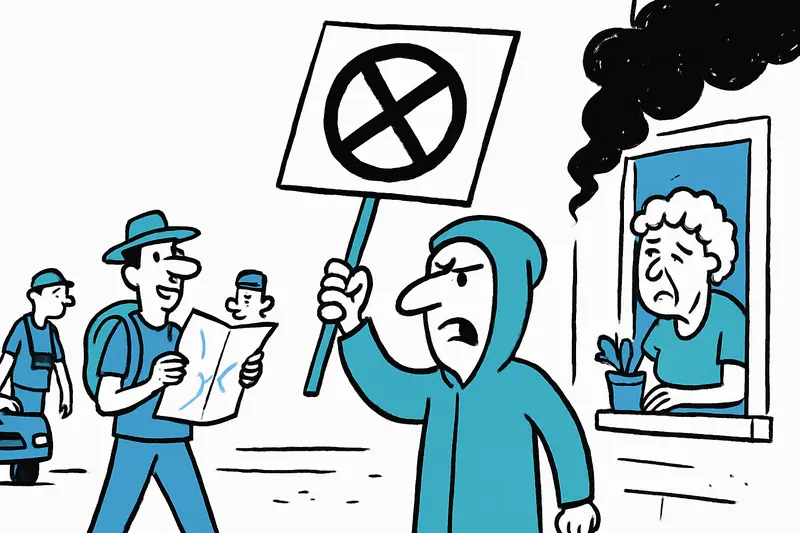
An everyday scene: midday at Plaça Cort in Palma, delivery vans beep, tourists walk around with city maps, and an elderly woman waters herbs in front of her window. She sighs about the housing ads in her neighborhood. It is precisely this mixture of tourist bustle and local everyday life that is at stake — and that needs protection, both from overuse and from arbitrary violence.
Critical points in practice: The role of surveillance cameras is ambivalent. They helped identify the suspects in Santa Maria, but they also serve as a surveillance tool against legitimate demonstrations. In addition, public outrage over images of arrests occasionally produces waves of solidarity that complicate legal assessments. Authorities must show that measures are proportionate; otherwise their intervention loses trust.
Concrete approaches that could work:
1) Public minimum standards for protest actions: Municipalities could offer binding codes of conduct that explicitly exclude property damage and hate speech, similar to debates raised by Poster Dispute in the Balearic Islands: How Much Provocation Can Public Space Tolerate?. Not as censorship, but as orientation for organizers.
2) Dialogue forums before large demonstrations: On the day before major marches, there should be moderated meeting points where concerns, routes and security questions are discussed transparently. This reduces misunderstandings and makes actions more predictable.
3) Local mediation offices: In tourist centers, contact points could be established to receive complaints about noise, rent increases or illegal rentals and mediate them promptly. Immediate measures can cushion frustration.
4) Legal and mediation services: For cases in which activists face criminal charges there is a need for independent legal advice; for owners and those affected, restorative procedures to resolve damages without public escalation.
5) Clear prosecution of hate speech: Antisemitic or xenophobic slogans are not a legitimate means of expression. Police and prosecutors must investigate these with priority so that the debate does not turn into violence against minorities.
6) Transparency in surveillance measures: Where cameras and image analysis are used, the municipality should be accountable for purpose, retention periods and use, so that data protection and security come into balance.
What matters now: proportionality and communication. Those who love the island and want to protect its quality of life must not resort to violence; at the same time the state must not reflexively criminalize protest. Both sides must learn to listen to the anger without romanticizing it, a tension noted in After Eleven Years at the Top: What Mallorca's Tourism Radar Really Needs to See.
Conclusion: The guiding question remains open, but manageable. Protest is an indispensable outlet in a society with strong competing interests — yet as soon as actions include harm to people or property or messages of hate, they lose democratic legitimacy. Better practice would be to resolve local conflicts through moderation, legal clarity and transparent measures. In this way we preserve space for both things: criticism of an overwhelmed tourism model and the everyday life of the people who live in Mallorca.
Frequently asked questions
What is Mallorca's climate like throughout the year?
When is the best time for swimming on Mallorca's beaches?
What should I pack for a Mallorca trip to the coast?
What activities are popular for visitors in Mallorca?
What practical measures exist to keep protests in Mallorca peaceful and lawful?
How could dialogue forums before large demonstrations help in Mallorca?
What role would mediation offices play in Mallorca’s tourist centers?
How is hate speech addressed during protests in Mallorca?
Similar News
Three Luxury Hotels in Banyalbufar: Lots of Money, Many Questions
A Danish investor plans three exclusive accommodations in Banyalbufar — including the historic Son Valentí. The announce...
2.1 tonnes of cocaine on sailing yacht off Spain's coast – a reality check for the coastguard
A 14-metre yacht was seized with 2.1 tonnes of cocaine. Who monitors the ports, how does the international hunt succeed ...
Heat Bonus in Mallorca: 100 Euros Extra for Outdoor Staff at MarSenses
MarSenses pays employees who worked outdoors in August an extra €100 as recognition. Lighter uniforms, reduced hours for...
Renovating in Mallorca: What You Really Can Do Without Neighbour Consent
Many think they can do whatever they want in their apartment. That's partly true — but only as long as structural elemen...
Cafetería San Siro: A Meeting Place on Schinken Street Since 1966
In the middle of Schinken Street, Cafetería San Siro has been offering Mallorcan hospitality for more than six decades —...
More to explore
Discover more interesting content

Can Cap de Bou

Townhouse Lleo 72
