
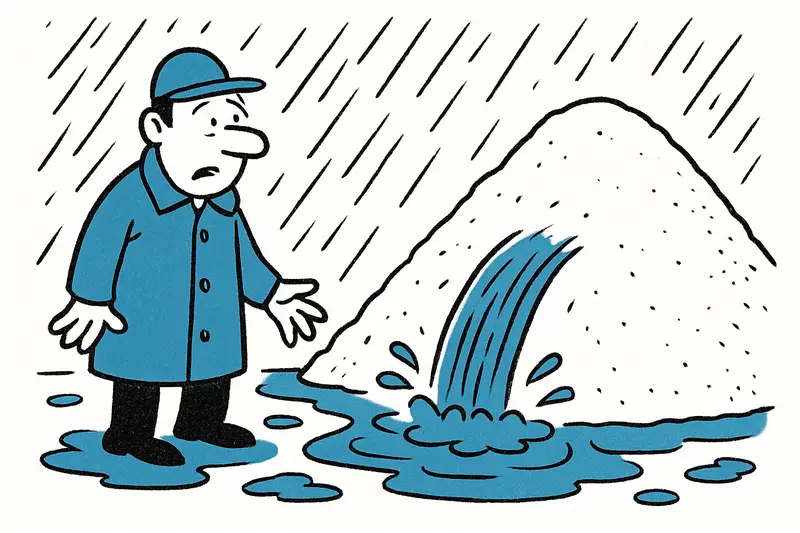
When the Salt Is Under Water: Storm Hits Saltworks at Ses Salines
A severe storm has badly hit the saltworks on Ibiza's south coast: around 11,000 tons of salt are lost or underwater. For people on site it is no longer just about crop loss, but about resilience, culture and future strategies.
When the Salt Is Under Water: Storm Hits Saltworks at Ses Salines
Those who drove along the narrow coastal road of Ses Salines early yesterday morning heard not only the roar of the surf. Over the pans lay the monotonous pumping, the squelch of wet rubber boots on muddy paths and the shrill cry of a seagull fluttering about like a forgotten windbag. Salinera Española reports: around 11,000 tons of salt are currently lost or underwater.
Why the figure is more than a statistic
On paper that may not sound like a national disaster. Spain harvests far more. Locally, however, this number is a severe cut: of a usual annual harvest of about 80,000 tons, so far only just under 21,000 tons have been recovered. Technicians are pumping, workers are pushing carts over muddy paths, dikes are being temporarily reinforced. Time is a factor: pumping out water, cleaning brine, checking quality — that takes time. Those responsible expect up to a month before a reliable assessment is available.
The key question: How resilient are our saltworks?
The pressing problem is not only economic. The salt pans are a cultural element; their salt ends up in restaurants from Palma to Port de Sóller, is sold in local delicatessens and is part of the islands' identity. If tradition and production are damaged by extreme weather, the question arises: Who pays the price — the owners, the employees, the community?
Underestimated consequences for work and supply
On Ibiza you can feel it immediately in everyday life: seasonal jobs are at risk, mainland traders have to rethink delivery schedules, small processors receive scarce batches. Chefs in Mallorca are also uneasy on rainy days: many buy salt with regional origin because it has a characteristic taste. Supply chains are closely interwoven — what goes wrong in Ibiza quickly appears on the table in Palma and at the farmers' market in Santa Catalina.
Ecological disruptions
Salt evaporation ponds are more than salt basins. They are habitats: wading birds rest there, small crustaceans and microorganisms create complex food chains. Sudden fluctuations in water level and salinity disturb breeding times and migration routes. A too-rapid influx or a long-term flooding can shift species — with consequences that become noticeable only months later in bird counts and insect catches.
What is often overlooked
Several points remain in the dark for too long in public debate. First: storage and quality issues. Not every pumped-out salt has the same quality; some batches are effectively lost. Second: insurance. Small operators often do not have comprehensive disaster policies. Third: traditional knowledge. Salt masters know how to control floods and form crystals — that is artisanal capital that cannot be replaced overnight. Fourth: the risk of cumulative events. One storm is bad. Several in quick succession could make whole production branches untenable.
Short- and mid-term responses
Practically this means: in the short term, pumping capacity and temporary dry storage areas must be increased. Mobile protective elements, provisional drying areas and prioritizing repairs of critical dikes help save quality. In Mallorca fishermen and dryers at Es Trenc remember similar improvised actions after storms, as reported in Después del aguacero: Ibiza entre charcos, aludes de barro y la pregunta de cuándo será el próximo — you quickly learn what is urgent.
In the medium term, investments are needed in more robust dike structures, better drainage and a coordinated emergency plan for personnel, machines and logistics. Insurance models that cover smaller businesses and a regional fund for crop losses would reduce financial risks. Digital monitoring systems could also help to observe water levels and salt concentrations in real time.
Ecology and marketing as part of the solution
For ecology, expanded monitoring programs are necessary — for example regular bird counts and measurements of microbial communities — so that lasting damage can be detected early. And economically there is an opportunity: market regional salt products more strongly as a quality good, with certificates for sustainability and climate adaptation. Such added value helps cushion revenue losses and protect jobs.
A societal perspective: climate, culture, solidarity
Ses Salines is a microcosm for a larger debate: how do we integrate traditional crafts into a world with more frequent extreme events? Who bears the cost when climate impacts hit the basis of local identity? The answer must begin locally — with technical measures, but also with social instruments: retraining for seasonal workers, faster access to emergency payments and transparent communication with residents.
Under grey skies people continue to work while the sea rushes in the background and a seagull occasionally cries over the pans. Patience is required — and the willingness to think beyond mere repairs. Only in this way can salt pans and the people who rely on them become more resilient.
We will keep following this and report as soon as new figures, voices from the region or decisions by the authorities are available.
Frequently asked questions
What happened to the saltworks at Ses Salines after the storm?
Will the storm affect salt supplies in Mallorca?
Why are the salt pans at Ses Salines important for Mallorca?
Can you still visit the salt pans at Ses Salines after heavy rain?
How long does it take to assess storm damage at a saltworks?
What happens to wildlife when salt evaporation ponds flood in Mallorca?
What kind of jobs are at risk when Mallorca’s salt production is hit by storms?
What can be done to protect saltworks like Ses Salines from future storms?
Similar News
Palma under the microscope: 87 arrests over forged passports – what now?
The National Police stopped 87 people at Palma airport this year with allegedly forged documents. Why are controls alone...

When a Taxi Fare Dispute in Magaluf Turned Bloody: How Safe Are Passengers and Drivers?
In Magaluf a dispute over the fare escalated: a tourist, now 18, is accused of having seriously injured a taxi driver in...
Why Mallorca Has Become So Terribly Expensive — A Reality Check
Rents are exploding, staple food prices are rising, wages are lagging behind. A look at the causes, what is missing from...
When Paradise Becomes Unaffordable
Hotel rooms, paella and the weekly grocery shop: Mallorca is becoming more expensive for many. Who pays the bill — guest...
End at Ballermann: What Is Lost with the Dino Mini Golf at Playa de Palma
On October 25 the dinosaur mini-golf course at Playa de Palma will close after more than 30 years. Why the city is recla...
More to explore
Discover more interesting content

Can Cap de Bou

Townhouse Lleo 72
