
More than seven days without water: Inca families demand answers from Ibavi
54 households in an Ibavi housing complex in Inca spent more than a week without regular tap water. Supply by tanker truck showed gaps — and raised questions about maintenance, communication and responsibility.
More than seven days without water: Inca families ask how this could happen
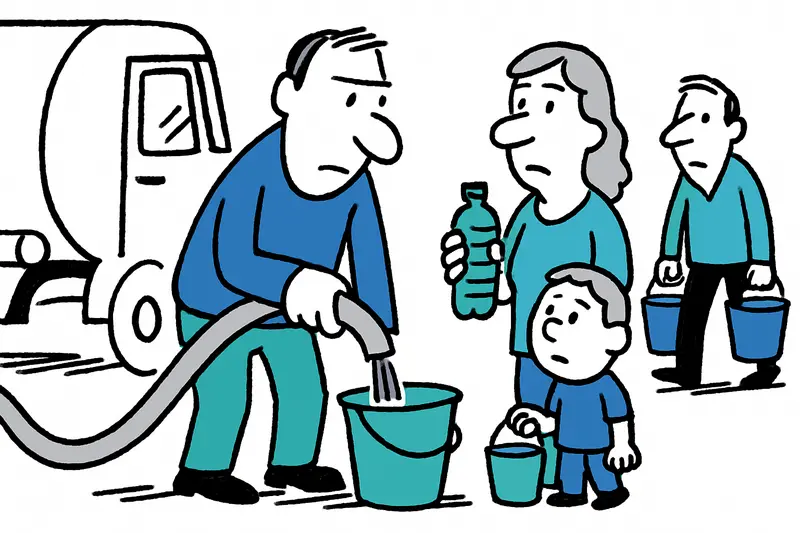
When the tap runs dry, you only notice how present water is in everyday life. In a residential complex in Inca, managed by the Balearic housing authority Ibavi, 54 households were left without normal tap water for more than a week. The images are familiar: a water tanker, buckets in queues, evening phone calls asking relatives if one can quickly come over to shower. The central question remains: Why does this keep happening, and who is responsible for ensuring such outages do not become the norm?
How the supply was improvised
Residents describe the scene vividly — the hum of the tanker as it turns into the courtyard, the clink of plastic bottles, voices gathering at the back of the building. The tanker helped, no question. But water from a truck does not replace a stable household connection: quantities were limited, distribution uneven, and queues formed. Some families had to stay overnight with relatives in Sineu or with neighbors, a situation echoed in Deià, where drinking water is shut off three days a week, because showering, cooking or washing baby clothes was otherwise impossible. Especially on hot days every liter becomes precious; you can sense it in the thin conversations in the stairwell and the smell of cold coffee in the morning that is no longer accompanied by a warm shower.
What Ibavi explains — and what remains
The housing institute said the fault had been fixed, pipes checked and repairs carried out. For many residents this sounds like a routine report: welcome, but not reassuring. Reports from Sóller and similar local coverage feed that skepticism. "This is not the first time," says a woman in her mid-forties who has lived here for ten years. "You can’t always rely on friends or family having space to shower." Skepticism thus accompanies the words of thanks. Good words, but trust is earned through transparency and reliability, not one-off repairs.
Underestimated consequences for daily life
The hardest hit are the elderly, single parents and families with small children. Interviews with neighbors reveal glimpses of everyday life: strict rationing of water on the third day, one bucket for the cat, one cup per person for brushing teeth. Such emergency measures are not ordinary — they are a warning sign. Added to this are financial burdens: extra bought bottles, additional trips to friends, lost working time. Who do you turn to about this, and who will reimburse these costs? This feeds into a broader water alarm affecting several Mallorca municipalities.
Aspects that are discussed too little
In conversations it becomes clear: it is not only about burst pipes. Communication, responsibilities and long-term maintenance are often worse organised than a technical diagnosis might suggest. Some points remain underexposed in the public debate:
1. Chain of responsibility: Who is responsible for internal pipes, who for the house connection and who for the municipal main line? Unclear boundaries lead to delays in repairs.
2. Old building installations: Even if the main line is intact, dilapidated risers or rotten connections in the apartments can cause outages. Drought pressures have also been reported in tourist areas, for example Deià's drought and its impact on hotels.
3. Emergency communication: Late or contradictory information increases stress and leads to rumors. A clear communication plan is missing.
Concrete demands and solution-oriented proposals
Several residents already have concrete ideas on how to improve the situation in the future. Their proposals are pragmatic and feasible:
Transparent status map: A public dashboard for affected buildings and current faults — accessible online and easy to understand.
Fixed contacts: A direct number or a designated contact person at Ibavi who is informed immediately in case of outages and provides feedback.
Regular inspections: Planned inspections of building installations at least once a year, with priority for older complexes.
Emergency plans: Agreed procedures for immediate aid (tankers, hygiene boxes, support for at-risk groups) and a quick review of who covers which costs.
Documentation and compensation: Residents should document outages (date, time, photos, receipts). This is the basis for possible compensation and serious complaints.
What the neighborhood does — and should do
The mood in the corridors is not hysterical, it is vigilant. Conversations about signature lists, a meeting with the municipal administration and the idea of a small water reserve room are circulating. An older neighbor almost dryly suggested the idea of a central water dispenser — a touch of irony in an otherwise serious context.
Water is not a luxury, it is basic infrastructure. As long as outages are treated as exceptions rather than as symptoms of structural problems, uncertainty will return again and again. If you live in the neighborhood: document, ask for fixed contacts and remain persistent — trust is built through reliability, not lip service.
Frequently asked questions
What should residents in Mallorca do if their building suddenly has no tap water?
How long can a water outage last before it becomes a serious issue for families in Mallorca?
Who is responsible for water supply problems in an Ibavi building in Mallorca?
Is it safe to rely on a water tanker during a water outage in Mallorca?
What can Mallorca residents do if they need to shower during a long water cut?
Are older housing complexes in Mallorca more vulnerable to water outages?
What should families in Inca keep if they want to complain about a water outage?
What are residents in Mallorca asking Ibavi to improve after repeated water cuts?
Similar News
Taking Off Differently: Pilot, Pere Garau Resident and Rock Musician
Andreas Thiele flies an Airbus A320 for Lufthansa, has an apartment in Pere Garau — and will release an alternative-rock...

Palma takes to the streets: Thousands demand 'Housing as a Right'
Around 3,000 people marched through Palma on Saturday to demand affordable housing. The protest followed the rejection o...

Beatings in Palmanova: Two British tourists injure taxi drivers — what needs to happen now
In Palmanova, two taxi drivers were attacked at night by apparently drunk tourists. One suffered severe facial injuries ...
Village Festivals of Art: ArtinSal, TastArt and Canal'Art Bring Culture to Mallorca's Streets
In October Ses Salines, Porreres and Santanyí turn their squares into exhibition spaces: three art nights, plenty of cra...
Christmas Market Conflict in Palma: Who Owns the Christmas Season?
The relocation of a privately organized, German-influenced Christmas market to Parc de la Mar is causing anger among loc...
More to explore
Discover more interesting content

Can Cap de Bou

Townhouse Lleo 72
