
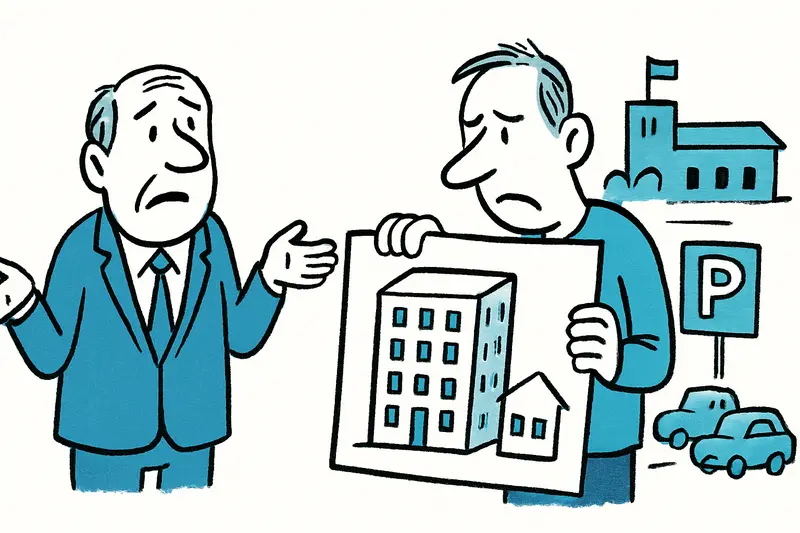
63 Apartments in Inca: Housing instead of Park-and-Ride — for whom?
63 Apartments in Inca: Housing instead of Park-and-Ride — for whom?
The Inca town council has cleared the way for 63 new apartments on the site next to the General Luque barracks. One central question remains: does the city lose important parking space as a result, and what are the consequences for traffic and the neighborhood?
63 Apartments in Inca: Housing instead of Park-and-Ride — for whom?
On the edge of the town center, next to the General Luque barracks, the Inca town council has amended the municipal plan: the former park-and-ride area is to be developed with 63 apartments. The developer is private and owns most of the land there. In addition, a new road section is planned that will connect Avinguda del Pla with Avinguda General Luque and the old road to Alcúdia.
Key question
Will a practical park-and-ride become a residential quarter that relieves pressure for the people of Inca, or will it create new strain on traffic and infrastructure?
Critical analysis
At first glance the decision sounds like a simple densification: centrally located land, private investors, housing close to town. But relocating a park-and-ride area at a traffic junction is not just a change on the map — it sets off a cascade. Those who used to park there may in future spill into residential streets or use on-street spaces around the market and the narrow alleys. The announced new link between Avinguda del Pla and the old road to Alcúdia could divert traffic in a different direction, but without accompanying measures there is a risk of more through-traffic in neighborhoods where children play and where the streets are already narrow.
What is missing in the public discourse
So far the public debate has focused mainly on the number of apartments — concrete commitments on replacement parking, public green spaces, social housing (Sóller: Parking lot replaced by 24 social housing units at Plaça de les Teixidores), or measures to reduce noise and air pollution are missing. It is also unclear how the new road section will integrate into the existing network: will bike lanes be planned? Will there be safe crossings for pedestrians so the connection remains safe for older neighbors who often walk to the market? And how will construction phases and detours be managed so that delivery traffic does not run for months through Carrer de Sant Miquel?
Everyday scene from Inca
Imagine a morning in Inca: market stalls at Plaça d’Inca, vendors calling out, a postman pushing his cart along Avinguda del Pla, dogs barking in the distance and the metallic clink of a plate in the café. On days with events at the youth center, parents park on the edge because the park-and-ride lot was a convenient option. If that space disappears, cycling will not be a viable alternative for some — the groceries are heavy, the bakery is a bit further away. Small, everyday trips could become more complicated as a result.
Concrete solutions
Urban planning must not only allocate building volume. Practical proposals that Inca could examine immediately:
1) Replacement parking with a clear concept: Replacement spaces close to the station or municipal underground parking, combined with affordable bus tickets so commuters do not block other residential streets.
2) Social quota: A share of the 63 apartments should be reserved as price-regulated housing. If the developer does not offer this voluntarily, the town can include it as a condition in the development plan (compare 110 Social Housing Units in Ramón Nadal: Built Quickly, But Who Pays the Price?).
3) Traffic mitigation measures: 30 km/h zones, well-marked bike and pedestrian paths, safe crossings at the new road link and tree planting to counter fine dust and heat.
4) Construction phases and communication: A clear construction schedule with information bulletins, detour plans and contact points for residents is important so that supply chains do not run through the narrow old streets.
5) Citizen participation: An open information session at the town hall or a moderated workshop could help make local needs visible — from childcare places to storage for e-bikes (for related infrastructure initiatives in Inca see Inca builds first municipal fast-charging network — a step with question marks).
Concise conclusion
63 new apartments are not inherently bad; centrally located housing can enliven city life. It becomes problematic if a city saves on practical traffic infrastructure and simply shifts the consequences elsewhere. Inca faces a decision: either the new site becomes part of a thoughtful, socially balanced urban development — or it becomes another patch in a patchwork that ultimately reduces quality of life in the adjacent neighborhoods. Some neighborhood involvement, clear conditions for the developer and simple traffic-planning measures would already help a lot. Anyone who knows the market on a sunny Thursday knows: a city is made by people — not just by square meters.
Frequently asked questions
Why is the park-and-ride area in Inca being replaced by apartments?
Will losing the park-and-ride in Inca make parking harder in the town centre?
What traffic changes are planned around the new apartments in Inca?
Will the new housing project in Inca include social housing or affordable homes?
What would change for residents near the old road to Alcúdia in Inca?
What kind of replacement parking does Inca need if the park-and-ride disappears?
How can Inca make the new apartment area safer for pedestrians and cyclists?
Is the Inca housing project likely to affect daily life around Plaça d’Inca?
Similar News
Released with Conditions: The Plus Ultra Suspicion and a Mallorcan Finca as Residence
A Dutch entrepreneur, sought in connection with the Plus Ultra case, was extradited to Spain after his arrest in Germany...

Haute Nuit in Puerto Portals: Fashion, Art and Indulgence by the Water
On October 2 the Lobster Club in Puerto Portals will be transformed into a stage for curated fashion, art and culinary e...

Magaluf: Watchtower Alarm – Lifeguards Pull Unconscious Beachgoer from the Water
After a drama in the late afternoon, two lifeguards at Magaluf beach rescued an unconscious 44-year-old man. He was stab...
Turquoise in the City: How dangerous is the color play of the Sa Riera?
The Sa Riera in Palma suddenly turned turquoise — a pretty motif, but behind the effect lies a discharge of saline waste...

Jeckliner at Sunnesching: Cologne spirit sets sail from Palma
In September 2027 the Mein Schiff 2 briefly becomes a floating carnival stage: four days with Cologne bands, comedy and ...
More to explore
Discover more interesting content

Can Cap de Bou

Townhouse Lleo 72
