
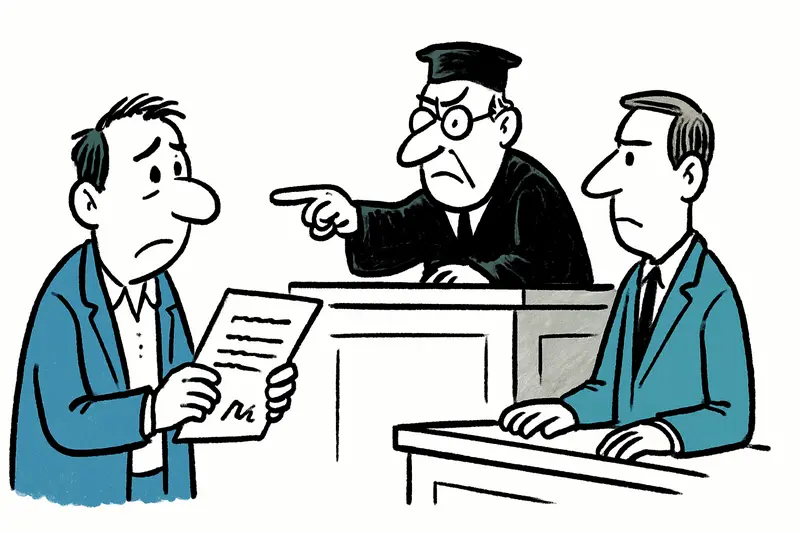
Indictment in Palma: German entrepreneur accused of deceiving court with forged payment receipts
Indictment in Palma: German entrepreneur accused of deceiving court with forged payment receipts
A dispute over around €15,000 for electrical services has triggered an indictment in Palma for forgery and attempted fraud in proceedings. The prosecution is seeking prison time and fines. What does this mean for creditors and the courts on the island?
Indictment in Palma: German entrepreneur accused of deceiving court with forged payment receipts
At the core: €15,000, three receipts, questions for our justice system
An ordinary business transaction, as commonplace as an invoice after completed electrical work, took a serious turn this summer in Mallorca. According to information from the hearing in Palma, a German real estate entrepreneur is accused of presenting three payment proofs that appear not to be genuine. The amount in question is around €15,000. The public prosecutor is seeking a prison sentence of two years and eight months as well as fines.
Key question: How can a court reliably distinguish between an authentic receipt and a fabricated copy without placing small creditors at a disadvantage?
Briefly on the sequence of events: The construction and electrical work is said to have been carried out in 2024. When the invoice remained unpaid, the service provider filed a lawsuit to claim the money owed. During the proceedings, three documents reportedly appeared that were supposed to prove payment. A handwriting and calligraphic expert opinion suggested that these receipts did not originate from the alleged signer. From this, the court investigations developed an indictment for forgery and attempted fraud in proceedings, as in cases reported in Charly in court in Palma: When stories collide with bank statements.
Critical analysis: At first glance this sounds like a clear case of fraud. In practice, however, the problems run deeper. Courts rely on written documents; often a judge decides on monetary claims based on the file without speaking personally to craftsmen, suppliers, or small businesses, a problem evident in Handyman scam in North Mallorca: arrest, unanswered questions and what residents should do now. If receipts are accepted at face value, a systemic flaw arises: whoever submits well-prepared false documents can buy time or at least delay a claim.
What is often missing in public debate: the perspective of local tradespeople. An electrician from the west of the island who parks his van outside the workshop and works with oil-stained hands does not have expensive digital payment confirmations. His proof of payment consists of cash receipts, transfer slips and phone calls. If his statement is set against an apparently neatly printed document, he often loses out — even if he is honest; cases such as Employee allegedly defrauded company in Palma with forged invoices for €150,000 underline this imbalance.
An everyday scene in Palma: taxi drivers step out in front of the courthouse, and the smell of espresso and roasted almonds from a stall draws those waiting. An older small business owner leans against the wall, holds the invoice in his hand and watches the hearing begin. His concern is not theoretical but whether he will ever see his money.
Concrete approaches: First, courts must consistently request digital banking data in doubtful cases, such as bank statements with corresponding transactions. Second, there should be an easy-to-use requirement to present original receipts — copies without proof of authenticity should carry less weight. Third, judges could order a quick, independent forensic review of documents at an early stage of proceedings, financed via court-held cost accounts so small creditors do not have to advance funds. Fourth: better information offers for craftsmen and small businesses in Mallorca on how to format invoices securely, document payment channels and conduct legally sound dunning procedures.
Also relevant for the rule of law is the proportionality of the sanction. Forgery is serious, no question. At the same time, penalties should be transparently justified and the proceedings must preserve all defense opportunities. Complaints, expert reports and investigations must be comprehensible so that neither those affected nor observers get the impression that the justice system clings to formalities or is dazzled by doctored papers.
For Mallorca the case has a second dimension: trust between clients and local service providers is an economic asset. When payments are disputed and documents cast in doubt, the entire network suffers — from the small electrician in Sóller to the property management in Portixol. A transparent, fast verification procedure therefore supports not only the administration of justice but also the local economy, as discussed in 25 Million in Focus: Trial of Matthias Kühn in Palma and What the Island Should Learn.
Concise conclusion: This is not only about an alleged fraud but about how robust our everyday system of payment evidence is. Judicial verification mechanisms must be practicable and affordable — otherwise the one who skilfully falsifies paper will prevail because the other cannot prove otherwise.
What happens next: The court must set a date for the main hearing. Until then the allegations remain allegations, and the procedure is the only way to bring clarity. For the island's craftsmen, it is a reminder: documentation matters. For the courts, it is an impetus to modernize procedures and document checks.
Frequently asked questions
How do Mallorca courts verify the authenticity of payment receipts?
What should small contractors in Mallorca keep to prove payments?
What penalties can occur for forging receipts in Mallorca?
Why is reliable payment evidence important for Mallorca's local economy?
What practical steps can Mallorca courts take to help small creditors in payment disputes?
What should Mallorca tradespeople know about documenting invoices securely?
How might a courtroom handle rapid verification of documents in Mallorca?
What happens next in the Palma case after the hearing start?
Similar News

Control with a Mask in Santanyí: Protest, Culture or Administrative Offense?
In Santanyí the local police escorted a traditionally masked activist away. Was it an identity check, an administrative ...
Up to €9,000 Fine in Inca: Why Wet Wipes Can Blow Up the Sewers — and What We Should Really Do
The municipality of Inca warns of blockages caused by wet wipes — fines of €300 to €9,000 are possible. A reality check:...

World Cup Trophy in Palma: Two Days Up Close
The World Cup trophy is coming to Palma at the end of October: two days on display at City Hall, and on 31 October photo...

End of October: Can you still swim in the sea in Mallorca?
The late-autumn sun still warms the air and the sea has retained its summer heat—many people don't pack away their swimw...
Years of abuse in Costa de la Calma – Neighbor calls Guardia Civil
In a villa in Costa de la Calma a neighbor alerted the Guardia Civil: a 19-year-old woman reported years of violence by ...
More to explore
Discover more interesting content

Can Cap de Bou

Townhouse Lleo 72
