
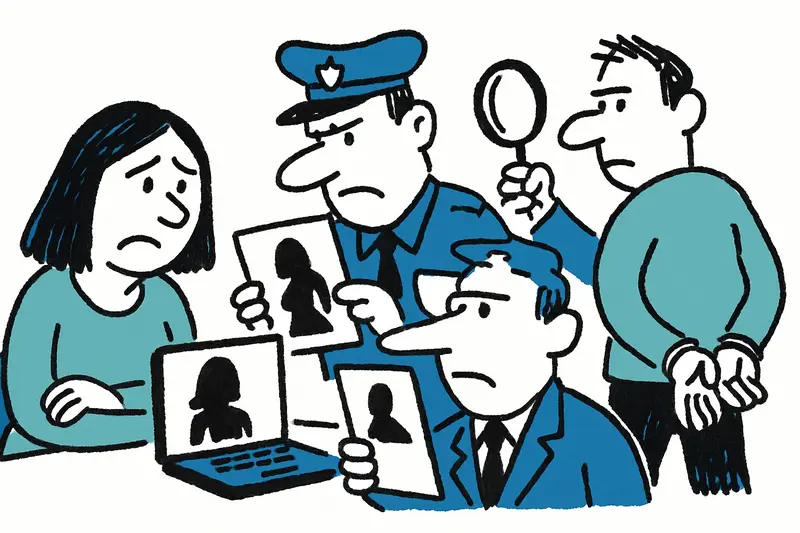
Investigations in Palma: What the Fernandes‑Ulmen Case Reveals About Protection Gaps in Deepfakes and Violence
Investigations in Palma: What the Fernandes‑Ulmen Case Reveals About Protection Gaps in Deepfakes and Violence
A trial in Palma brings Spain's protective mechanisms against digitally sexualized violence into the spotlight. What lessons can be drawn for Mallorca and Germany?
Investigations in Palma: What the Fernandes‑Ulmen Case Reveals About Protection Gaps in Deepfakes and Violence
Key question: Does Spanish law really protect victims better — and is that enough in the age of AI?
In the early afternoon, when buses slow down at Passeig del Born and the voices from cafés blend, something is being discussed on Mallorca that rages on social networks and ends up in court files: a complaint by a woman who lives here against her former partner over allegedly AI-generated nude images and other criminal allegations. The case has been proceeding as a preliminary investigation since December 2, 2025, under file number DPA 1365/2025 before a court in Palma. In Spain, such preliminary investigations are confidential; only involved parties can access the files.
The central question remains: Why do victims like her turn to Spanish courts, and what does that say about the state of our legal systems? In practice, Spain is ahead in several areas: the law against gender-based violence has existed since 2004, there is a national observatory, and technical measures such as electronic ankle monitors for at-risk persons have been introduced over the years. As of early 2024, authorities reported that more than 4,000 such systems were in use. There are also nationwide specialized court divisions, trained judges, and crisis centers and hotlines reachable around the clock in dozens of languages; recent reporting on a suspended sentence after abuse in Palmanova has prompted debate about how outcomes match those structures.
That sounds like functioning infrastructure. Still, one must not romanticize: laws and devices alone do not solve a problem rooted deeply in relationships, power structures, and digital business models, and research shows how prostitution on Mallorca is shifting into the digital realm. The numbers show progress — 48 women killed by a partner or ex-partner last year in Spain, the lowest value since recording began. For comparison: in a neighboring country, 132 fatal cases of domestic violence were recorded in 2024. These figures are stark and put any introduced measure into perspective; they are no reason for complacency.
Part of the problem lies in the speed of technology. Deepfakes can be created and spread with free tools long before courts or police can react. Spain is currently preparing a draft law that would criminalize the use of AI to generate images or voices without consent; consent is excluded for minors under 16, and violations could carry up to two years in prison. At the same time, the data protection authority has shown that existing rules can be applied: in autumn 2025 it fined a private individual €2,000 for publishing an AI-generated nude image. Such individual cases are important but insufficient to fundamentally change systems.
What is often missing in public discourse is practical evidence gathering and cross-border coordination. A quick interim injunction does little good if the image has already been shared across multiple platforms in several countries. Authorities and victims need accelerated access to server logs, clear rules for platform takedown requests, and agreed procedures between states. On Mallorca this means concretely: investigators and judges here must work closely with colleagues in the countries where the platforms are based, and there need to be binding agreements so that evidence does not sink into jurisdictional disputes; the limits of enforcement are shown in cases such as a court in Palma convicting a bar owner for secret video recordings, which required extensive cross-agency cooperation.
Another gap is victim support beyond legal measures. Hotlines and crisis centers are important, yet many victims report that technical assistance is lacking: fast help removing content, understandable legal advice, and psychosocial support with digital expertise. In everyday Palma one often meets people shuttling between town hall, law firms and community meetings — they need straightforward, centralized support, not scattered services.
Concrete proposals that could have rapid impact on Mallorca and elsewhere: 1) legal clarifications that define platform liability for deepfakes and force accelerated takedown procedures; 2) binding bilateral agreements for digital evidence preservation; 3) expansion of specialized digital forensics teams within police and prosecutors' offices; 4) state grants for civil society support centers that provide technical takedown assistance; 5) mandatory training for judges on AI techniques and evidentiary issues; 6) low-threshold prevention in schools using real cases — not a wagging finger, but practical tools for children and parents.
One more thing: protection must not be merely symbolic and fast. In Spain courts can issue protective orders within hours; those who know the system and have access to legal counsel benefit from this. On Mallorca you often see people finding their way to an office or counseling center only weeks later. That must change — quick help needs visible pathways, information campaigns and a contactless emergency access route for digital cases; recent reporting on the trial over secretly installed cameras north of Palma underlines the need for faster, more cohesive support.
Conclusion: The case currently under investigation in Palma makes clear that Spain is ahead in some instruments. It also shows that technology, law and everyday practice must work better together. Someone sitting at a café table in Mallorca smelling the sea should not only talk about legal progress but about practical steps so that digital violence is prevented more quickly and victims are protected sooner. Without such steps, good intentions remain mere declarations, not protection.
Frequently asked questions
How can someone in Mallorca report AI-generated nude images or deepfake abuse?
Are deepfakes and AI-generated nude images illegal in Spain?
What legal protection do victims of gender-based violence have in Mallorca?
Can Mallorca police and courts act fast enough in deepfake cases?
What should I do in Mallorca if intimate images are shared online without consent?
Is there support in Palma for victims of digital violence?
Why are deepfake cases such a problem for Mallorca and the courts?
What is the best way to get help quickly after digital abuse in Mallorca?
Similar News
Palma, Palma de Mallorca, Palma‑Mallorca: What is it really about?
The debate over the city's name is more than grammar: it concerns identity, law and branding policy. A sober reality che...
Warning to Bathers: Nipping Fish in Cala Major and Other Coves — a Reality Check
In Cala Major and several beaches around Mallorca, bathers report painful “nips”. Who are the animals, why are they gett...

Rental Car Theft in El Arenal: What This Incident Reveals About Our Gaps
A teenager steals a running rental car in El Arenal, flees on foot, climbs over walls and is caught by the Guardia Civil...
Red Rope in Palma's Library: What Helps Against Selfie Tourism — and What's Missing
Palma's city library cordoned off an area with a red rope to keep selfie tourism away from reading and working activitie...

Fort San Carlos: Museum, Harbor Dispute — and a Conflict That Demands Answers
The military museum at Fort San Carlos sits right on Palma's harbor, with unexpectedly quiet rooms filled with cannons a...
More to explore
Discover more interesting content

Can Cap de Bou

Townhouse Lleo 72
