
Knife attack in Son Ferriol: Arrest after attack on father and grandfather
Knife attack in Son Ferriol: Arrest after attack on father and grandfather
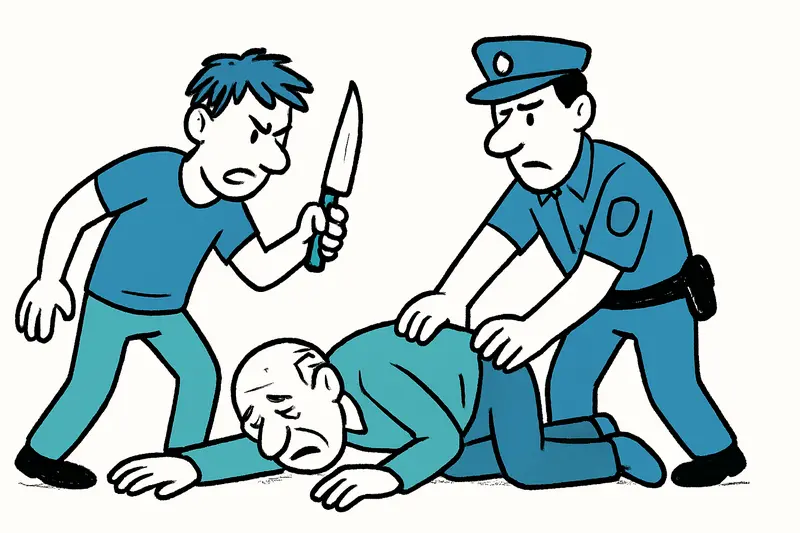
In Son Ferriol a 25-year-old was arrested after allegedly attacking his father and grandfather with a kitchen knife in their shared apartment. The grandfather is critically injured at Son Espases hospital. Our reality check asks: What is missing in the prevention of domestic violence and the care of mentally disturbed people in Mallorca?
Knife attack in Son Ferriol: Arrest after attack on father and grandfather
Reality check from the neighborhood
Key question: How could such an attack occur in an apartment in Son Ferriol, and which gaps in prevention, care and neighborhood protection must we finally name in Mallorca?
On 22 February 2026 the Spanish National Police reported: In a multi-family building in Son Ferriol a 25-year-old allegedly attacked his father and grandfather with a kitchen knife. The father sustained multiple injuries, the grandfather was seriously injured and taken to the emergency department. Police arrested the suspected perpetrator; he was transferred to the psychiatric ward of Son Espases hospital. These are the verifiable facts.
The brutal violence in a family home hits an otherwise quiet neighborhood; other recent local cases covered by our site, such as Arrest after knife attack in Pere Garau: How safe is Palma's neighborhood? and Stabbing in Port d’Alcúdia: 49-year-old in custody, underline that such incidents can occur in different settings across the island. Anyone entering the small kiosk on the corner of Carrer de Son Ferriol in the morning hears buses, the clinking of coffee cups and sometimes snatches of conversation from house entrances. It is precisely this everyday calm that makes such incidents particularly unsettling: to neighbors everything seems normal until the sirens arrive.
Critical analysis
The facts leave several questions open: Were there prior signs of psychological problems or domestic tensions? Did neighbors, school, employer or health services have cause to intervene earlier? In Spain there is a complicated interface between police work, social services and the health system. A patient is only brought into psychiatric care when certain criteria are met; this can sometimes result in people with unstable mental states not receiving adequate support in daily life. Coverage of similar cases, for example Pre-trial Detention after Knife Attack in Costitx — What Was Missing to Prevent It?, raises comparable questions about missed prevention.
Violent acts in homes often involve dynamics that are underrepresented in public debate: family shame, fear of stigmatization and lack of knowledge about available help. That makes preventive work more difficult, because warning signs are overlooked or trivialized.
What is missing in the public discourse
We talk a lot about repression — more police, tougher sentences — but rarely concretely about the bridges between mental health care and social prevention. In Son Ferriol not only are resources lacking, but also visible, easy-to-access contact points: a daytime psychological consultation in the neighborhood, an evening emergency hotline for relatives, and information in the mother tongue for families with a migration background.
The role of the neighborhood is also often underestimated. In apartment blocks with older residents, low-threshold neighborhood networks would be useful: volunteers who regularly check in briefly so that problems become visible earlier.
Concrete approaches
1) Expand outpatient crisis intervention: mobile teams that respond quickly to reports of mental health crises and perform professional on-site assessments. 2) Strengthen interfaces: clear protocols between health services, social work and police so that information can flow more quickly — while respecting the law and data protection. 3) Promote neighborhood initiatives: community centers in Son Ferriol should offer information days on how to recognize warning signs and what steps are possible. 4) Protection for vulnerable elderly: programs that better involve older residents and provide regular health checks. 5) Training for police and emergency services in de-escalation and operational tactics for domestic violence incidents with a psychological component.
Everyday scene
Imagine: it is a cold morning, the streetlights still glow faintly, a neighbor hangs out laundry, children run to the bus stop. An ambulance passes by; seconds later people stand in stairwells and exchange worried looks. Such scenes linger in memory — they change how we perceive our neighborhood.
Concise conclusion: The arrest stabilizes the immediate situation but does not provide answers. Son Ferriol does not need blanket mistrust, but better-networked help, more low-threshold services and a culture that looks beyond shame. Only then can violent incidents in homes not only be punished but become rarer.
We will follow up and report when authorities or health services publish further information.
Frequently asked questions
What happened in Son Ferriol, Mallorca, in the reported knife attack?
Is Son Ferriol in Mallorca usually considered a quiet neighborhood?
What should families in Mallorca do if someone shows signs of a mental health crisis?
How do police and health services usually respond to violent incidents with a possible psychiatric component in Mallorca?
What warning signs in a Mallorca apartment building should neighbors take seriously?
What makes a stabbing in Palma or other Mallorca neighborhoods so difficult to prevent?
What support services would help residents in Son Ferriol, Mallorca, after a violent incident?
Where in Mallorca was the suspect after the Son Ferriol attack?
Similar News
Mistaken identity with fatal consequences: Brutal assault in S'Aranjassa — what's missing in the follow-up?
At S'Aranjassa a visitor to a finca was tied up, beaten and thrown out of a van. Three men have been arrested, including...
High heel slips, car accelerates: accident on Camí de Son Hugo
A woman lost a high-heeled shoe on the forecourt of the sports facility at Camí de Son Hugo. The car accelerated, mounte...
Phone Scam: How Two Hotel Employees at Playa de Palma Lost Thousands of Euros
One morning in September, two reception employees at Playa de Palma were pressured by alleged alarm-company staff — in t...
When the Wallet Becomes a Danger: Attack in Peguera and Lessons for Mallorca
In Peguera, two women are said to have stolen the wallet from a 75-year-old German couple. When the victim intervened, t...
Plata stays Plata: Young people take over, Llonguets remain
A small bar on Carrer de l'Argenteria will continue: Tolo Serra hands the place over to young Mallorcans at the end of t...
More to explore
Discover more interesting content

Can Cap de Bou

Townhouse Lleo 72
