
Mallorca First — popular slogans, complicated reality
Mallorca First — popular slogans, complicated reality
A new political actor demands priority for locals, its own police and less tourism. Can this work, or is it merely symbolic politics? A reality check with an everyday scene, missing facts and concrete solutions.
Mallorca First — popular slogans, complicated reality
A reality check on demands to limit immigration, a local police force and cuts to tourism
Can a policy that mobilizes with slogans like Mallorca First solve the island's pressing problems without excluding people and without ignoring legal obstacles? That is the guiding question since a new political movement, as reported in Posters, Provocation, Polarization: How Mallorca's Streets Become a Campaign Ground, began demanding much tighter control of incoming residents, priority for long-term inhabitants and a reduction of tourist capacity.
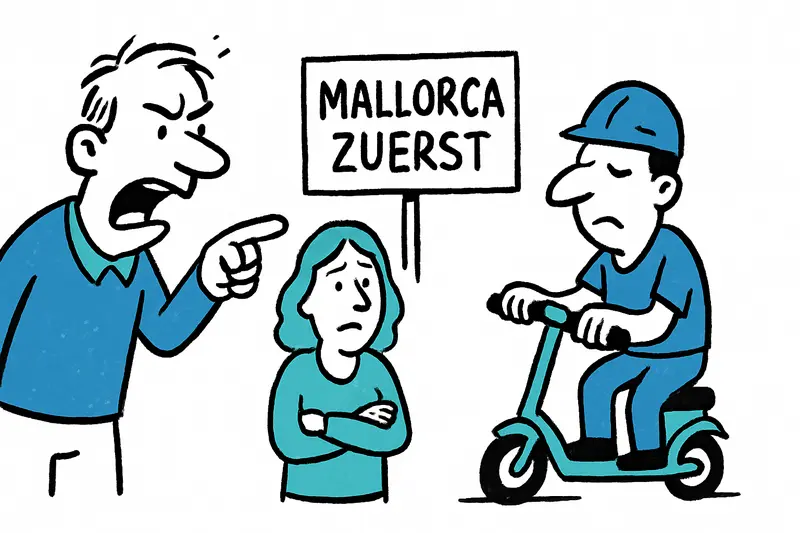
The promises sound simple at first glance: fewer newcomers, priority for public services for people with long-term residence, language skills as an access requirement, a regional police force and a ten percent reduction in available beds. In the Plaça de la Porta Pintada in Palma you hear scooters in the morning, voices from cafés and the skeptical looks of local shopkeepers when such demands are voiced. The picture is typical: people groaning under rising rents, as detailed in Balearic Islands in the Price Squeeze: Who Can Still Afford Mallorca?, facing a service and tourism sector that depends on outside workers, and for an analysis of the forces behind mass tourism see Reality Check: Why Mallorca Can Hardly Escape Massification.
Critical analysis: legal and practical limits
First: competencies. The Balearic Islands are part of the Spanish state. The security structure — National Police and Guardia Civil — belongs to the state apparatus. A separate island police force would be negotiable, but cannot be created overnight; it would require constitutional steps, recruiting personnel, financing and coordination with Madrid. Second: housing and the labour market are closely intertwined. Anyone who wants to limit in-migration must address the reasons for it: a lack of affordable housing, precarious seasonal jobs and a shortage of long-term prospects in other sectors.
Third: the social compatibility of access restrictions. Rules that tie benefits to length of residence or language tests cut deep into social law. They can push people into precarious situations and carry legal risks. Such measures often remain silent about transitional solutions for refugees, seasonal workers or families already living here.
What is missing from the public debate
The debate too often stays at the level of slogans. There is a lack of reliable figures: how many people actually came to the island for work, how many for second homes? What effect would an annual growth limit of 20,000 people have on the labour market, schools and clinics — and who would enforce it? Also hardly discussed is the role of owners, investors and short-term rental platforms in pressuring the housing market. This is examined in Who Shapes Mallorca's Streets? A Reality Check on Island Demographics.
An everyday scene from Palma
Early evening on the Passeig del Born: a teacher leaves the school with a bag of pa amb oli, two colleagues discuss class sizes while a construction worker who has lived on the island for five years passes by on his e-scooter. This scene shows how interwoven the problems are: education, work, housing. A simple political divide between locals and newcomers falls short.
Concrete solutions
1) Data-driven analysis: immediately set up an independent observatory that transparently records in-migration, labour migration, the rental market and tourism capacity. Decision-makers need these figures as a basis.
2) Regulate the housing market: stricter rules for holiday rentals in municipalities with housing shortages, targeted support for social housing, vacancy taxes on permanently unused properties and support programmes for young families and workers.
3) Labour market and education policy: better organisation of seasonal work through regulated contracts, qualification programmes for locals in growing sectors (renewables, care, IT) and language and integration offers for newcomers linked to concrete employment perspectives.
4) Smart tourism management: control capacity through licensing, variable taxation in peak season, and promotion of quality offers instead of pure bed-count politics. A blanket ten percent reduction requires precise impact calculations; targeted measures in problem areas are preferable.
5) Legal and administrative-political steps: if the idea of a regional police force is pursued further, a phased plan is necessary: feasibility study, negotiations with the central government, budget planning and a municipal pilot project.
6) Local participation: neighbourhood, worker and business councils should decide on practical measures — acceptance is not created from above but in local assemblies.
Concise conclusion
Those who take concerns about rising rents, overloaded schools and hospitals seriously cannot accept populist answers as a substitute for practical politics. Demands for priority for locals and drawing new boundaries may mobilise, but they neither solve the causes nor overcome the legal and practical hurdles. What would truly help is a combination of reliable data, targeted housing and labour-market policies, fair tourism management and honest negotiation with the state. In short: more planning, fewer slogans. On Mallorca, where the sounds of construction sites, sea waves and late deliveries are part of daily life, we need solutions that are sustainable in the long term — not quick slogans.
Frequently asked questions
What are the legal hurdles to creating a regional police force on Mallorca?
Why don't slogans like Mallorca First solve Mallorca's housing and tourism problems?
What concrete steps could Mallorca take to manage housing and tourism more effectively?
How would limits on in-migration affect Mallorca's economy and services?
What role do short-term rental platforms play in Mallorca's housing market?
What housing and labor measures could help young families and workers in Mallorca?
Why is local participation important in shaping Mallorca’s policies?
What would a sustainable approach look like for Mallorca amid rising rents and crowded services?
Similar News

Born conflict: Who owns Palma's most elegant promenade?
The city ordered bars on Passeig del Born to dismantle their terraces ahead of a planned sit-in. Residents, restaurateur...

Unidentified body near Tolleric: How can a person be overlooked in the middle of the island?
An older man was found dead in a patch of woodland near the cliffs of Tolleric. He had no identification, showed signs o...
Water shortage in Mallorca: Reserves shrinking, answers lacking
Despite rainfall, reservoir volumes remain low: Gorg Blau falls, Cúber rises slightly — together only 39.9 percent. Key ...
Arrest in Frankfurt after Mallorca Flight: What the Case Reveals About Gaps in the System
A 67-year-old Dutchman was arrested during a check in Frankfurt. Behind the scenes is an international warrant from Spai...
Chairs gone, debate remains: Who can really use Palma's Born in the evening?
The city had terraces on Passeig del Born dismantled shortly before a planned public action. A conflict between restaura...
More to explore
Discover more interesting content

Boat Tour with BBQ along Es Trenc Beach

Private transfer from Mallorca Airport (PMI) to Pollensa
