
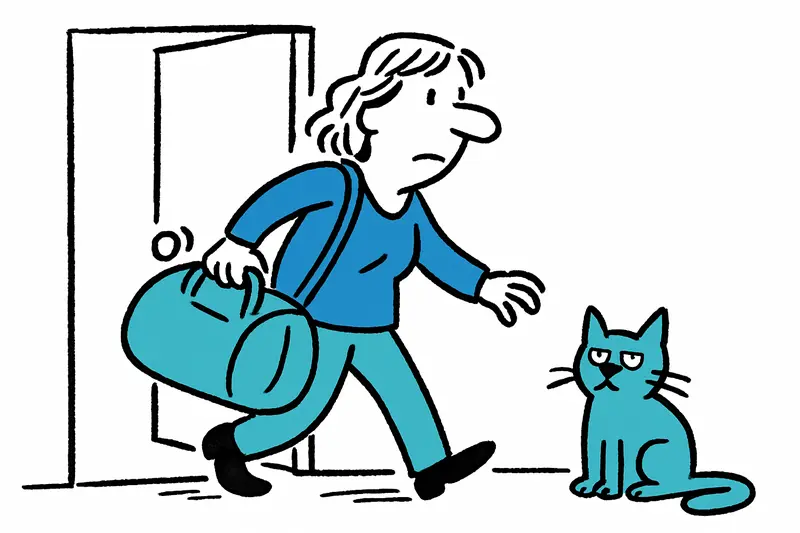
Leaving Pets Alone in Mallorca: What the New Law Really Means
Leaving Pets Alone in Mallorca: What the New Law Really Means
The Spanish animal welfare law sets clear time limits: dogs may be left alone for a maximum of 24 hours, cats and other pets for three days. What's missing from the discussion — and how can you avoid costly mistakes?
Leaving pets alone in Mallorca: What the new law really means
Key question: How practical is the new supervision requirement for dogs, cats and other pets on an island with many short trips?
Since the new rules came into force, strict time limits apply: dogs may be left alone for at most 24 hours, cats and similar pets up to three days. Anyone who exceeds these periods risks fines of several hundred up to 10,000 euros and, in extreme cases, the removal of the animal from the owner's care. These are hard facts — and they have tangible consequences for everyday life and holidays in Mallorca.
Critical analysis: The rule is clearly formulated, but its application raises questions. On one hand there is the legitimate protection of a sentient being; on the other, numerous everyday situations in which owners find themselves in a dilemma. Someone traveling with a dog or cat to Mallorca and flying to Barcelona for a weekend, a hospital stay being required, or a tradesperson suddenly needing a week — how will this be handled in practice? Authorities need staff and clear protocols to distinguish between negligence and unforeseeable emergencies. Without clear guidelines, arbitrary reports and unsettled citizens are likely.
What's missing from the public discourse: So far it is mainly about penalties. Hardly any discussion is about support systems for owners: emergency care networks, affordable boarding kennels in rural areas, an official list of vetted pet sitters in every municipality, or rapid aid for older people who cannot place their dog at short notice. The question of how holidaymakers with pets in vacation rentals are treated rarely comes up either — yet Mallorca is an island with many holiday-related accommodations and short departures, and recent moves by platforms such as Airbnb to remove listings without a registration number complicate the picture.
Everyday scene from Palma: Early in the morning on the Passeig Mallorca, bicycle bells, the clack of a bakery door and a small pinscher tugging impatiently on the leash. The owner explains between two dogs that she has planned a two-day trip for tomorrow and has asked a neighbor to check in twice a day. This is exactly the kind of everyday arrangement the law is meant to encourage — yet the worry remains whether that will be enough if an official later decides otherwise.
Concrete problems: The provision requires "active and effective supervision". Electronic cameras, automatic feeders or neighbor checks are, according to interpretation, not sufficient. What counts as "social contact" for dogs is not always clear. A short look at the surveillance camera is no substitute for taking them for a walk. This creates practical challenges for working people, commuters and owners of second homes.
Concrete solutions:
1) Municipal emergency lists: Municipalities should collect vetted pet sitters and short-term beds and make them available online, including prices and contact details. A phone call to the town hall could help faster in future than a complaint.
2) Information campaigns: Short information booklets in several languages (German, English, Spanish) in health centers, town halls and at the airport. Many people do not know that technical monitoring is not considered supervision.
3) Proof regulation: For exceptional situations (hospital stay, traffic accident) a simple documentation should be sufficient so that no immediate penalty follows — with deadlines for subsequent submission.
4) Support for interim solutions: Subsidies or taxi vouchers for transport to a boarding kennel, especially for older owners with low incomes. Cooperation between municipalities and private kennels could reserve places.
5) Uniform application: A clear fines sheet that communicates from when a warning, when a fine and when seizure are threatened. This makes decisions comprehensible and reduces arbitrariness.
Why this matters: Mallorca is not a metropolis without community structures — here neighbors, dog sitters and family networks help. But precisely these informal solutions are not available to everyone. Seasonal workers, new residents or tourists are often left alone. A law that protects must not drive people into illegality or existential hardship.
Punchy conclusion: The new rules have the right intention: animals should not be neglected. The challenge is implementation. Fines alone are not enough. On the Plaça Cort as in the countryside of Santanyí, practical infrastructure, clear rules and humane exceptions are needed. Otherwise outraged neighbors, unnecessary reports and owners who panic for fear of punishment are likely — the opposite of what the law aims to achieve.
Practical tip at the end: If you need to be away for longer, plan in advance: a list of three reliable contacts, phone numbers of a nearby boarding kennel (Son Servera, Manacor, Palma), and a small emergency folder with vaccination records and microchip number. That protects against trouble — and costly fines.
Frequently asked questions
How long can I leave a dog alone in Mallorca under the new rules?
Can I leave my cat alone for a weekend in Mallorca?
What happens if you leave a pet alone too long in Mallorca?
Does a camera or automatic feeder count as supervision for pets in Mallorca?
What should I do in Mallorca if I need to be away unexpectedly and my pet is home alone?
Where can I find short-term pet care in Mallorca if I travel for a few days?
What does the new pet law mean for holiday rentals in Mallorca?
How should pet owners in Mallorca prepare for being away longer?
Similar News
When the Wallet Becomes a Danger: Attack in Peguera and Lessons for Mallorca
In Peguera, two women are said to have stolen the wallet from a 75-year-old German couple. When the victim intervened, t...
Plata stays Plata: Young people take over, Llonguets remain
A small bar on Carrer de l'Argenteria will continue: Tolo Serra hands the place over to young Mallorcans at the end of t...
Unnoticed in the Luggage Compartment: How a Boy Traveled More Than 100 Kilometers in a Team Bus
A minor traveled in the undercarriage of a team bus for more than 100 kilometers until his cries for help were heard. A ...

Cap Vermell Grand: Second Michelin Key – a Gift for the East
The Cap Vermell Grand in Capdepera has been awarded its second Michelin key. For the region this elevates the luxury off...
Eurowings lets four aircraft carry names – a friendly idea that also reaches Mallorca
Eurowings is launching a campaign: four Airbus A320s are to carry the first names of people who help others in everyday ...
More to explore
Discover more interesting content

Can Cap de Bou

Townhouse Lleo 72
