
Llucmajor Faces Waste Chaos: Why a Strike Is About More Than Just the Smell of Trash
Llucmajor Faces Waste Chaos: Why a Strike Is About More Than Just the Smell of Trash
UGT has announced an indefinite strike of Llucmajor's refuse collectors. A mediation attempt is scheduled. Why the problem runs deeper than negotiated wages and how the municipality might respond.
Llucmajor Faces Waste Chaos: Why a Strike Is About More Than Just the Smell of Trash
A mediation hearing is meant to be the last resort. What would happen if the bins stop being collected and what is missing from the debates.
In front of Llucmajor's small town hall façade, on the plaza before the Ayuntamiento, the smell is sharper than usual on an ordinary afternoon. Seagulls circle, cars honk, and the bins at the roadside are overflowing. The union UGT has now announced that if no agreement is reached, municipal refuse workers could launch an indefinite strike. A final mediation attempt has been scheduled. If no agreement is reached, the strike is planned to start next Monday.
Key question: What would an indefinite refuse strike in a municipality like Llucmajor concretely mean—for residents, tourism and public health—and how can the conflict be resolved sustainably?
Briefly: Workers accuse the contractor of failing to implement a wage agreement from last year. The contractor, in turn, claims the city administration is not meeting its payment obligations and wants to accelerate the tendering of the service. Workers also demand extended weekly rest periods. So far the administration has remained reserved in its statements. A mediation hearing has been set for Thursday at 9:30 a.m.
Critical analysis: At first glance this appears to be a classic labor dispute. On closer inspection, however, it reveals a tangle of outsourcing mechanisms, public budgeting and short-sighted procurement practices. When a contractor complains that the municipality is not honoring its commitments and the municipality remains silent, a vacuum emerges between collective bargaining law and procurement law. This means workers end up bearing the consequences while the city administration responds cautiously for political reasons. The logic of rapid re-tendering favors providers that calculate with low wage costs; this may yield short-term savings but creates long-term staffing and quality risks.
What is missing from the public discourse: First, few voices address the health and environmental consequences of a prolonged strike. Rats, mosquitoes and foul odors are not just a nuisance; they carry infection risks, especially in residential areas and around schools. Second, the impact on the tourism economy is insufficiently considered: restaurants, vacation rental hosts and small shops are directly affected when sidewalks, parking areas and collection points become littered, as highlighted by Foul-Smelling Promenade, Empty Promises: Hoteliers in S'Arenal Put Pressure on Llucmajor. Third, there is a lack of clear discussion about procurement practices themselves: How are wage increases and disposal requirements accounted for in contracts? Who covers cost increases in the event of unforeseen events? A similar problem appears in Binissalem Suffocates in Waste: Who Cleans Up - and Who Pays?.
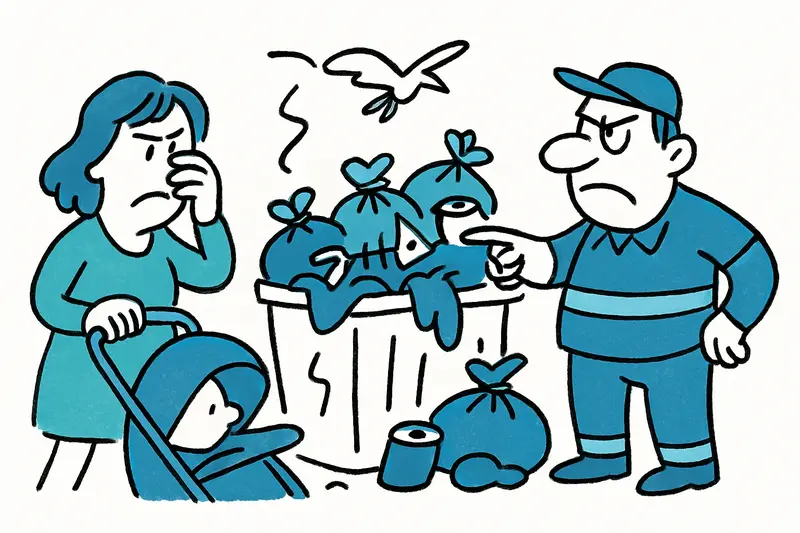
Everyday scene from Llucmajor: Early in the morning you see a café cleaner on Carrer Major standing perplexed next to a pile of uncollected sacks. A mother pushes her stroller past and covers her nose. Hotel guests on the access road to the airport look puzzled as to why a normally well-kept section has suddenly become littered. Similar scenes were reported in s'Arenal in Trash Chaos in s'Arenal: Residents Mobilize — Demonstration in Front of the Town Hall. Such scenes will become everyday life in a few days if the bin collectors stop running.
Concrete solutions: 1) In the short term, the municipality should activate an emergency plan: prioritize collections in residential and tourist zones, set up temporary covered collection points, deploy municipal machinery and, if necessary, award short-term contracts to additional certified companies. 2) On the mediative level, the mediation should take place transparently, ideally with an independent third party as moderator and a clear deadline for binding commitments on wage implementation and municipal payment obligations. 3) In the medium term, procurement practices must be revised: contracts should include minimum standards for wages and rest periods as well as mechanisms to adjust to cost changes. 4) In the long term, the island needs a regional waste strategy that provides risk reserves and reduces dependence on individual contractors.
Practical measures that can take effect immediately: set up a hotline for citizen complaints, provide free drop-off points for commercial businesses, increase enforcement against illegal dumping during a strike and communicate clearly which streets will be kept clean and when.
Why this matters: A strike affects not only employees and their income. It reveals how vulnerable municipal services have become when payment responsibilities, procurement and working conditions are not considered together. A solution that addresses only wages or only procurement policy remains fragile.
Conclusion: Llucmajor is at a point where immediate measures are necessary, but sustainable answers are even more important. The mediation on Thursday is a chance to prevent a strike. If it fails, the result must not simply be a pile of rubbish, but a wake-up call for a serious reform of waste management logic. Otherwise everyone will be left with the smell—not just the trash can.
Frequently asked questions
What happens in Mallorca if refuse workers go on strike?
How long can an indefinite waste strike in Mallorca last?
Is it safe to leave rubbish outside during a strike in Mallorca?
How can a rubbish strike affect tourism in Mallorca?
What is happening with the waste dispute in Llucmajor?
Which areas in Llucmajor would be hit first by a bin collection strike?
What can local councils in Mallorca do during a waste strike?
What should residents in Mallorca do if rubbish collection stops?
Similar News

The Maricarmen Case: Why an Eviction Is Forcing Spain's Housing Debate
Images of an 87-year-old woman on a stretcher have sparked a debate in Spain that also runs deep in Mallorca. Who protec...

Parking dispute in Els Hostalets: When a gap leads to violence
A parking dispute on Calle Aragón escalated into a mass brawl at night. Why do trivial conflicts here turn bloody so qui...

Bodycams in Palma: More clarity needed so surveillance doesn't become the norm
Palma's local police equip UII officers with Axon Body 4 cameras. Useful for evidence collection — but specific rules on...
When the Bread Door Closes: Why Maria de la Salut Lost Its Last Bakery
The only bakery in Maria de la Salut, a sales outlet of Forn de ca'n Joan Terès from Palma, has permanently closed. What...

Ancient Piece Brought to Light: Guardia Civil Recovers Roman Anchor Fragment off North Coast of Mallorca
Divers from the Guardia Civil recovered a massive iron piece from Roman times off Mallorca's north coast. The roughly 35...
More to explore
Discover more interesting content

Can Cap de Bou

Townhouse Lleo 72
