
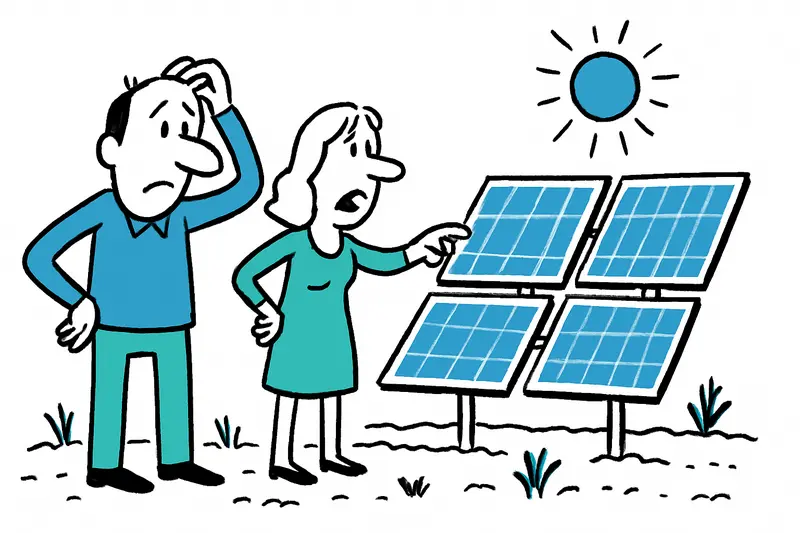
Llucmajor: A Wave of Solar Parks — How Much Land Is Too Much?
Llucmajor: A Wave of Solar Parks — How Much Land Is Too Much?
In Llucmajor, hectares of land are currently being rezoned for several large photovoltaic plants. Approvals come with conditions — but many questions remain unanswered. A reality check on site.
Llucmajor: A Wave of Solar Parks — How Much Land Is Too Much?
Guiding question: How much fertile soil may Mallorca sacrifice to large-scale power production?
The debate over photovoltaics on Mallorca has taken a new turn in recent weeks. In the south of the island several large projects are now gathering together, claiming a total of well over one hundred hectares of landscape: Calablava 4 with 103.69 hectares and 67,232 modules, plus Llucmajor Solar with 39.4 hectares and 70,602 modules — after a reduction from an earlier design of more than 52 hectares and around 92,700 modules. The formal environmental impact decisions have been published; several technical conditions are foreseen. That sounds like progress. In the fields next to the Ma-19, when the heat makes the air shimmer and the cicadas chirp like a metronome, reality scratches at a different picture.
Critical analysis: The official files contain many checks and conditions, but approvals do not automatically resolve the practical conflicts. The municipal administration of Llucmajor has raised concerns: the documents on cable routes and the use of municipal land appear incomplete to them. That is not insignificant. If cable corridors, substations and access roads are to be laid over agriculturally used paths, the usability of the surroundings changes permanently. The positive compatibility decisions often come with phrasing such as “permissible under conditions” — meaning decisions pass responsibility on to later detailed plans.
What is missing in the public discourse: there is a lack of a shared view on cumulative effects. Individual projects may be acceptable on their own, but four large plants in close proximity amount to a spatial cluster that shares infrastructure and shapes the landscape quality across a whole section of the municipality. Also underexposed is the question of soil class. Although it is demanded that areas with high agricultural value be preserved, it remains unclear how this value is to be determined comprehensively and protected in a binding way. Transparency regarding cable routes, duration of land use, decommissioning obligations and ownership structures is often missing in the files, but it is crucial for residents and farmers (Son Bonet at a Crossroads: City Forest or Solar Park?).
Everyday picture from Llucmajor: early in the morning, when the bakery on the plaza takes the first bread out of the oven, you can see the farmers cruising the side roads in their pickups, olive trees, shrubs with wild rosemary and the slightly dusty field paths warmed by the heat. Children play in the shade of the church while tractors turn the soil further out. For many of them the plans are not abstract numbers but changed routes, more noise during construction and the fear that leased plots will be irretrievably lost. This local picture is often overlaid by technical reports — yet it is precisely this life that should be protected first.
Concrete solutions that could take effect immediately: 1) Prioritize roofs and urban areas — hotels, industrial halls and parking lots offer a lot of unused space (Mallorca's roofs remain empty — why the sun goes unused and how the island can change that). 2) Promote agrivoltaics more: systems that combine agriculture and energy production preserve soils and farmers' incomes. 3) Give priority to fallow or regeneration-needing land instead of fertile arable land. 4) Provide clear, publicly accessible plans for cable routes and substations before final approvals are granted. 5) Binding decommissioning and restoration guarantees as well as funds that pay municipalities for landscape maintenance and fire protection after operation. 6) Local participation: cooperative or municipal shares in projects so that profits do not end up solely with investors.
On fire protection and biodiversity: the environmental authority prescribed studies on fire risk and clearances for battery installations; that is correct. In practice, it must be checked whether the proposed barriers of vegetation and buffer zones are professionally planned. Particularly sensitive is the location of a red kite nest, whose protection zone must explicitly be kept free of modules in one project. Such requirements are sensible — but: will they also be monitored and enforced when the big digger rolls in?
What the authorities should do now: order a cumulative overall assessment for the municipal area, write binding criteria for the exclusion of prime agricultural land and set clear rules for cable routes (Building law relaxed: How Mallorca decides between housing and farmland). Fire protection concepts must withstand external expert review, not only that of the project responsables. The municipality should keep a local register of all agreements, lease contracts and compensation commitments, public and easily accessible.
Punchy conclusion: Energy security and climate obligations force transformation — that is indisputable. But Llucmajor must not become a concentration camp for solar pipes and modules in which agriculture, landscape and local quality of life are the losers. Technology alone is not enough; what is needed are solid rules, transparent planning and genuine participation. Only then can solar plants be built without making the island poorer in the long run. The heat shimmers, the cicadas remain; the decision about how the fields will look tomorrow must be made now.
Frequently asked questions
When is the best time to visit Mallorca for beach weather and outdoor activities?
What should I pack for a Mallorca trip?
Are there family-friendly beaches in Mallorca?
What are the must-do outdoor activities in Mallorca?
Is it easy to get around Mallorca without a car?
What should I know about swimming and safety in Mallorca's sea?
Can I do day trips from Mallorca to see more of the island?
What is Mallorca like in winter?
Similar News
Plata stays Plata: Young people take over, Llonguets remain
A small bar on Carrer de l'Argenteria will continue: Tolo Serra hands the place over to young Mallorcans at the end of t...

Unnoticed in the Luggage Compartment: How a Boy Traveled More Than 100 Kilometers in a Team Bus
A minor traveled in the undercarriage of a team bus for more than 100 kilometers until his cries for help were heard. A ...

Cap Vermell Grand: Second Michelin Key – a Gift for the East
The Cap Vermell Grand in Capdepera has been awarded its second Michelin key. For the region this elevates the luxury off...
Eurowings lets four aircraft carry names – a friendly idea that also reaches Mallorca
Eurowings is launching a campaign: four Airbus A320s are to carry the first names of people who help others in everyday ...
From the Reality Studio to the Pitch: Aleks Petrovic Makes Mallorca His Base
The former participant in numerous TV shows moves from Dubai to the island and launches a project with FC Germania Mallo...
More to explore
Discover more interesting content

Can Cap de Bou

Townhouse Lleo 72
