
Son Bonet at a Crossroads: City Forest or Solar Park?
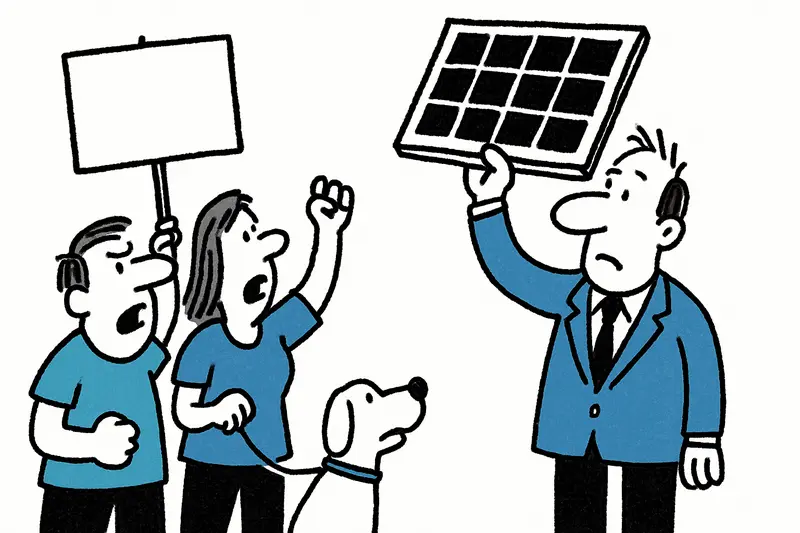
Around 200 residents protested in Son Bonet against plans to build a solar installation on an area designated as public space. Amid flip-flops, dogs and the smell of coffee, the question remains: how can the energy transition be reconciled with protecting urban green spaces?
Son Bonet at a Crossroads: City Forest or Solar Park?
On early Saturday afternoon the meadow next to the small Son Bonet airfield filled with people, voices and the soft drone of occasional propeller engines. Around 200 residents had hung banners reading 'City forest instead of panels' and 'Our green, our air'. It smelled of freshly brewed coffee from a stand on the corner; dogs ran between people's legs, and a child proudly held a handmade sign.
The central question: Who owns public space?
At its core this is not only about solar panels. It is about the legal designation and intended use of a parcel that the municipal land-use plan marks as public space. It is precisely there, protesters say, that the airport operator plans to install a large-scale solar array. The atmosphere at the rally was determined but factual: speeches were given by long-time neighbors, local council members and engaged young people who are imagining a different vision for their neighborhood.
The guiding question is simple to state and hard to answer: Must the energy transition come at the expense of urban green space, or are there workable alternatives that allow for both?
What is often missing from the public debate
In many solar projects, climate and energy arguments play the leading role — and rightly so. But in Son Bonet practical and local aspects come to the fore: How will a solar park change the microclimate? What access routes and maintenance paths are required, and will they bring additional traffic? Who will economically benefit from the installation — the municipality, a private operator, or third parties?
Also little discussed is the issue of land sealing. Large installation areas often mean natural soil is covered. In an inner-city location this affects not only biodiversity but also the recreational quality for residents.
Politics, protest and the legal situation
The mayor of Marratxí made a point of appearing at the assembly and affirmed that all parties before the last elections wanted to keep the area as public green space. That is political backing for the movement — but political promises are not automatically legally binding. The decisive factors will be the ongoing approval procedures and the contract between the airport operator, the city and potential investors.
Protesters are demanding a written pledge from the town hall: no rezoning. At the same time they announced petitions and further actions. Formally the approval process does not yet appear to be closed; this gives residents room to negotiate — and makes the timing of the dispute particularly important.
Concrete opportunities and solutions
Rather than thinking in black and white, it is worth looking at combined solutions: What if public spaces are prioritized for parks, playgrounds or urban forests — and solar installations are moved more to roofs, parking structures and peripheral areas? The island has many suitable roofs and already sealed surfaces that could be used for photovoltaics, and local redevelopment debates such as Portixol to Become Greener – How Much of the Harbor Will Remain? illustrate competing uses of limited urban space.
Other options include agrivoltaic systems that combine agriculture and energy production, or community energy projects in which local cooperatives hold shares in installations. Such models bring income into the municipality and increase acceptance.
Another practical proposal would be to plan and maintain solar sites so they are combined with green elements: shade-providing hedges, flower strips for insects and flexible areas that can be used as recreational space in drier months; similar mixed approaches have been discussed in projects like Luis Sitjar: Palma plans sports, housing and more green — but is it enough?
The less visible problem: Who bears the costs?
In discussions about renewable energy it is rarely made clear who bears which costs — and who collects the profits. If a private operator comes with a lease agreement, money flows into company accounts. If the municipality operates the system, revenue stays local, but so does responsibility for maintenance and follow-up costs.
Transparent cost-benefit calculations and a participation model for residents could help build trust. Public information evenings, independent environmental assessments and citizen forums would be conservative but necessary measures.
What could happen next
The coming weeks will show whether the moral momentum can be turned into a legal consolidation. Residents are planning further actions; signature campaigns and information stands have been announced. At the administrative level, talks will be necessary: a binding land-use decision, clear environmental requirements and possibly an alternative plan for decentralized solar projects.
Son Bonet is a small part of Mallorca, but the debate there stands as an example for a larger question on the island, reflected in discussions such as Rethinking Portixol: More Green, Fewer Parking Spaces — But at What Cost? How do we shape the energy transition without sacrificing our urban quality of life? The answer does not lie solely on the meadow next to the airfield — it lies at negotiation tables, in planning offices and in the hands of the citizens.
Note: The figures on the number of participants are based on eyewitness reports from the assembly; an official statement from the airport operator was not available at the time of the event.
Frequently asked questions
What is the dispute about at Son Bonet in Mallorca?
Why are residents in Son Bonet opposing the solar park plan?
Is the Son Bonet solar project in Mallorca already approved?
Could Mallorca place solar panels on rooftops instead of open land like Son Bonet?
What is public space supposed to mean in the Son Bonet case?
How could a solar park affect the environment around Son Bonet in Mallorca?
What are the best times of year to enjoy Mallorca’s green spaces?
What kind of community involvement is planned for the Son Bonet issue?
Similar News

Maribel: Five Decades of Service – Housekeeper from Peguera Celebrated with a Special Honor
Over 50 years in the hotel business: María Isabel “Maribel” Molinos was honored in Palma at the Nit del Turisme by Unive...

Orange Alert over Parts of Mallorca: Are We Prepared?
Dark clouds and an announced wet spell have triggered an Orange alert in parts of Mallorca. A reality check: what's miss...

Sundair & Co.: Sale speculation and what it could mean for Mallorca
Rumors about a possible sale of the airlines Sundair and Fly Air 41, which belong to Schauinsland-Reisen — and whether b...
Anne Wünsche in Mallorca: A job offer with a catch — who fits the role of personal assistant?
Influencer Anne Wünsche has left Berlin and is urgently looking for a full-time personal assistant in Mallorca. Why the ...

Daily from New York: Palma Between Boom and Strain
United will increase the Newark–Palma route to daily flights in 2027 using Boeing aircraft (231 seats). What does the in...
More to explore
Discover more interesting content

Can Cap de Bou

Townhouse Lleo 72
