
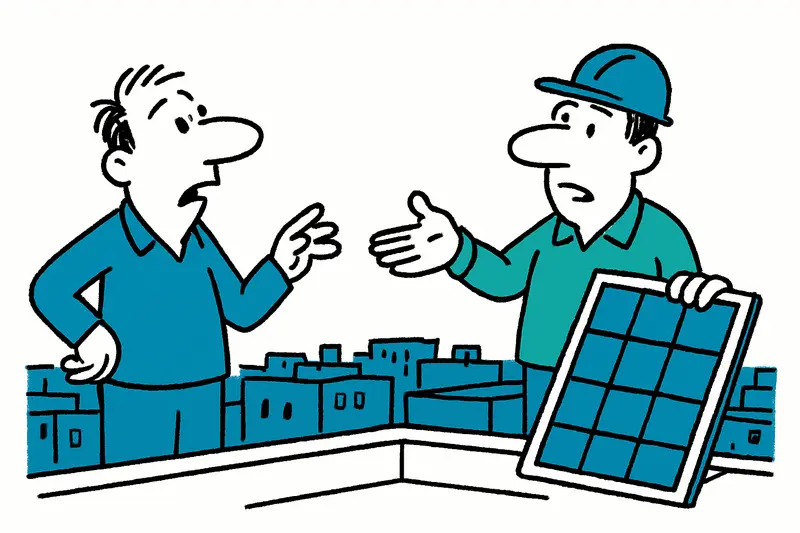
Mallorca's roofs remain empty — why the sun goes unused and how the island can change that
You can see them almost everywhere in Palma: unused roof spaces. Yet solar use is stalling. A day‑to‑day portrait of causes, little‑explored hurdles and concrete solutions for the island.
Palma has sun — but hardly any solar panels on the roofs
Last Friday I was sitting on a small roof terrace in the old town, the evening sun warming the tiles, seagulls barking in the harbour and somewhere a frying pan crackled. The view swept over rows of houses, courtyards and flat roofs — many completely unused. The paradoxical picture: seven hours of usable sun per day, thousands of square metres of roof space — and only a few collectors.
The central question: why do the roofs stay empty?
The answer is not a single gremlin, but a mix of practical problems: paperwork, cost responsibility and social barriers. Installers talk about applications that drag on for weeks, about required permits in neighbourhoods with heritage protection rules like Son Espanyolet and Santa Catalina, and about communities of owners where every new idea immediately ends up on the owners' association agenda — usually leading to lengthy votes.
Added to this is an economic calculation that does not immediately convince many owners: small systems require relatively little initial investment, but registration, certificates and sometimes grid connection fees can make the return only pay off after many years. For landlords of tourist apartments — in a market where Mallorca stays crowded — there is another problem: who invests when holiday guests consume the electricity but the landlord pays for the system?
Aspects that are often overlooked
Less frequently mentioned in the public debate are two structural barriers. First: the role of the dominant grid operator. A large, regional company means simplified infrastructure, but also standardised rules that make small producers' lives more complicated. Many owners shy away from the coordination and metering procedures required to feed surplus solar power into the grid.
Second: the complexity of homeowners' associations. In Palma's old town many buildings are owned by a variety of individuals — a situation highlighted by reporting on the housing shortage on the Balearic Islands — and legally binding template solutions are often missing. Without clear, easy-to-apply agreements, deciding on solar systems remains a social hurdle.
Concrete levers: practical solutions instead of lip service
From conversations with installers, property managers and homeowners, pragmatic measures emerge that could have immediate effect:
1. Simplified registration procedures: A central digital platform for registration and permits would take the wind out of many bureaucratic hurdles. An online form instead of three visits to offices — it sounds banal, but it is effective.
2. Template agreements for homeowners' associations: Standard contracts that clearly regulate rights, costs and benefits would avoid disputes and speed up decisions.
3. Financial incentives: Low-interest loans, tax depreciation or grants for storage technology would accelerate economic viability — especially for landlords of holiday apartments, who also face challenges as the local beach economy is faltering.
4. Local information campaigns: Neighbourhood events that clearly explain costs, savings and how things work — with real numbers from local projects — build trust.
A small calculation example, without number acrobatics
Air conditioners cause noticeable peaks in summer. A rough example: if 100,000 households on Mallorca each installed a 3 kW system plus battery storage, that would amount to a nominal capacity of 300 MW, roughly equal to the current photovoltaic output of the Balearics. Much of that could be consumed locally during the day and would significantly reduce dependence on peak power plants. Such calculations show: it's not just about CO2, but about grid stability and cost reduction.
Why politics must act, not just talk
The island has the potential to significantly exceed the national target for renewable energy — if politics, trades and residents actually cooperate. Instead of blanket funding promises, pragmatic implementation steps are needed now: clear rules, simpler technical standards and financing support that make the math easier even for small owners.
Until then many collectors remain a pretty picture in PowerPoint presentations while air conditioners hum through Palma's streets. That would be a shame — and unnecessary.
A final suggestion: one pilot project per neighbourhood — with simplified registration, a model association agreement and municipal start-up funding. Start small, scale fast. That could return to Mallorca the roofs the sun has long been giving.
Frequently asked questions
Why are there so few solar panels on Mallorca’s roofs despite all the sunshine?
Is it worth installing solar panels on Mallorca if the payback takes years?
Can apartment buildings in Mallorca install solar panels easily?
Why do heritage rules make solar panels harder to install in Palma?
What does Mallorca need to make rooftop solar easier for homeowners?
How much solar potential do rooftops in Mallorca actually have?
Does solar power help reduce electricity peaks in Mallorca in summer?
Why do holiday apartment landlords on Mallorca face extra challenges with solar panels?
Similar News
Plata stays Plata: Young people take over, Llonguets remain
A small bar on Carrer de l'Argenteria will continue: Tolo Serra hands the place over to young Mallorcans at the end of t...
Unnoticed in the Luggage Compartment: How a Boy Traveled More Than 100 Kilometers in a Team Bus
A minor traveled in the undercarriage of a team bus for more than 100 kilometers until his cries for help were heard. A ...

Cap Vermell Grand: Second Michelin Key – a Gift for the East
The Cap Vermell Grand in Capdepera has been awarded its second Michelin key. For the region this elevates the luxury off...
Eurowings lets four aircraft carry names – a friendly idea that also reaches Mallorca
Eurowings is launching a campaign: four Airbus A320s are to carry the first names of people who help others in everyday ...
From the Reality Studio to the Pitch: Aleks Petrovic Makes Mallorca His Base
The former participant in numerous TV shows moves from Dubai to the island and launches a project with FC Germania Mallo...
More to explore
Discover more interesting content

Can Cap de Bou

Townhouse Lleo 72
