
From Megapark to the Altar: Party Singer Now Offers Weddings in Mallorca
A well-known party artist combines partying and marriage: instead of a traditional church there are ceremonies at the Megapark – relaxed, loud and with slide sandals. A notary is still required for legally valid marriages.
From Megapark to the Altar: Party Singer Now Offers Weddings in Mallorca
Between Playa beats and flower crowns: couples like the relaxed mix
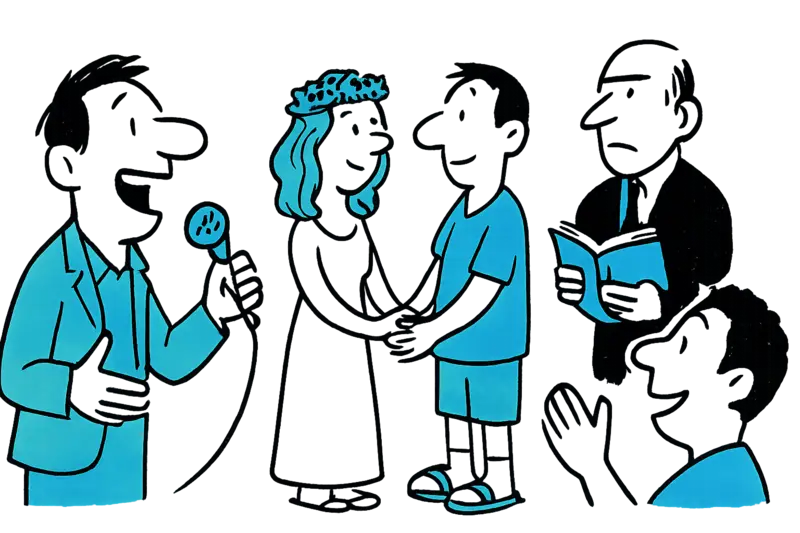
In the early afternoon, when seagulls circle above Playa de Palma and a drum beat drifts over from an open bar, a scene has recently emerged that was rarely seen on Mallorca: a party singer leads couples to the altar – or rather: to the stage in front of the Megapark. The ceremonies are short, loud and colorful. They attract passers-by, awaken curious sunbathers in their deckchairs and end many a morning walk with applause.
The artist tested the idea at first with his partner: two trial weddings, people say at the cafés along the paseo, have already taken place. The bridal couples did not wear tails or lace dresses, but Ballermann-style outfits – including slide sandals and white socks. That fit the mood: no pomp, rather a wink at the traditional wedding. Many holidaymakers stopped, filmed with their phones and celebrated spontaneously. The whole thing felt less staged and more like a collective experience.
There is economic potential. After the first dates, requests for October and November piled up. On Mallorca, where the tourist offering is constantly sought and reinvented, such a niche could help the low season: local businesses – from the florist on Avenida de Joan Miró to the small bar on the beach – benefit when morning ceremonies generate walk-in customers. The offer also gives couples without long preparation time an alternative to traditional weddings.
Legally the matter is clear: a symbolic ceremony in front of an audience is possible. For a legally binding marriage, however, an officially authorized representative must be present. At the previous celebrations there was therefore always an additional formal instance involved so that the marriage can later be recognized by the registry office. In parallel, the singer has begun training that would allow him to work more closely with formal procedures in the future. Until then, a notary or the responsible officials remain part of the ceremony.
The concept combines two things that repeatedly come together on the island: the desire to celebrate and emotion. The open stage of the Megapark creates an atmosphere in which strangers become spectators and sometimes congratulators. Anyone who has strolled along the Playa in the morning knows the mix of music, the smell of sunscreen and fried fish – here that becomes a moment that briefly intertwines beaches, tourism and everyday life.
For some, this is not a real wedding; for others, it's exactly right: uncomplicated, loud and sincere. The idea is also an example of how offerings on Mallorca change when regular guests, organizers and venues experiment together. Small businesses along the route could offer targeted services: flash floristry, mobile photographers or an after-ceremony breakfast at the café next door.
A look into the future: if interest continues to grow, it will be necessary to formalize procedures and involve neighbors, residents' associations and authorities. Noise, scheduling conflicts and safety issues are points that should be clarified early. If professionally organized, these weddings could become a new facet of the island's image – a bit quirky, direct and very Mallorca.
In the end, a warm picture remains: people who otherwise listen to different music stop to celebrate a brief moment of love. This is no replacement for the church tradition, but an addition to the island's offerings. And as the sun slowly sinks over the sea, unknown guests applaud, the sand crunches underfoot, and for a minute the Playa is not only a holiday spot but also the setting for a vow.
Frequently asked questions
What is Mallorca's weather like throughout the year?
When is the best time to swim in Mallorca?
What should I pack for a Mallorca trip?
What outdoor activities are popular in Mallorca?
Is Mallorca easy to explore without a car?
What food should I try in Mallorca?
Which Mallorca beaches are family-friendly?
When is the best time to visit Mallorca to avoid crowds?
Similar News
Urgent Clearing of Palma's Torrents: Flood Prevention or Symptom of Short-Sighted Planning?
The city of Palma is responding to storm forecasts and has cleared several torrents. We ask: Is the short-term clearing ...

Evaneos and Mexico: A Reality Check for Sustainable Travel
Travel advertising often reads like a promise: local, sustainable, unique. But how deep do these promises really go? A c...

The Maricarmen Case: Why an Eviction Is Forcing Spain's Housing Debate
Images of an 87-year-old woman on a stretcher have sparked a debate in Spain that also runs deep in Mallorca. Who protec...
Parking dispute in Els Hostalets: When a gap leads to violence
A parking dispute on Calle Aragón escalated into a mass brawl at night. Why do trivial conflicts here turn bloody so qui...
Bodycams in Palma: More clarity needed so surveillance doesn't become the norm
Palma's local police equip UII officers with Axon Body 4 cameras. Useful for evidence collection — but specific rules on...
More to explore
Discover more interesting content

Can Cap de Bou

Townhouse Lleo 72
