
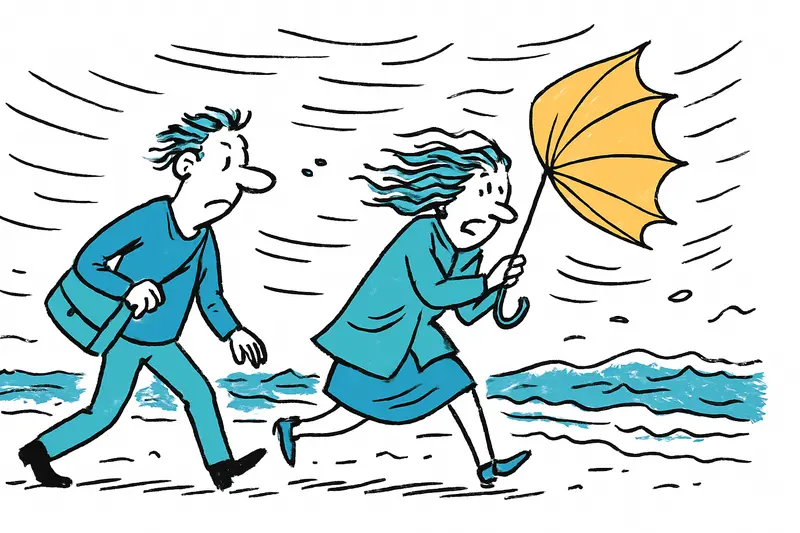
Mallorca in the Wind: Why a Yellow Alert Doesn't Mean a Beach Walk
For Sunday, AEMET is forecasting strong gusts and rough seas in Mallorca. Here’s what the yellow alert means in everyday life—and why caution matters more than a scenic view along exposed stretches of coast.
A calm-looking sky is no reliable way to measure the wind
How dangerous can a Sunday in Mallorca look when light is still breaking through the clouds over Palma and the thermometer reads 19 degrees? On November 22, the answer may not be found in the sky above Plaça d’Espanya. AEMET has issued a yellow warning for wind and rough seas in parts of the island. Gusts of around 70 kilometres per hour are expected in the Serra de Tramuntana, reaching up to 90 at higher elevations. Strong gusts are also forecast in the north and northeast.
This is not a forecast that brings everyday life to a complete halt. But it is not weather where the warning colour should be treated as a friendly decoration on your phone, either. Yellow means conditions outdoors could become unpleasant or locally dangerous, especially where the wind hits paths, roads and the coast without obstruction. In everyday life, the difference between “a little windy” and a gust that snatches a car door from your hand can be much greater than the number on the screen suggests.
Where the island feels the wind first
The exposed areas of the Tramuntana are particularly vulnerable in these conditions. Winds at higher elevations can be considerably stronger than in the towns below. AEMET has already recorded a gust of 83 kilometres per hour at Serra de Alfabia; the reading was 55 in Palma harbour and 77 on Cabrera. These are measurements at individual stations, not a guarantee that the wind will be equally strong on every street. That difference is precisely what makes the conditions difficult to assess: behind a row of buildings, it can feel almost still, while around the next bend the wind may suddenly tug at vehicles and branches.
Warnings also apply to the north and northeast. Not all towns, such as Alcúdia and Pollença, are equally exposed, and Campanet is not the same as a stretch of coastline. A regional warning describes an area, not the weather outside every front door at a particular moment. If you are travelling, don’t assume that conditions in the mountains or by the sea will be similar just because the morning in Palma still looks reasonably pleasant.
Then there is the sea. Waves of two to three metres are expected along the Tramuntana coast and in the north and northeast; the warning remains in effect into the evening. At first, that may sound like a figure for sailors. It matters just as much to walkers. On rocks, low sea walls and exposed viewpoints, a single wave can reach much farther than the one before it. Taking a photo at the edge is not a wise trade for dry shoes—or, in the worst case, for much more.
What often gets lost in public discussion
Weather warnings often focus on peak figures: 70, 83, 90. Less often discussed are the ordinary consequences people have to deal with throughout the day. Are loose items on balconies secure? Is that planned hike along a ridge really necessary? What about the café parasol, the parked bicycle or the pushchair on an open promenade? Not every gust will lead to an emergency call. But even small objects can become airborne in strong winds.
Getting around is another consideration. If you’re driving along an exposed stretch, take extra care, especially in a high-sided vehicle. Motorcyclists and cyclists feel crosswinds directly. There is no single recommendation that suits every route; if you feel unsure, postpone the journey or choose a more sheltered route. And at sea, a sun icon in a weather app does not make the coast calm.
A Sunday between the café and the edge of the coast
In Palma, a day like this can start harmlessly: chairs scrape across the ground, an awning briefly bangs against its fittings, and someone outside the bakery pulls their scarf tighter. Then a gust sweeps through the street, pushing dry leaves across the pavement. It’s an everyday scene, not a disaster. But it shows how differently the same weather can affect the island. In the sheltered old town, it may amount to nothing more than fluttering napkins; up in the Serra or on an open coastal path, the conditions call for a different level of caution.
Anyone travelling with visitors will know the feeling: the viewpoint is in the plan, the trip is paid for, and now the weather is expected to cooperate. That’s exactly when a quick reality check helps. The coast isn’t going anywhere. On a windy day, lunch in a sheltered place or a walk through a more enclosed town centre is often a better choice than the famous photo spot with an unobstructed view of the surf.
What you can do now
Before setting off by car or on a hike, check the latest AEMET warning and local conditions again—not just the day’s high temperature. In exposed areas, keep away from cliffs, rocky outcrops and low-lying shores that could be flooded. Bring lightweight pots, drying racks and other loose items on balconies indoors or move them somewhere secure. In strong crosswinds, it makes sense to drive more slowly and avoid unnecessary journeys. If you’re heading out on the water, take the warning seriously and stay ashore if in doubt.
A yellow warning is no reason to panic. But it is an invitation to adapt your plans to the island, rather than expecting the island to adapt to your plans. Palma may still seem pleasant on Sunday while conditions in the Tramuntana and along the north coast are already much rougher. Keep that in mind and you don’t have to give up your outing—just perhaps the most exposed spot at the edge.
The wind is not a spectacle that can always be judged correctly from a safe distance. With gusts approaching 90 kilometres per hour and waves several metres high, the wisest choice is often the least dramatic: keep your distance, secure loose items and, if necessary, postpone your coastal walk until a calmer day.
Frequently asked questions
What does a yellow wind warning mean in Mallorca?
Is it safe to walk along the coast in Mallorca during strong winds?
Can Mallorca feel calm in Palma but windy in the mountains?
Does a sunny, mild day mean it is safe to go out in Mallorca?
What should I wear for a windy day in Mallorca?
Is it safe to drive in Mallorca when strong winds are forecast?
Should I hike in the Serra de Tramuntana during a wind warning?
What should I do with loose items on a balcony during strong winds in Mallorca?
Similar News
Serious Crash Near Santa Maria: What We Still Don’t Know About the Road to Muro
Three 19-year-olds crashed on the road between Santa Maria and Muro early Sunday morning. Two were seriously injured. Th...

Carrer Apuntadors: When Social Hardship Becomes a Neighborhood Conflict
An arson attack on a shelter in Palma’s old town was more than an isolated act: it raises the question of when legitimat...

A New Player, an Old Mallorca Question: When Does the Island Truly Become Home?
A German footballer has lived in Mallorca for six years and now plays for FC Germania. His journey raises a bigger quest...

Siurells de Plata 2026: Mallorca Honors Commitment to People, Culture and Nature
At the gala in Son Termes, people and institutions from social services, research, culture, the environment and sport we...
When the Newspaper Is Missing from the Kiosk: What Bild’s Print Exit Means for Mallorca
The print edition of Bild is no longer available to buy on Mallorca. This is more than an empty space on the newspaper r...
More to explore
Discover more interesting content

Can Cap de Bou

Townhouse Lleo 72
