
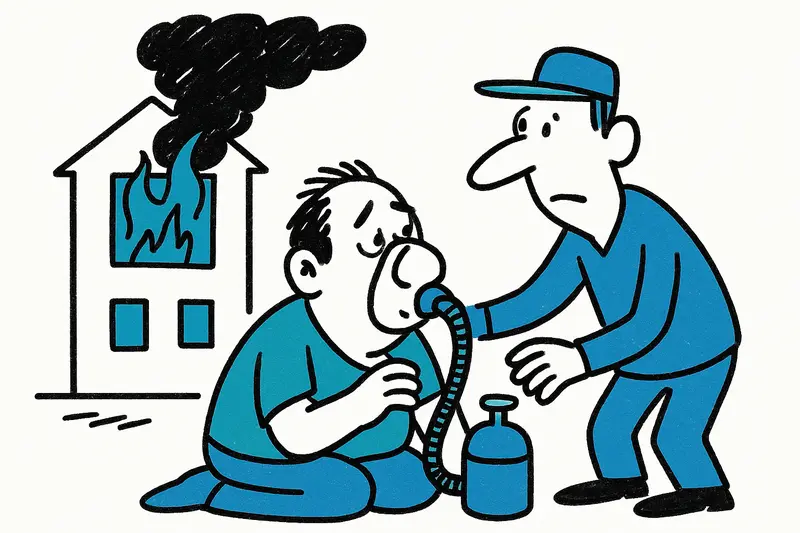
Magaluf After the Inferno: Why Can Household Fires Be So Deadly Here?
Magaluf After the Inferno: Why Can Household Fires Be So Deadly Here?
Two dead, dozens injured: The fire at Trianon II raises fundamental questions about housing safety, emergency response and responsibility in Magaluf. A critical assessment.
Magaluf after the inferno: Why can household fires be so deadly here?
Key question
Why did a fire, apparently caused by a refrigerator in the Trianon II residential block on Calle Martín García Ros, so quickly cost two people their lives and injure dozens?
Critical analysis
The facts are harsh: in the early hours a fire broke out on the third floor of Trianon II. Smoke and flames spread rapidly. Units from the Calvià municipal police, fire departments from Calvià and Llucmajor, and ambulances from SAMU 061 were on site within minutes. Still, two residents died, around 27 others were injured, some seriously, and five firefighters suffered smoke inhalation. A house fire starting from a household appliance can seem trivial — but the deadly outcome highlights gaps in prevention, building equipment and the handling of escape routes.
What is missing from public discourse
Reports name the cause, casualty figures and the response; see Fire in Can Morro near Porto Pi: A Wake-Up Call for Mallorca's Fire Safety. They often remain silent, however, on three points: 1) the technical condition of older residential blocks along the party mile — who checks the electrical installations in seasonal rentals and workers' lodgings? 2) the presence of smoke detectors, fire doors and automatic extinguishing systems in residential buildings like the Trianon complex; and 3) how many residents are registered as particularly vulnerable (elderly people, single workers, people with mobility impairments) and whether there are targeted evacuation plans for them.
An everyday scene from Punta Ballena
The morning after the fire the smell of smoke still hangs over Calle Martín García Ros. Neighbours in sweatpants stand in front of the houses, some tourists in shorts, paramedics unpack oxygen tanks. Flags at the town hall fly at half-mast, workers pull tarps over entrances. The bar opposite is half open — the coffee machine clicks, waiters clear their throats, and in the background an event organizer announces that the Mallorca Live Festival will go ahead as planned. This clash of normality and grief is typical for Magaluf: loud everyday life, narrow streets, people who live, work and party here — often under the same roof.
Concrete solutions
The tragedy can be remedied if municipalities and owners take action. Short-term sensible measures include mandatory smoke detectors in all apartments, visible evacuation plans in stairwells, and regular fire safety checks for rental accommodation and worker housing. Technically necessary are inspections of electrical systems in older blocks, especially in kitchens and for refrigerators with long running times. For emergencies: easily accessible stairwells, intact fire doors and sufficient extinguishing materials on each floor reduce deaths from smoke. At the municipal level Calvià should consider whether there are financial incentives or subsidy programs for safety upgrades — and create a register of vulnerable residents so that rescue services can prioritise them.
What emergency services can improve
The emergency line was reportedly overloaded; hundreds of calls heavily strained the system. This shows: the control center and rescue coordination need plans for mass calls and faster prioritisation. This was also evident during Fire in Port d'Alcúdia: Why the big scare is also a wake-up call for fire safety. It would also be helpful to keep mobile field hospitals seasonally near known hotspots such as Punta Ballena, instead of only setting them up in an emergency. Finally, tall buildings require special rescue equipment and exercises that must be trained regularly.
Economic and social dimensions
In many blocks along the party mile seasonal workers, long-term tenants and owners live close together. Structural deficiencies often hit those who cannot afford a quick move. The question of liability — owners, landlords, operators of short-term rentals — remains central and is rarely examined in depth in the reporting. Without clear responsibilities, necessary safety investments will be missing.
Sharp conclusion
The fire in Trianon II was more than an accident; it is a warning. A refrigerator can be the spark and the start, but the deadly result arises at the interfaces of technology, administration and everyday life. If Calvià does not systematically improve now — from smoke detectors to inspections — we will read similar reports again. In short: it is not only about what burns, but about who looked the other way beforehand.
Frequently asked questions
Why can a household fire in Mallorca turn deadly so quickly?
Are smoke detectors required in Mallorca apartments?
What should you do if there is a fire in your building in Mallorca?
Why are older apartment blocks in Magaluf more vulnerable to fire?
Is Punta Ballena in Magaluf affected by residential fire safety concerns?
How can homeowners improve fire safety in Mallorca flats?
What makes smoke inhalation so dangerous in apartment fires?
Why do emergency services struggle with major fires in Magaluf?
Similar News

Mallorca gets winter link to Lyon: Transavia France flies from October
Transavia France will launch a winter direct connection Palma–Lyon from late October: twice weekly, around 17,000 seats ...
Ses Fontanelles: 1,700 Years Underwater – the Wreck That Makes Mallorca Proud
A Roman merchant ship lay hidden for 1,700 years off Can Pastilla. Now Ses Fontanelles is in the spotlight: salvage, con...
Mini-tsunamis in Mallorca: Harmless natural phenomenon — or an underestimated danger?
Two harbor towns in Mallorca recorded unusual water level fluctuations. An analysis: How rissagas form, who is at risk —...
Stinging jellyfish in Cala Banyalbufar: Why everyone suddenly fled the water
In Cala Banyalbufar, Pelagia noctiluca washed up in droves. A personal account of why this is no coincidence, what is of...
New low-pressure trough brings rain — and the heat remains: What's missing in Mallorca?
A short, intense window of showers hit Mallorca, yet the air remained muggy and warm. Key question: Why does rain hardly...
More to explore
Discover more interesting content

Boat Tour with BBQ along Es Trenc Beach
Private transfer from Mallorca Airport (PMI) to Pollensa
