
Between Quays and Bureaucracy: How Mallorca's Ports Are Responding to Landings
More and more boats are reaching the Balearic Islands – and the ports are turning into improvised reception centres. Who helps, who decides, and which solutions are missing in Mallorca? A look at everyday life on the Passeig Marítim and the gaps in administration and politics.
Ports as provisional reception sites: who bears responsibility?
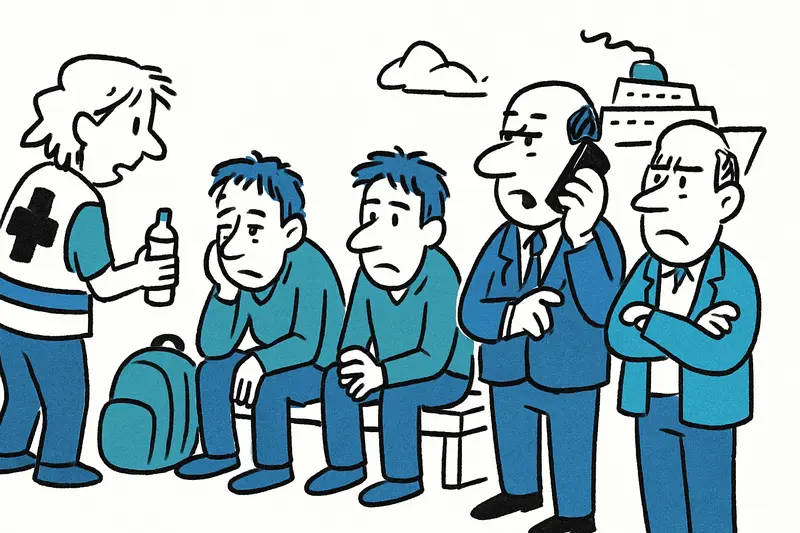
When the ferries come into port in the morning, the roar of ship engines mixes with the cries of seagulls. On the benches of the Passeig Marítim groups of young people sit, shivering from the night, with backpacks, plastic tarps, sometimes shoes in bags. Volunteers bring coffee, the Red Cross distributes blankets. And in back rooms phones ring – officials trying to make decisions.
The central question
Who should organize landings in the future: the municipality, the central government or Brussels? This is not merely an administrative theoretical question. It's about personnel, space, rights and the daily life of residents – for example on Avinguda Gabriel Roca, which functions as a waiting area in the morning. The answer affects how humane assistance and legal control work together.
What is currently faltering
The situation has a simple but consequential cause: lack of capacity. There are simply too few staff in the authorities responsible for identification and registration. Space is limited; often work must be done in improvised zones. This leads to patchy data – and with it uncertainty about how many will actually stay in Mallorca or travel on.
Politically the issue is already being simplified: some speak exclusively of order and security, others emphasize only the humanitarian duty. Both extremes are inadequate. Reality is mixed: people arriving after often dangerous crossings, authorities having to plan legally secure steps, and volunteers increasingly reaching their limits.
Aspects rarely mentioned enough
First: onward travel. Many of the arrivals by boat use the ferry to the mainland. Without reliable follow-up local services hardly know who stays and what long-term support needs will arise – housing, jobs, health care.
Second: the data basis. When registration processes stall, reliable figures for political decisions are missing. Authorities then have to react based on estimates – a poor foundation for sustainable planning.
Third: volunteer fatigue. In the early morning hours you see helpers in red vests who have had little rest for months. The social network is strong – but limited and hard to plan.
Concrete: Which steps would help?
No utopia is needed, but pragmatic measures:
1. Mobile identification and registration teams: In the short term, reinforced teams at the ports could speed up initial reception. A combination of trained staff and digital data collection would shorten waiting times.
2. Temporary, dignified accommodation at the port: Tents are not enough. Clean sanitation, basic medical care and secure rest areas would ease the situation.
3. Better data sharing between island, central and EU levels: Only with reliable figures can resources be planned efficiently. A simple, data-protection-compliant interface could help here.
4. Clear allocation of responsibilities and funding: If Madrid and Brussels take on functions, this must be communicated transparently. Long-term funding lines for staff and infrastructure should be binding.
5. Regional onward travel concepts: Agreements with ferry operators and mainland authorities could coordinate onward travel while ensuring that those in need of protection remain registered.
Looking ahead
The island is increasingly part of a migration movement, no longer just a transit point. That means: Mallorca needs solutions that allow both humanity and the rule of law. The fastest response is local – volunteers, police officers, social services. But without support from Madrid and funding from Brussels these answers remain fragile.
In the coming months it will become clear whether provisional measures develop into stable structures. Until then residents hear the creak of bollards, see helpers at sunrise and ask themselves: Can we carry this task permanently – or will the island always only be the harbour where problems are moored?
Note: The observations described are based on local impressions and official statements. On the ground volunteers and institutions work under partly difficult conditions.
Frequently asked questions
Why are Mallorca’s ports being used for migrant arrivals and temporary reception?
Who is responsible for handling migrant landings in Mallorca?
What is the situation like at Palma’s Passeig Marítim during early arrivals?
Why is it difficult to know how many migrants stay in Mallorca after arriving?
What would improve migrant reception at Mallorca’s ports?
Why are volunteers in Mallorca’s ports under pressure?
How does onward travel from Mallorca affect local migration management?
Is Mallorca becoming a long-term arrival point instead of just a transit stop?
Similar News

Release after bloody attack in Palma: Why the court's decision raises questions
An 18-year-old who allegedly inflicted a serious neck injury on a man at Plaza Gomila using a wristwatch wrapped around ...
Kidnappings in Inca: Three young men forced into car trunks and abused in the forest – a reality check
In Inca, three 18-year-old men were forced into car trunks by masked assailants at the Plaça des Bestiar, taken to a for...
Spreading Massification: The Brake That Still Has Much Work to Do
Marga Prohens announces limits on volume tourism. The measures sound harsh — but are they enough to save everyday life, ...

Through the Keyhole onto the Party Yacht: How Daniela Katzenberger Is Planning Her 40th on Mallorca
Daniela Katzenberger turns 40 and wants to celebrate it on the island — likely with a boat, cake and her mother. A relax...
By Boat Instead of the Road: Palma's Water Bus — a Reality Check
The 'Bus Nàutic' launches in two stages — but questions remain over interim operations, fares and environmental requirem...
More to explore
Discover more interesting content

Can Cap de Bou

Townhouse Lleo 72
