
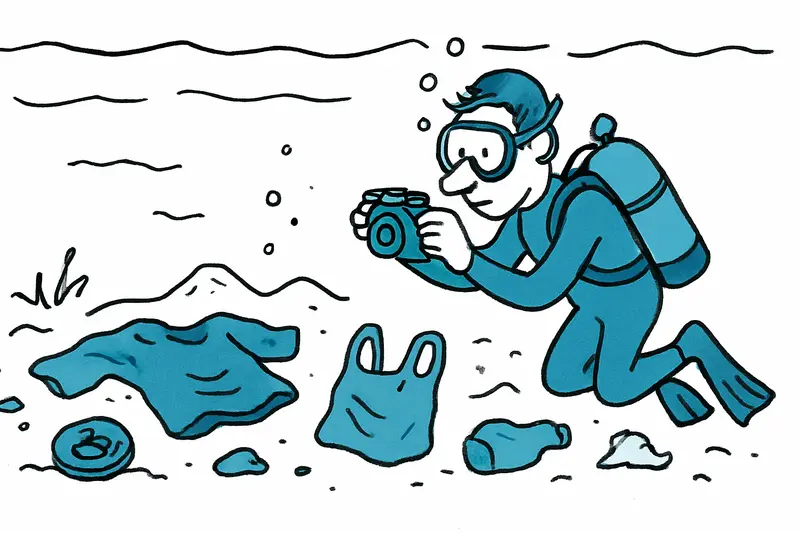
Marine litter off Santa Ponça: Diver documents littered seafloor at Caló d’en Pellisser
A local diver found clothing, plastic and old iron remains at Caló d’en Pellisser. Central question: What to do when the seabed becomes a dumping ground?
Marine litter off Santa Ponça: Diver documents littered seafloor at Caló d’en Pellisser
Clothing remains, plastic and rusted iron objects — a local takes stock and calls for more responsibility
Central question: How do municipalities, watersports operators and holidaymakers react when the seabed directly in front of a popular coastal stretch becomes a dumping ground for household waste and scrap?
Early in the morning, when the sun already warms the Paseo of Santa Ponça and the cafés at the harbor send coffee aromas into the street, a local diver was again under water. Ramón Javier Fernández Barea, known in the scene as “Es Canari”, dived at Caló d’en Pellisser in the municipality of Calvià. What he brought up was not a souvenir but pitiful evidence of an old and recurring problem: clothing items, pieces of plastic and rusty metal objects scattered across the sandy areas.
Just before the beach the waves are usually inviting, small motorboats tie up, children build sandcastles. Under the calm surface a different picture emerged. In addition to everyday waste, Fernández also found items that had apparently been there for a long time: a thin rod topped with a trident, remains of a sunken boat that now serves as a hiding place for octopus, and scattered iron objects showing signs of corrosion. Such finds point not only to isolated acts but to a longer-term process.
Critical analysis: On Mallorca the issue of marine litter is often handled on land — beach cleanups, awareness campaigns, municipal bins. What is missing, however, is systematic observation of the seabed. Beach photos often show only what is visible at low tide. Many items sink. There plastic fragments break down and metal turns into sludge, with consequences for fauna. A sunken boat quickly becomes an artificial cave for marine life, but can also release pollutants if fuel, paints or metals corrode.
What is insufficiently present in public discourse: precise figures, coordinated operations and long-term plans for underwater cleanup. Authorities, port operators and watersports centers must provide regular data so patterns can be detected — for example whether seasonal storms, boat traffic or illegal dumping are the main causes.
Volunteer dive actions are valuable and impressive, but they do not solve the problem sustainably. There are places on the island where community initiatives clean individual hotspots; other areas remain unmonitored. Authorities, port operators and watersports centers must provide regular data so patterns can be detected — for example whether seasonal storms, boat traffic or illegal dumping are the main causes.
Everyday scene from Mallorca: On the Paseo of Santa Ponça a vendor sits in front of her small shop, laughs and adjusts a straw hat. The boat rental operator at the pier fills tanks, engines rumble. A seagull steals the last bite of a tourist’s ice cream. This image of normality meets something that remains invisible until someone like Fernández dives and turns over the sediment.
Concrete solutions that could help here: first, a regular monitoring program for sensitive seabed areas, run in partnership by diving associations, the municipality and the university. Second, a coordinated reporting chain: divers should be able to submit lists of finds that the port authority reviews to map hotspots. Third, targeted recovery operations supported by local port infrastructure so heavy objects can be disposed of properly. Fourth, stricter controls against illegal dumping from the water and education for boat operators on proper disposal of old equipment. Fifth, better labeling and disposal options for waste at beaches and marinas — not just another trash can, but collection points for fishing gear, plastics and metal debris.
Technical aids must not be missing: simple mapping apps for divers, seasonal sonar scans by harbor administrations and sustainable funding for underwater cleanups. What matters is a shared register so that each recovery action does not remain an isolated event but becomes part of a strategy.
Fernández' dive at Caló d’en Pellisser was once again more than collecting trash. It is a piece of information work. His finds show that not only must beaches appear clean, but what lies beneath the surface must also be made a responsibility. Those who only count sunshades here overlook a burden that lasts longer than a season.
Conclusion: It is not enough to post outrage or to organize a beach cleanup once a year. If we truly want to protect Mallorca’s bays, we need a pragmatic combination of monitoring, reporting channels and organized recoveries. And a bit more respect when disposing of things — especially on the water. Otherwise we will one day be left with the sight of an idyllic beach above a forgotten field of rubbish.
Frequently asked questions
What is the weather like in Mallorca in spring?
Is Mallorca warm enough for swimming outside the main summer season?
What should I pack for a trip to Mallorca in spring?
What is the best time of year to visit Mallorca for mild weather?
Is Palma de Mallorca a good place to visit in spring?
Can you do outdoor activities in Mallorca when the weather is mild?
How windy is Mallorca in spring?
What is Port de Sóller like to visit in spring?
Similar News

German tourist dies in Sa Calobra – a reality check for emergencies on Mallorca's beaches
A 40-year-old tourist died at the Torrent de Pareis. The emergency call, a doctor who happened to be present, a defibril...

Deadly Tractor Accident in Bunyola: What Needs to Be Done Now
In a work accident on an estate near Bunyola, a roughly 40-year-old man lost his life. His wife and a small child were o...
Head-first dive into the shallow part of Cala Fonoll: An accident and the unresolved question of responsibility
A young tourist dove into Cala Fonoll and was seriously injured. Key question: Why are clear warning signs missing at da...

Mistaken identity with fatal consequences: Brutal assault in S'Aranjassa — what's missing in the follow-up?
At S'Aranjassa a visitor to a finca was tied up, beaten and thrown out of a van. Three men have been arrested, including...

High heel slips, car accelerates: accident on Camí de Son Hugo
A woman lost a high-heeled shoe on the forecourt of the sports facility at Camí de Son Hugo. The car accelerated, mounte...
More to explore
Discover more interesting content

Can Cap de Bou

Townhouse Lleo 72
