
Trash on the Seabed at Playa de Palma – Alarm Below the Surface
Trash on the Seabed at Playa de Palma – Alarm Below the Surface
A dive off Can Pastilla reveals remnants of nets, plastic and encrusted marine animals lying just meters from the busy coast. Why this is not only an aesthetic problem and what is missing.
Trash on the Seabed at Playa de Palma – Alarm Below the Surface
A dive off Can Pastilla revealed what many only suspect from the shoreline
Key question: How can a coast that is lively with joggers in the morning and tourists in the evening at the same time become a dumping ground, without the problem being noticeably solved in everyday life?
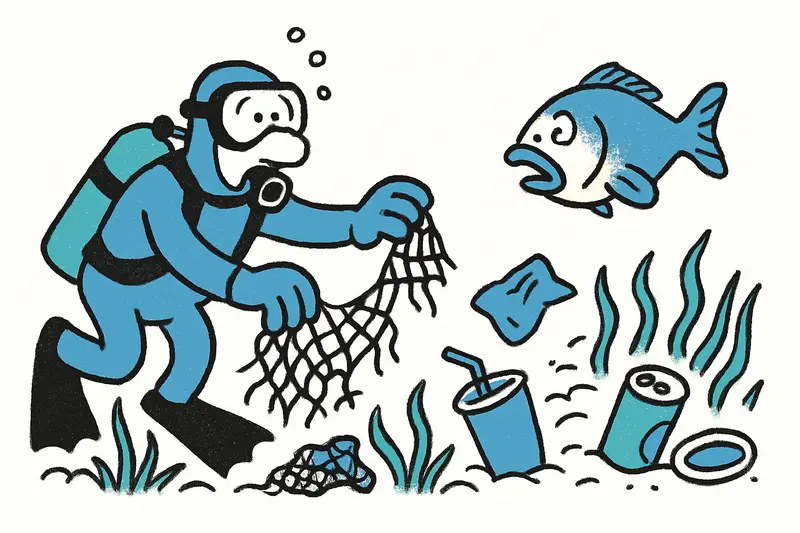
Off Can Pastilla, where the promenade smells of fresh coffee in the morning and buses along the Avenida bring a succession of languages, a dive showed what wind and currents bring: synthetic nets, small plastic pieces and clinging packaging remnants lie among Posidonia meadows. This is not only ugly — it directly affects living creatures. In one case black plastic fragments were stuck to a shorebird, in another to a sea cucumber (Parastichopus regalis). Both observations come from a recent dive log accompanied by a local volunteer action, as documented in What Lies Beneath Mallorca's Coast: Trash Slipping Out of Sight.
Critical analysis
The debris is not scattered randomly. Lightweight items like bags and packaging accumulate along the edges of Posidonia banks, heavier nets sink and become part of the habitat. Posidonia is a key structure: it binds sediments, supplies oxygen and provides shelter for juvenile fish. When plastic gets entangled there, the ecosystem slowly loses stability. The consequence: species that depend on clean meadows become rarer; at the same time habitat fragmentation increases.
What is missing in the public discourse
There is much talk about beach cleaning and tourist images. Less is said about what happens under the water's surface. Authorities, hoteliers and recreational users rarely speak in a tone that recognizes the continuity of the problem: pollution is not a one-off event after a stormy day, it is a constant pressure that in turn creates problems for fish stocks, water quality and diver safety. The role of drainage systems, pleasure boats and the seasonal tourist flow is too quickly reduced to isolated actions.
Everyday scene from Mallorca
Imagine the Playa de Palma on a late morning: children building sandcastles from wet sand, vendors pushing ice cream carts, excursion boats departing. On the promenade the ringing of bicycle bells, in the air oregano and sunscreen. Below this lively surface lies another picture: Posidonia leaves with plastic fragments hanging on during rising and falling dives, and a diver's hand carefully trying to free nets without causing further damage. This parallel world is part of our everyday life — it helps determine the future of the beaches.
Concrete solutions
1) Prevention on land: More waste bins along the promenade, more frequent emptying during peak tourist times and displays with clear, multilingual labeling. 2) Technical barriers in road gullies and drainage channels that retain plastic during heavy rain before it is flushed into the sea. 3) Targeted diver clean-ups: initial actions accompanied by scientific oversight so that clusters of net debris are removed in an orderly way — with reporting chains to inventory finds. 4) Anchor and mooring bans over particularly sensitive Posidonia fields, combined with clear protected-zone maps for boat operators. 5) Transparent numbers: regular cleanliness checks and a public data page so communities and neighboring municipalities can track successes or deficits. 6) Cooperation with coastal restaurants and rental businesses: less single-use, mandatory return systems for beach packaging.
What can be done immediately — and what will take longer
In the short term, electric pumping at drainage outlets, additional clean-up actions and information signs can be implemented. In the medium term, legal adjustments are needed: tougher sanctions for illegal disposal, clear rules for boat operators and better coordination between the tourism sector and environmental authorities. In the long term, the question must be asked how beach use and nature conservation can be organized so that both coexist without constant intervention.
Punchy conclusion
Those who drink their first coffee at Playa de Palma in the morning usually only notice the surface. But under that surface a problem is accumulating piece by piece that is hollowing out our beaches in the long term. It is not enough to show outrage or clean up after every storm. If the island community wants these coasts to remain clean and productive for the children of tomorrow, clear, linked measures on land and in the water are needed — otherwise the promenade will stay pretty and the seabed will continue to suffer.
Practical question at the end: Who takes the lead — the municipality, the Consell, boat operators or the tourism industry? As long as this guiding question remains open, many actions will be patchwork. And the sea has little patience for patchwork.
Frequently asked questions
What is the weather usually like in Mallorca in late May?
Is Mallorca warm enough for swimming in late May?
What should I pack for Mallorca in late May?
Is late May a good time to visit Mallorca?
What kind of activities are best in Mallorca in late May?
What is Palma de Mallorca like in late May?
Is Porto Cristo a good place to stay in Mallorca in late May?
Is Santa Maria del Cami a practical place to visit in Mallorca in late May?
Similar News

Who Benefits from the Half‑Hourly Flight on the Edge? Aena, Investments and the Island's Interests
Almost one billion euros is flowing into Son Sant Joan. The figures show the scale of investment and expected beneficiar...

Are the Balearic Islands the Southern Border of Europe? A Reality Check on Immigration
The Balearic Islands are again calling for EU aid after a sharp rise in arrivals by sea. Conflicting priorities between ...

"Expensive chaos" and many open questions: What clients can do when a lawyer suddenly stops responding
Several clients complain that a well-known German lawyer in Mallorca has been unreachable for months. Key question: What...

TV tip: 'The Last Problem' — Mallorca as the setting of a classic crime
A classic whodunit on Mallorca: A new miniseries set in spring 1959 brings storm, an isolated hotel and a dense web of s...
Nipping Sea Creatures: Why Bathers in Cala Major and Elsewhere Should Be Cautious
In Cala Major, bathers have reported being nipped by small fish. What is behind it, how can problems be avoided — and wh...
More to explore
Discover more interesting content

Can Cap de Bou

Townhouse Lleo 72
