
Fried-Egg Jellyfish off Santa Ponça – Causes, Risks and What to Do Now
Sudden yellow blotches in the water: thousands of 'fried-egg' jellyfish are drifting off Playa de Santa Ponça. A look at the causes, risks and practical advice on what to do.
Sudden yellow blotches on the beach
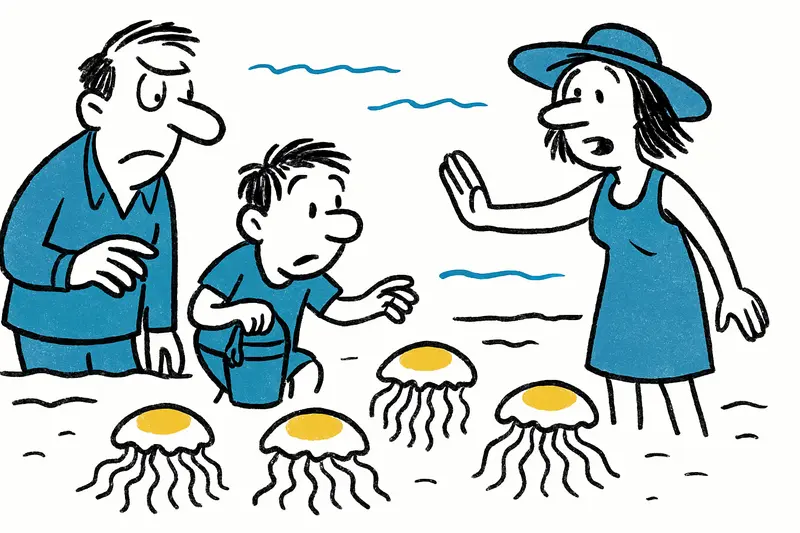
Yesterday morning the Passeig of Santa Ponça presented an unusual sight: walkers stopped in their tracks, children with buckets stared in amazement, gulls circled above the water — and unusually many jellyfish were swimming close to the shore. Lifeguards put up signs, a few café owners shook their heads. "I've never seen anything like this here," said a vendor at the beach kiosk at about 10:15 a.m., while the sea lapped quietly against the breakwater — reported in Medusas 'huevo frito' frente a Santa Ponça – causas, riesgos y qué hacer ahora.
What animals are these?
The specimens found are Phacellophora camtschatica, commonly known as the fried-egg jellyfish. Its transparent bell can reach about 60 centimetres, with a yellow spot in the middle that resembles a fried egg. Long, thin tentacles often float like hairs in the water and give the yellow blotches an almost surreal, delicate movement.
Are they dangerous?
No reason to panic: the sting of this species is considered relatively mild. Most people feel at most a tingling or slight redness. Still, lifeguards advise caution: avoid touching them and do not leave children unsupervised. Allergic reactions are rare but possible. Anyone who is unsure or has stronger symptoms should visit the nearest beach station — there are first aid measures available, from rinsing with seawater to vinegar-based treatments.
Why are they here all of a sudden?
This raises the key question: why are jellyfish that are originally more common in the North Pacific now appearing off Mallorca? There is no simple answer. Several factors are likely at play: warmed surface waters, altered ocean currents and short-term weather conditions — yesterday a light northeast wind blew and the sea was somewhat choppy — can drive mass organisms toward the coast. Human influences also contribute, such as ballast water from large ships that can transport organisms over long distances.
What is often overlooked
Two aspects are rarely discussed enough: first, the role of nutrient inputs from rivers, sewage and agriculture. More nutrients promote phytoplankton; this in turn can trigger food chain effects that favor jellyfish populations. Second, the declining number of natural predators: overfishing removes fish and other predators that would eat juvenile stages of jellyfish. Together, these factors create conditions under which jellyfish are more likely to form large swarms.
What are the consequences?
For bathers the effects are usually limited — rarely dramatic for health, but unpleasant. For local businesses, visible jellyfish infestations can be immediately noticeable: fewer bookings, hesitant families, changed beach behaviour. Fisheries and marine ecology also suffer if jellyfish consume large amounts of plankton and fish larvae.
Concrete measures and opportunities
So what can be done? In the short term, clear information, signage and trained lifeguards help. The Santa Ponça tourist office has already distributed leaflets with behavioural tips; that is important. In the medium term we need better reporting chains and monitoring: regular beach checks, photos via citizen-science apps, coordinated reports to the municipality and the port authority.
Long-term structural solutions are necessary: stricter rules for ballast water, measures to reduce nutrient inputs on land, more sustainable fisheries policies and more research into species introductions. There is also an opportunity in local cooperation: when beach owners, tourism operators and scientists sit together, early warning systems and information campaigns can be developed — this builds trust among locals and visitors.
What visitors should know now
Stay calm, keep your distance and feel free to photograph the phenomenon — but do not touch the animals. Warn other beachgoers and inform the lifeguards. For skin irritation: rinse with seawater or lukewarm water, do not rub with sand or towels. For severe complaints: seek medical help. The promenade often still shows the yellow blotches in the evening when the sun is low — a beautiful but respectful photo opportunity.
A local outlook
The "fried-egg" jellyfish are impressive and remind us how interconnected our seas are. For Santa Ponça this means: be cautious when swimming, but also take the chance to improve beach management and public information. If we seriously address the causes — from cleaner coastal management to better shipping rules — such episodes can become rarer and less disruptive. Until then: enjoy, observe, and keep your distance.
Note: The lifeguards are responding quickly and the municipality is monitoring the situation. If you discover something unusual, report it directly to the beach station or the tourist office.
Frequently asked questions
Are the fried-egg jellyfish in Santa Ponça dangerous to swimmers?
What should I do if I get stung by a jellyfish in Mallorca?
Why are fried-egg jellyfish appearing off Mallorca now?
When is it safest to swim in Mallorca if there are jellyfish?
Can you touch fried-egg jellyfish on the beach in Santa Ponça?
What should families do when jellyfish are close to the shore in Mallorca?
How do lifeguards and beach stations in Santa Ponça respond to jellyfish sightings?
What are the wider effects of jellyfish swarms on Mallorca's beaches?
Similar News
Fear in the Sa Teulera Forest: Youth Groups Harass Cruising Zone in Palma
In the wooded area of Sa Teulera, those affected report verbal attacks, property damage and intimidation. How safe is th...

Axa opens first health center in Palma: €3 million, 650 m² and more local access for La Vileta
In the heart of La Vileta, Axa has opened its first own health center in Mallorca. On around 650 square meters and with ...

30 Years of Nit de l'Art: What Palma's Art Night Really Shows — and Conceals
Nit de l'Art celebrated its thirtieth anniversary: full galleries, young visitors — and the quiet tensions between the a...

Hunt for Older Holidaymakers: Arrests after Suspected Pickpocketing in Port d'Andratx and Bellver
Five suspects were arrested after investigators accuse them of targeted pickpocketing of elderly tourists in Port d'Andr...

Knife stabbing in Magaluf: Why it must not remain an isolated incident
A 21-year-old tourist was stabbed in the chest in Magaluf and is in life-threatening condition. A reality check: what's ...
More to explore
Discover more interesting content

Can Cap de Bou

Townhouse Lleo 72
