
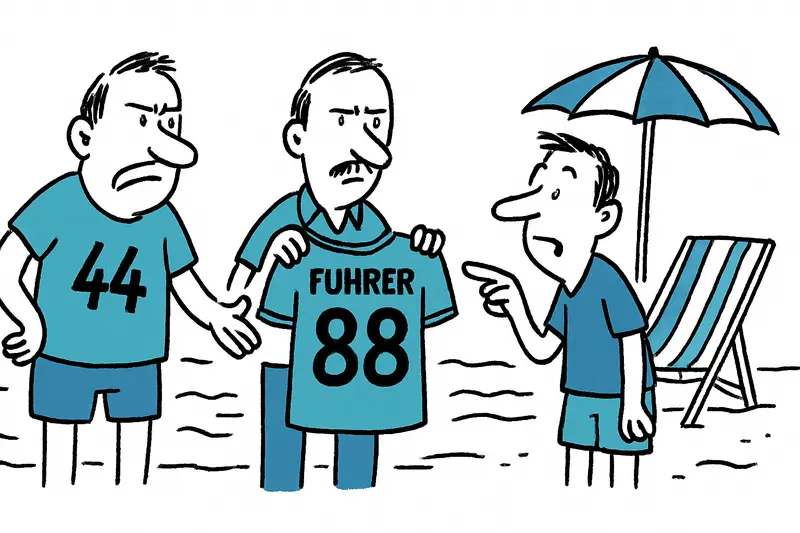
Back at the Playa: When Football Jerseys Become Political Provocation
On Schinkenstraße copied DFB jerseys bearing 44, 88 and the word "Führer" have reappeared. Why such merchandise slips through legally on Mallorca — and what residents, restaurateurs and authorities could practically do.
Back at the Playa: When Football Jerseys Become Political Provocation
A Guiding Question
Why are jerseys with clearly nationalist symbolism being offered again at Playa de Palma, even though some of them are banned in Germany — and what can be done locally to reduce the visibility of such motifs?
Critical Inventory
In recent weeks, copied football jerseys have repeatedly appeared on Schinkenstraße and the adjacent alleys, bearing the back numbers 44 and 88 and the word "Führer." Apparently this is merchandise sold by street vendors and sometimes offered at improvised stalls. Similar patterns of provocative material have been documented elsewhere, for example in New xenophobic graffiti at Playa de Palma – How is the island reacting?. Major sports brands have already removed such designs from official collections; nonetheless, cheap imitations circulate on the island. In Germany the use of certain Nazi symbols is a criminal matter; on Mallorca, observations show, these regulations do not automatically apply — and that is part of the problem.
What Is Missing from the Public Discourse
The debate often stops at moral outrage and questions about the vendors' intent, profit or provocation. What is missing is a sober look at three levels: the legal situation in Spain versus Germany, the economic side of informal vendor structures, and the responsibility of the hospitality industry and municipalities on site. No one speaks concretely enough about how suppliers source their goods and how sales locations are controlled — precisely the points where practical levers exist.
Local Everyday Scenes
On a spring evening walking down Schinkenstraße you hear the clatter of sales tables, the rattling of police scooters, the laughter of groups of tourists and bargaining in German. Between sun, sea air and frying fat these are the places where conflicts arise: a bar couple at an entrance refuses entry to a guest wearing such a jersey; a few meters away a vendor, spotting a uniform, quickly loads his goods onto a handcart and disappears down the rambla. These scenes show: the problem is visible, manageable and at the same time diffuse.
Critical Analysis
The core problem is not only the availability of a shirt, but the combination of demand, lack of regulation of sales locations and differing legal frameworks. As long as a product can legally be offered in Spain, tourists may wear it. At the same time, the availability of cheap copies is a business model that quickly adapts to demand — including provocative motifs. Authorities react sporadically: inspections temporarily disperse vendors, hosts exclude individual persons. Such episodes are described in Tumults at Playa de Palma: When Controls Threaten the Beach Scene. That is not enough.
Concrete Approaches
1) Municipal regulation of sales areas: Palma could enforce much stricter temporary permits for street trading and formulate clear prohibition criteria for offering clothing with inhumane symbols. 2) Regulatory measures combined with targeted sanctions: repeated violations should be sanctioned with fines and longer sales bans. 3) Responsibility of businesses: cafés, bars and clubs can publish house rules that prohibit wearing certain symbols — visibly at the entrance and communicated to staff and security. 4) Education instead of taboo breaking: hotel receptions, landlords and tourist information points could distribute short notices to German-speaking guests explaining why these signs are hurtful and have consequences in Germany. 5) Attack the supply chain: authorities could take stronger action against intermediaries who import the copies; customs and trade inspections and cooperation with platforms through which such shirts are ordered would be points of attack. 6) Strengthen civil society: local initiatives, hospitality associations and neighborhood groups should develop actions that set clear norms — for example educational campaigns or visible signs of solidarity along the promenade, and should respond to controversies like Posters, Provocation, Polarization: How Mallorca's Streets Become a Campaign Ground.
What We Can Do at the Playa Immediately
Scrutinize permits more rigorously, enforce door policies consistently, inform vendors about new rules — these are measures the mayor's office, police and business associations can implement without lengthy legal changes. Small, coordinated steps have an effect: reduce visibility, disrupt affiliation with informal networks, increase pressure on the procurement channels for the copies.
Pithy Conclusion
The jerseys are more than provocative souvenirs. They are a symptom of a gap between public sentiment and administrative practice. Whoever walks the promenade in the evening and sees such shirts experiences not only bad taste — they experience a challenge to coexistence. Mallorca can and should not remain passive here: with clear rules, visible door policies and targeted education, the presence of this merchandise can be curbed without turning the island into a repressive state of exception. It is a practical problem that demands practical solutions — and they begin on Schinkenstraße, not end in legal paragraphs.
Frequently asked questions
What is the weather like in Mallorca in early spring?
Can you swim in the sea in Mallorca during spring?
What should I pack for Mallorca in early spring?
Is Mallorca a good destination for a spring holiday?
What is Palma de Mallorca like in spring?
Is Alcúdia good for walking and sightseeing in spring?
What is the weather like in Sóller in spring?
How should I plan outdoor activities in Mallorca if the weather changes?
Similar News

More Electric Cars in the Balearic Islands: Sales Rise Sharply
Between January and August, 14,185 vehicles without petrol or diesel propulsion were sold — an increase of more than 40 ...
Autumn in Mallorca: What Truly Remains of Summer
The days grow shorter, the evenings cool — and yet more of summer lingers than you might think: sounds, recipes, people,...
Rescue operation at Tolleric: Why nighttime cliff parties become dangerous
A British holidaymaker fell about ten meters at the cliffs of Tolleric during the night, later climbed back up and was r...
Car accident on the MA-1: Mother and daughter on a bicycle struck by a fellow countryman – Who protects cyclists here?
On the MA-1 between Portopí and the Cala Major exit, a mother and her daughter on a bicycle were struck by a car. A para...

Smoke over the UIB: Who is responsible for the fire on the roof?
On Saturday afternoon a fire broke out on the roof of the Arxiduc Lluís Salvador building at the University of the Balea...
More to explore
Discover more interesting content

Can Cap de Bou

Townhouse Lleo 72
