
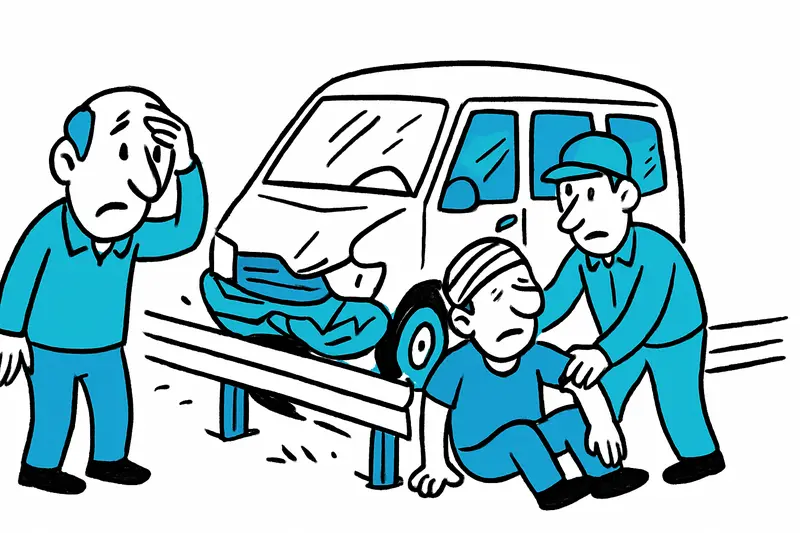
Minibus accident on the Ma-13 near Inca: Why a fall through the guardrail is more than an isolated incident
Minibus accident on the Ma-13 near Inca: Why a fall through the guardrail is more than an isolated incident
A 45-year-old minibus driver was seriously injured in an accident at the Sa Pobla exit. What lies behind the speed, the infrastructure and the rescue operation on the Ma-13?
Minibus accident on the Ma-13 near Inca: Why a fall through the guardrail is more than an isolated incident
On the Ma-13, shortly after the slip road toward Sa Pobla, a journey for a 45-year-old minibus driver ended yesterday in a hospital bed. The man apparently lost control of his vehicle at high speed, broke through the guardrail at the roundabout of the Sa Pobla exit and fell several meters down the embankment onto the motorway below. At the time of the accident there were no passengers on board. The fire brigade freed the driver from the vehicle and emergency services took him to a hospital.
Key question
Why is “a driving error at high speed” not a sufficient explanation when a vehicle breaks through guardrails and falls several meters down a slope?
Critical analysis
On Mallorca the picture that emerges here is easy to follow: the Ma-13 is a busy lifeline between Palma and the north. Recent incidents, such as the Severe rear-end collision on the Ma-13: Why the stretch between Inca and Palma often becomes a bottleneck, underline how this stretch can be hazardous. Roundabouts are everywhere, access lanes are short. Vehicles that arrive faster than intended have little room for correction. That a minibus loses control at a roundabout can have many causes. Speed alone does not fully explain the fall. Equally decisive are road surface condition, visibility, signage, the state of the guardrail and its anchoring in uneven terrain.
Vehicle technology also plays a role. Minibuses have a different center of gravity than cars; during abrupt steering maneuvers or aquaplaning they react differently. The report does not mention any technical defects or distraction, but that is often where the official narrative ends: driver error as the sole cause, without checking whether the vehicle, the infrastructure or organizational processes (for example drivers' working hours) contributed to the hazard.
What is missing in public discourse
In public we quickly talk about accident statistics and individual mistakes. Rarely do we address systemic questions: How safe are guardrails when mounted on embankments? How well are roundabouts at motorway junctions designed? Are there speed measuring points, or is the Ma-13 uncontrolled at critical locations? Other crashes, like the Head-on Crash on the Ma-13 near Alcúdia: Could the Accident Have Been Prevented?, show different failure modes and the need for broader analysis. And: are operators of minibuses, whether private or commercial, regularly checked for maintenance, tire tread and brake condition?
A scene from everyday life
Imagine the spot: early morning, still damp air over the almond groves, two lorries overtaking each other, a coach rumbling toward Aucanada. Traffic hums along the Ma-13. At the roundabout for the Sa Pobla exit stands a juniper bush, behind which the guardrail appears as a thin border between everyday life and a fall. You rarely hear pedestrians here; instead there is the honking of trucks and the beep of a mobile phone in the driver’s cab. Such small details set the rhythm on the road and can play a role in critical maneuvers.
Concrete solutions
1. Upgrade infrastructure: inspect guardrails on embankments and reinforce them where stability is questionable due to the terrain. Smaller protective berms or additional crash attenuation systems can prevent a vehicle from completely breaking through.
2. Make roundabouts safer: enlarge run-off areas, improve drainage, clearer markings and reflective materials for night and rain conditions.
3. Inspections and technology: regular, random technical inspections for minibuses; mandatory telematics for commercially operated vehicles that record speed and braking behavior.
4. Speed enforcement and prevention: mobile or fixed speed measurements at critical points of the Ma-13, combined with visible presence of road authorities. Public awareness campaigns for professional drivers about breaks, load securing and adapting speed to the route.
5. Training and emergency management: specialized training for drivers of minibuses and small transporters. Review emergency plans of response teams: how quickly can fire and rescue services reach such embankment locations? A fast, well-coordinated response can reduce injuries.
Why this matters
An accident like this is not an isolated event. It highlights weaknesses in several areas: vehicle technology, infrastructure, enforcement and rescue. Local reporting, for example the Spanish account of a serious rear-end collision Grave choque por alcance en la Ma-13: por qué el tramo entre Inca y Palma se convierte con frecuencia en un cuello de botella, reinforces that these are recurring problems. If we stamp the driver as “solely to blame,” the gaps remain open. The risk persists—for the next driver, the next exit, the next rainy day.
Conclusion
The incident at the Sa Pobla exit is a wake-up call. Not only because a person was seriously injured, but because the combination of speed, road layout and protective systems apparently led to a fall. We must ask which measures can prevent the same safety gap from becoming a tragedy again. An honest analysis and quick improvements on the Ma-13 would avoid not only damage to vehicles but, above all, human suffering.
Frequently asked questions
What is the weather like in Mallorca in May?
Can you swim in Mallorca in May?
Is May a good time to visit Mallorca?
What should I pack for Mallorca in May?
What is Palma de Mallorca like in May?
Is Port de Sóller a good place to go in May?
What is Alcúdia like in May?
What activities are best in Mallorca in May?
Similar News

Who Benefits from the Half‑Hourly Flight on the Edge? Aena, Investments and the Island's Interests
Almost one billion euros is flowing into Son Sant Joan. The figures show the scale of investment and expected beneficiar...
Are the Balearic Islands the Southern Border of Europe? A Reality Check on Immigration
The Balearic Islands are again calling for EU aid after a sharp rise in arrivals by sea. Conflicting priorities between ...

"Expensive chaos" and many open questions: What clients can do when a lawyer suddenly stops responding
Several clients complain that a well-known German lawyer in Mallorca has been unreachable for months. Key question: What...

TV tip: 'The Last Problem' — Mallorca as the setting of a classic crime
A classic whodunit on Mallorca: A new miniseries set in spring 1959 brings storm, an isolated hotel and a dense web of s...

Nipping Sea Creatures: Why Bathers in Cala Major and Elsewhere Should Be Cautious
In Cala Major, bathers have reported being nipped by small fish. What is behind it, how can problems be avoided — and wh...
More to explore
Discover more interesting content

Can Cap de Bou

Townhouse Lleo 72
