
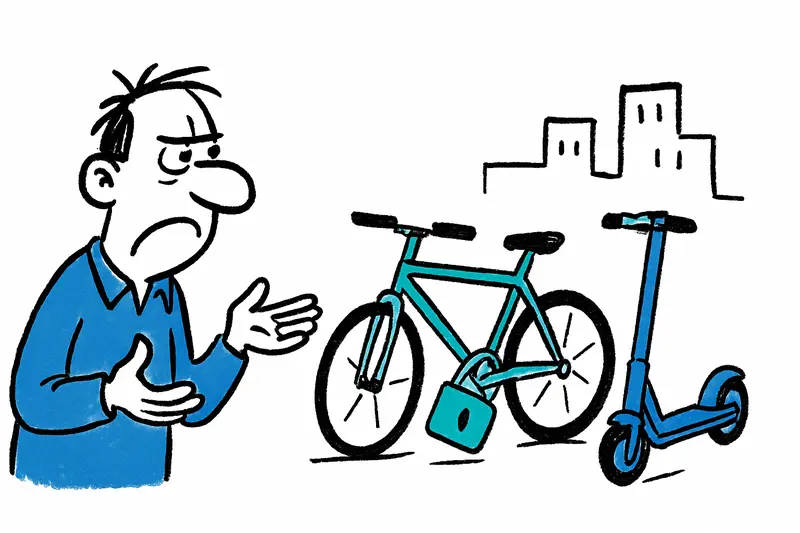
More than 400 Bicycles and E-Scooters Stolen in Palma — What's Missing in the Discourse?
More than 400 Bicycles and E-Scooters Stolen in Palma — What's Missing in the Discourse?
419 thefts in one year: The police call them opportunistic thieves. We ask: Why are individual locks alone not enough?
More than 400 Bicycles and E-Scooters Stolen in Palma — What's Missing in the Discourse?
Leading question: Are individual locks enough, or does Palma need a new shared approach for bikes and scooters?
The bare number is brief and somewhat empty: 419 thefts were reported in Palma last year. Spanish interior authorities provide this figure, the police warn of opportunistic thieves and recommend sturdy locks as well as noting frame numbers and distinguishing features. Those are sensible tips. But they only reach the people who are attentive — and not the whole problem.
On the Carrer de Sant Miquel, right next to the market, there is often a row of bikes and parts of scooters in the early evening. It smells of fried fish, voices murmur, a tourist checks their phone. In this mix of hustle and proximity ideal conditions arise for thieves: a brief distraction, a poorly secured bike, and it's gone. These are everyday scenes that don't appear in any statistic — only their consequence: the gap in the bike chain and the feeling of no longer being safe.
Critical analysis: The police warning is correct, but it overlooks three levels. First, there is the infrastructure. Many streets in Palma have too few reliable anchor points where a heavy lock can be properly attached. A thin post or a metal rod does not protect a bike from quick prying.
Second, tourism and short-term use play a role. Holidaymakers often park e-scooters or rental bikes for just minutes, which also diminishes their sense of security precautions. A little further on, at the harbour, you see e-scooters parked in the mornings without locks because the rental companies' systems are optimized for user convenience rather than security; this tension has been highlighted in reporting such as Palma takes stock: Arrests made — is that enough to make beaches safer?.
Third: transparency and data sharing. If frame numbers or unique features were recorded and a central, publicly accessible list existed, matching stolen vehicles would be easier, similar to BikeRegister national cycle database. Today such information is fragmented: police, private rental companies, insurers — each works on its own island, as noted in Eight Break-ins in One Week: Arrest in Palma — and What's Still Missing.
What's missing in the public discourse
We often talk about the victims, about personal carelessness, about the statistics. We speak too little about the responsibility of rental companies, about municipal parking spots and about a simple, functional registration for private bikes. Also missing is a realistic assessment of the role of organized gangs versus opportunistic thieves. The 419 cases could hide very different patterns; a public breakdown by neighbourhoods and times of incidents would provide more insight than a single total number.
Concrete, practicable solutions
1. More robust anchor points on main routes and in shopping areas: sturdy hoops and bike stations at Plaça Major, Passeig del Born and Mercado Olivar would reduce the chances for quick thieves.
2. Mandatory clear marking: a uniform QR code or a central frame-number database that police and citizens can use. Not an extra luxury, but comparable to pet identification.
3. Rules for rental companies: minimum standards for security devices on e-scooters and rental bikes, including a mandatory mechanism that makes parking without locking more difficult.
4. Public-awareness campaigns with clear, local examples: not just "Use a strong lock," but short spots at kiosks and on webcams showing how to secure a bike properly — practical, visible, repeatable.
5. Better data for everyone: the city should publish anonymized locations, times and methods of incidents. That helps shops, neighbourhoods and police districts plan prevention measures.
6. Cooperation instead of isolation: insurers could offer discounts for registered bikes, holiday rental hosts could hand out information sheets, and EMT stops could provide combined parking areas.
An effort, many small gains
None of these proposals is revolutionary. But together they could significantly reduce the likelihood of theft. The police recommendation — sturdy locks and noting frame numbers — remains correct. However, it is only the starting point of a larger concept: when city planners, rental companies, police and citizens remove the small obstacles, a quick shopping trip will no longer be a risk.
Pointed conclusion
419 disappearing bikes and scooters are more than a number. They show where Palma needs to improve everyday safety: better parking infrastructure, mandatory identification, clear rules for rental companies and visible prevention work. Until then: whoever loves their bike stores a number in their phone, buys a decent lock and parks where a stable bolt is in the ground; incidents such as Robbery in Can Pastilla: Luxury watch worth €6,000 — escape by e-scooter reveals vulnerabilities show the stakes. But the city must create the environment in which such precautions make sense.
Frequently asked questions
How common is bike theft in Palma?
What is the best way to secure a bike or e-scooter in Mallorca?
Are e-scooters more at risk when they are parked for just a few minutes?
Where in Palma should I be especially careful when parking a bike?
Why is bike theft in Palma not just a problem for careless owners?
Should rental companies in Mallorca do more to prevent theft?
Would a central bike registration system help in Palma?
What should Palma do to reduce bike and scooter theft long term?
Similar News
When the Tap Only Runs Sometimes: Why Municipalities in the Balearic Islands Are Now Rationing Water
Deià, Valldemossa, Esporles, Sóller and several places on Menorca are scaling back water supply. Who is responsible, why...
Battle for the Ramp: Why Cala Gamba Needs More Than Enforcement
The Guardia Civil intervened in Cala Gamba — residents breathed a sigh of relief, but unease remains. Key question: Are ...
He dances at the Duty-Free: How an airport employee brings a smile to Palma
A Duty-Free employee at Palma Airport created a viral TikTok with dancing breaks. Why the scene is more than just an int...
Stolen Motorcycle in Palma: Fatal Crash in Coll d'en Rabassa Shortly After Theft
A motorcycle parked on Plaza Miquel Dolç in Son Gotleu was reportedly stolen in the early hours. Hours later two men cra...
When More Guests Mean Less: Mallorca's Restaurants at the Limit
Despite record visitor numbers, the revenues of many restaurants are shrinking. Why more visitors don't automatically me...
More to explore
Discover more interesting content

Boat Tour with BBQ along Es Trenc Beach

Private transfer from Mallorca Airport (PMI) to Pollensa
