
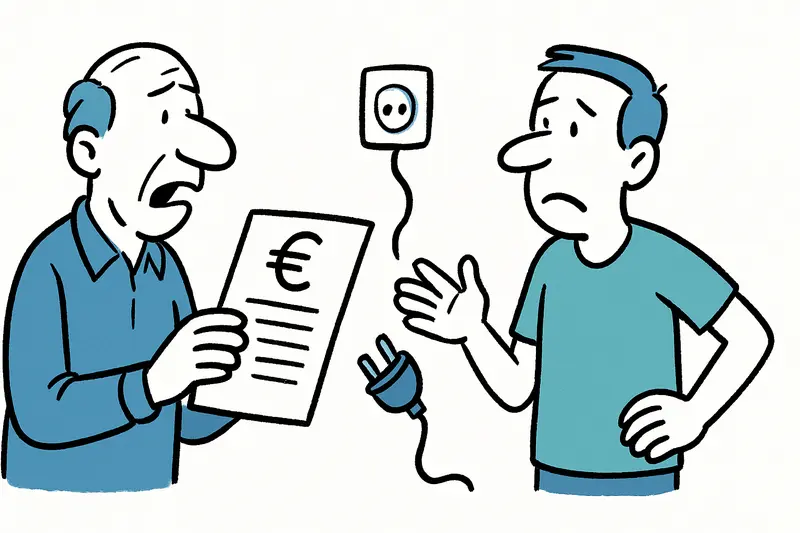
Who pays for the electricity in Casetes de Capellans? A billing question that's more than just money
Who pays for the electricity in Casetes de Capellans? A billing question that's more than just money
€15,844.75 outstanding, meters registered to the municipality – but who is responsible for supplying the coastal settlement? A reality check from Muro.
Who pays for the electricity in Casetes de Capellans? A billing question that's more than just money
Guiding question: Can a municipality be liable for an electricity supply if users don't pay — and how do we prevent citizens from ultimately footing the bill?
On a late afternoon the country road from Muro runs warm, cicadas chirp over the dry grass, and at the beach of Casetes de Capellans the sea laps at the edge without much fuss. Right here lies a dispute now being fought with cold figures and threatening letters: unpaid electricity bills for May and June amount to €6,132.81 and €9,711.94 respectively. Together that is €15,844.75 — and the total may yet rise, because the July bill is due soon and statutory surcharges apply in cases of enforcement.
This is not an abstract set of numbers. Already in 2025 the electricity supply in Casetes de Capellans had been cut off — with consequences that, according to the municipality, led to damages and claims, a situation also documented in Manacor: Threats and Utility Shutoffs — How Unprotected Tenants Were Left Beside the Racetrack. Currently the meter is registered in the name of the town administration, as discussed in Muro aims to end the grey zone: Special plan for the Capellans' casetes under review: the municipality pays the bills upfront and seeks reimbursement from the local neighborhood association. The association apparently refuses to pay as long as it is not the contract holder and cannot manage the supply itself. Mayor Miquel Porquer, however, wants to keep the previous framework: the municipality intends to maintain the connection under the municipal contract.
Critical analysis: Three problems occur simultaneously. First, the legal question: who bears responsibility? A meter in the name of the municipality does not automatically mean the commune is liable for private consumption costs — yet the risk to the municipality is real if payments are not made. Second, distributive fairness: when residents consume without a clear bill recipient on site, a collective debt can arise that individuals did not directly cause or cannot control. Third, the technical and organizational side: without clear submeter infrastructure, transparent billing and a binding payment structure, conflicts escalate quickly.
What is missing from the public debate: the voices of the affected residents are barely heard. There is no clear picture of local ability to pay, no breakdown of who consumes how much, and no analysis of whether there are systemic reasons for non-payment — for example faulty bills, opaque allocation keys or economic hardship. Likewise, there is no neutral review of the legal situation surrounding the municipal contract status and possible liability consequences. And nobody has so far spoken loudly enough about preventive technical solutions: submetering, load management or small community solar projects could mitigate many problems, an issue echoed in long-running disputes elsewhere such as Costa Canyamel: 22 Years of Official Inaction — Who Bears the Responsibility?.
Everyday scene from Muro: on the Plaça de Muro old men sit under pine trees, discussing football and electricity prices, while young families unpack their coolers at the weekend. A fisherman returns from the afternoon catch, shaking his head at the bureaucracy, and a young woman from the Casetes says quietly: "We want electricity, but not that fines and fees end up outweighing everything." Such sentences show: it is not just about figures, but about trust and quality of life.
Concrete solutions that should be examined immediately:
1) Legal clarification and mediation: The municipality and the association should promptly initiate an independent legal review and agree to mediation. That alone would help prevent the situation from escalating into an expensive court case.
2) Short-term installment plan: Instead of enforcement, a clearly regulated installment and repayment plan should be offered, tied to proof of individual households' ability to pay.
3) Technical separation: Submeters for each unit or precise consumption measurement would create transparency and avoid misunderstandings. This can often be implemented within a few months.
4) Alternative contract models: A contract in the association's name with securities (deposit, guarantee, escrow account) could accommodate residents' demand for self-management without completely excluding the municipality.
5) Energy advice and local solutions: An audit of consumption, subsidies for efficient appliances or a small community solar project could reduce costs in the long term and lessen dependence on the central supplier.
Punchy conclusion: The current confrontation is neither sustainable nor fair. A meter registered to the municipality must not be used as an administrative lever to load unpaid bills onto the commune's shoulders — and conversely an association must not shirk responsibility when it benefits from the supply. Transparency, technical clarity and a pragmatic payment plan would help both sides. Muro has the responsibility to find a solution that protects households while limiting municipal risk — before another summer evening with power outages and angry letters disturbs the peace on the coast.
Frequently asked questions
When is the best time to visit Mallorca for warm, pleasant weather?
What should I pack for a beach trip to Mallorca?
Is it easy to get around Mallorca without a car?
Where are good swimming spots in Mallorca for calm seas?
Are there seasonal events or festivals worth catching in Mallorca?
What should I know about weather and packing for Mallorca’s shoulder seasons?
Are there family-friendly activities in Mallorca for a relaxing break?
How does Mallorca’s coastline influence the best beach choices?
Similar News

Jeckliner at Sunnesching: Cologne spirit sets sail from Palma
In September 2027 the Mein Schiff 2 briefly becomes a floating carnival stage: four days with Cologne bands, comedy and ...
Finally Home: Mike and Leyla Heiter Buy Villa with Sea View in Mallorca
The reality TV couple Mike and Leyla Heiter have bought a house in Mallorca with a roof terrace and sea view. An Instagr...
Arrest after series in Palma: Who protects apartments from repeat offenders?
The National Police arrested a man in Palma who investigators say may have broken into several apartments. In one incide...
How a Teenager Without a Driver's License Stole a Rental Car — and What It Means for El Arenal
In El Arenal a minor took advantage of an unattended rental car with its engine running. Flight, climbing over walls and...
Three-ton llaut salvaged in Puerto Portals – volunteers clear microplastics from the harbor
During the weekend operation in Puerto Portals, divers pulled an approximately three-ton llaut from the harbor. Associat...
More to explore
Discover more interesting content

Can Cap de Bou

Townhouse Lleo 72
