
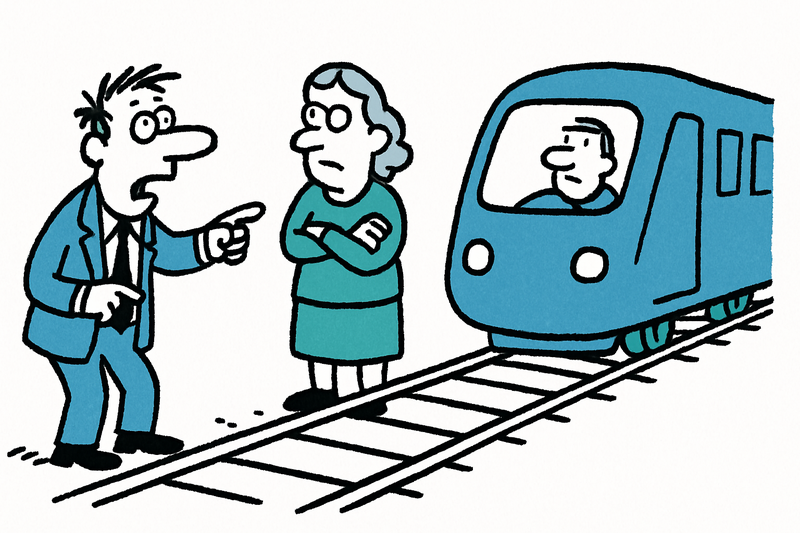
New Rail Link to Calvià: Opportunity or Traffic Illusion?
The Balearic government is planning a train connection Palma–Son Espases–Calvià. Between feasibility, nature protection and costs the key question arises: Will the rail truly solve traffic problems or create new ones?
Key question: Will the new rail solve traffic problems – or merely shift them?
The Balearic government has a big idea: train connection Palma–Son Espases–Calvià. It sounds promising at first glance, especially when you think of the traffic jams on the MA-1 towards Portals or the endless lines of cars on Avinguda de Gabriel Alomar on hot August days. But the central question remains: Will the railway genuinely improve mobility in a sustainable way, or will new problems emerge – high costs, landscape interventions, unresolved "last mile" issues?
What is technically and timewise planned?
At the moment a feasibility study is underway, with results expected in early 2026; local coverage includes analysis of the train connection from Palma to Calvià. Positively: if the study gives the green light, the project will be prioritized. Practically, however, this also means many technical questions must be answered in the coming months – route alignment, whether tunnels are necessary, how crossings with existing roads are resolved and how traffic is organized during the construction phase. Not to be forgotten: Son Espases (the Hospital Universitario Son Espases) is a sensitive location with ambulances driving through the roundabout with sirens; the connection must also function from a medical perspective.
Analytical view: What is often overlooked
Many discussions focus on the grand vision – extensions to Peguera or Andratx, better connections for tourists. Less examined is how the connection will be integrated into the existing transport system. Will timetables be coordinated with bus lines? Will there be through-tickets, bike transport or park-and-ride facilities at termini? And how sensitive are demand forecasts to seasonal peaks when in August suddenly thousands of people arrive over a single weekend?
Ecology vs. emissions balance
A common argument for rail is the climate balance: fewer cars, less CO2. But construction itself can mean significant interventions – rock fill, clearings, potential impacts on local biotopes and agricultural land around Calvià and Santa Ponsa. The equation only adds up if many car trips are actually avoided during operation. Therefore robust scenarios are needed: how many commuters will really switch from car to train, and which accompanying measures (e.g. attractive feeder buses) are necessary?
Finances and priorities
Construction costs are likely to be enormous. Who will pay? Regional budgets, EU funding, perhaps public-private partnerships – each option has pros and cons. Transparency is crucial: open cost-benefit calculations, clear financing plans and milestones, otherwise surprises such as delayed payments or subsequent reductions in service may occur. One possible approach would be building the project in phases: first Palma–Son Espases as a test, later extensions depending on demand data.
Social and local aspects
A walk through Calvià reveals ambivalence: residents in village centers value quiet and see construction work and additional noise as a real nuisance. Tourist hotspots, on the other hand, hope for relief: less time spent searching for parking before the beach, fewer congested cars on the Paseo Marítimo. Decisive will be good communication and compensation or participation models: jobs from construction and operation, compensatory areas and noise protection walls are just some of the possible measures.
Concrete proposals instead of wishful thinking
To minimize risks, transport planners often suggest pragmatic steps: a trial express service Palma–Son Espases with strong bus connections as a pilot; establishment of park-and-ride on the periphery (e.g. near Marratxí); noise-reducing track technology and planted embankments instead of large-scale clearings. Equally important: clear KPIs (passenger numbers, shift rate from cars) and a transparent staged plan that allows adjustments if targets are not met.
What remains unanswered?
The 2026 study will clarify many technical questions, but it will not resolve all social and ecological conflicts. How will real estate markets react? Will better connections fuel demand for building land? Who pays the follow-up costs? And – often forgotten – how will seasonal fluctuations in passenger numbers be managed when summer traffic is twice as heavy as in winter?
Conclusion: Courage for rail – but on honest terms
A train connection Palma–Son Espases–Calvià could become a real improvement in mobility if it is carefully planned, implemented step by step and equipped with clear social and ecological protection mechanisms. The island needs modern infrastructure, but it must not become a runaway project: without transparent financing, sensible connection solutions and genuine citizen participation, a promising vision can quickly turn into a construction site full of question marks. We hear the sirens of ambulances, the seagulls at the harbor and the rhythmic clack of trains – the decision whether the latter will be heard more often in the future is still open.
Frequently asked questions
Will a new train to Calvià really help reduce traffic in Mallorca?
When could the Palma–Son Espases–Calvià rail project move forward?
What would the new rail line mean for Son Espases in Mallorca?
How could a train to Calvià affect the landscape and environment?
Will the new rail connection in Mallorca be useful for commuters or mainly for tourists?
What should Mallorca travellers know about park-and-ride if the Calvià rail line is built?
Could a train to Calvià change travel around Palma and the southwest of Mallorca?
What are the main risks of building a new rail line in Calvià?
Similar News
Release after bloody attack in Palma: Why the court's decision raises questions
An 18-year-old who allegedly inflicted a serious neck injury on a man at Plaza Gomila using a wristwatch wrapped around ...
Kidnappings in Inca: Three young men forced into car trunks and abused in the forest – a reality check
In Inca, three 18-year-old men were forced into car trunks by masked assailants at the Plaça des Bestiar, taken to a for...
Spreading Massification: The Brake That Still Has Much Work to Do
Marga Prohens announces limits on volume tourism. The measures sound harsh — but are they enough to save everyday life, ...
Through the Keyhole onto the Party Yacht: How Daniela Katzenberger Is Planning Her 40th on Mallorca
Daniela Katzenberger turns 40 and wants to celebrate it on the island — likely with a boat, cake and her mother. A relax...
By Boat Instead of the Road: Palma's Water Bus — a Reality Check
The 'Bus Nàutic' launches in two stages — but questions remain over interim operations, fares and environmental requirem...
More to explore
Discover more interesting content

Can Cap de Bou

Townhouse Lleo 72
