
Nighttime Gap in Capdepera: Who Responds When the Local Police Don't Patrol?
Nighttime Gap in Capdepera: Who Responds When the Local Police Don't Patrol?
Residents in Capdepera and holidaymakers in Cala Rajada report that local police often do not patrol at night. What does this mean for safety and daily life — and how can the gap be closed?
Nighttime Gap in Capdepera: Who Responds When the Local Police Don't Patrol?
Key question: What happens when, in a lively holiday resort, no one from the local police goes out onto the streets at night?
A hot summer night in Cala Rajada: music from the bars mixes with the noise of scooters, tourists stroll along the promenade, teenagers sit on the steps at the harbour. At this hour, when the municipal population of around 13,000 swells to almost 40,000 in season, a surprising gap becomes apparent – in recent days there have been reports that at night no local police officers were regularly on patrol.
The figures that leaked from the station: on June 17 there was only one officer in the control room; on another night two colleagues were scheduled, but for safety reasons one could not go out alone. Result: calls about alcohol consumption in public places with minors and reports of illegal street racing were not handled by the local patrol but were forwarded to the Guardia Civil, a pattern reported in Arrest in Capdepera: After shots at a checkpoint — what does it reveal about security and rental-car crime?.
In the short term, the combination of staff shortages and strong nightly demand is problematic. For those affected, this means delayed response times or the absence of an immediate point of contact on site. For the municipality it means a loss of trust. People expect quick and reliable help when they are on holiday or are woken up at night.
What is often missing from the public discussion now is the question of causes: is it a lack of personnel due to unattractive working conditions, rigid duty rosters, gaps in holiday cover, or a reluctance to work night shifts? Also rarely examined is how strongly seasonal peaks strain an already tight workforce and how few fallback mechanisms exist.
Locals report that the duty chief sometimes took the calls himself on certain nights but could not go out because there simply was no one to reinforce him. The municipal administration confirms that in such cases the Guardia Civil is informed — they respond depending on availability. That model only works as long as the higher authority has free capacity, as debates around concentrated night operations elsewhere have shown in Night raid at Playa de Palma: assessment, questions and what's missing.
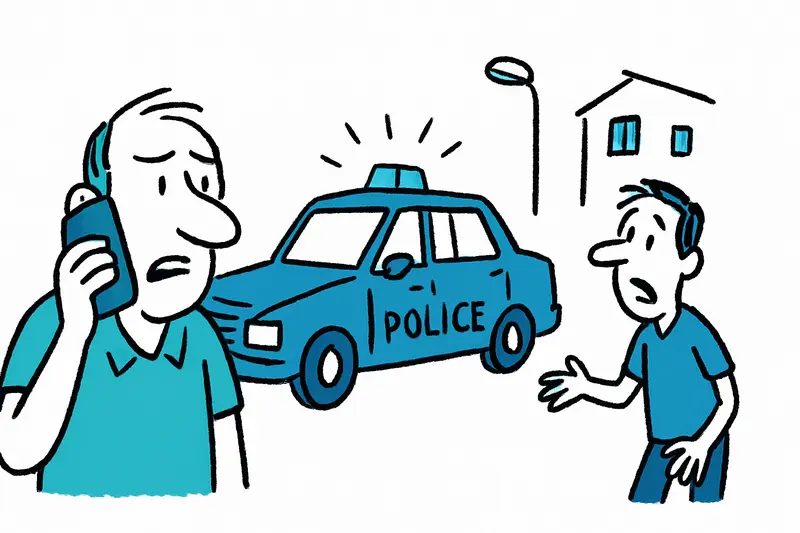
A concrete everyday image: a patrol car stands empty on the harbour street with its door open. A tourist who has just been robbed dials the emergency number, but only hears: We are forwarding this. Meanwhile the night noise continues, and the group reporting the theft stands bewildered at the roadside. Such scenes do not leave the sense of security unaffected, especially on busy promenades (see Alarm on the Paseo Colón: How safe are Mallorca's promenades after nightfall?).
How can such nights be prevented? The first building blocks for pragmatic solutions are obvious. Short term: clear on-call rules that cover sudden staff shortages; cooperation with neighbouring municipalities for shared night patrols; reliable shift allowances so that night duty does not become a constant burden. Medium and long term: targeted recruitment campaigns, training drives and incentives such as service housing or more flexible working models so that summer duty does not turn into a burnout trap.
Technology can complement but not replace personnel: camera surveillance at hotspots, a centralized emergency call handling with clear escalation paths and a digital incident documentation system would make the situation more transparent. Equally important is a clear contractual agreement between the municipality and the Guardia Civil that defines response times and responsibilities during peak periods.
What rarely appears in debates is the role of the community. Neighbourhood reporting systems, coordinated security teams from local businesses and a stronger involvement of tourism providers could help provide first aid and information more quickly until the police arrive on site, as recent incidents such as Night-time Break-ins in Can Picafort: Caught — What Now? illustrate.
In the end it is not just about numbers on the duty roster, but about trust. If local security does not work reliably during a holiday season when the streets are full of people, the image of the place and the everyday quality of life for residents suffer. The question is not whether the problem is unpleasant — it is — but whether those responsible will now act more concretely.
Conclusion: Capdepera needs more than short-term calls to the Guardia Civil. A combination of staffing measures, clear agreements, technical supplements and civic engagement can close the nighttime gap. If the municipality takes summer nights seriously, the result must not be just a meeting "this week" but a plan with concrete steps and timelines — so that no one has to wait alone for help at night.
Frequently asked questions
What happens if there's no local police patrol at night in Cala Rajada, Mallorca?
How does Capdepera respond when nighttime coverage is thin?
Why do night patrol gaps appear in Capdepera during peak tourist season?
What steps should Mallorca towns take to improve nighttime security during peak season?
Could neighbouring towns help with night patrols on Mallorca’s northeast coast?
What role can technology play in nighttime safety when police are stretched?
How should visitors report incidents at night in Mallorca’s tourist areas?
What can tourists do to stay safe if police response is delayed on a busy Mallorca night?
Similar News

Ryanair Flight Diverted to Barcelona: An In-Flight Emergency and the Questions That Follow
A Ryanair jet from Pisa to Málaga landed in Barcelona after a passenger became acutely ill. Why these cases need more at...
Alarm in Port de Pollença: What now for the polluted bay?
Hundreds of people protested on the beach of Port de Pollença. The environmental organization Arrels Marines demands a p...

Micaela Schäfer: Between Playa de Palma and a Berlin Law Firm — New Calm, an Old Tomcat and Solid Finances
The party artist from the Ballermann scene appears surprisingly down-to-earth: a new relationship with a Berlin lawyer, ...
At Playa de Palma: Fire in Residential Building – six people rescued on the roof, what is missing in prevention?
In the evening a fire broke out on the first floor of a five‑storey building on Calle Trasimé. Six residents fled to the...
New License Requirement for Mini-Boats in Mallorca: Protection Measure or Tourism Brake?
From October 1 renters of small recreational boats in the Balearics must present a boating license. Critical questions r...
More to explore
Discover more interesting content

Boat Tour with BBQ along Es Trenc Beach

Private transfer from Mallorca Airport (PMI) to Pollensa
