
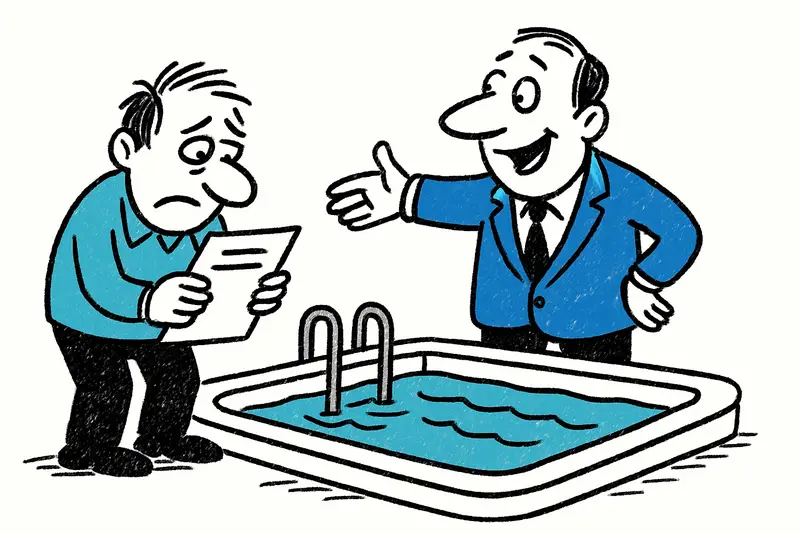
Why a Pool in Palma Suddenly Costs Hundreds of Thousands More — and What That Means for Buyers
In Palma, sellers ask significantly more for apartments with a pool — often a premium of over 50%. We ask: What are buyers really paying for, what are the consequences for residents, and which strategies help when buying?
A pool as a price driver: Has water become a luxury in Palma?
The central question is: Why does a shared or small rooftop pool suddenly often make a difference of more than €200,000 in the asking price? When you stroll through the lanes of La Lonja on a hot afternoon, hear the voices from café terraces and the distant giggles from an inner courtyard pool, it becomes clear: the water sells an idea of life — but at what cost?
Concrete numbers and examples
Market analyses show it clearly in new data on how much more expensive a house with a pool in Palma: apartments with a pool currently cost on average about 55% more than comparable properties without water features. A typical case you see often: an 80 m² apartment near the old town or on the edge of Son Espanyol with access to a communal pool is currently listed on average at about €592,000. This is not a penthouse with a private terrace, but a regular city apartment — with the luxury of a shared pool.
Why prices rise so steeply
Several drivers converge here. First: scarcity of green and open spaces in Palma. A pool is a visible, photographable extra that particularly attracts international buyers. Second: renovation boom. Owners invest in modern facilities — pool construction is seen as an efficient value booster. Third: market perception. Agents and listings present pools as an "upgrade"; that creates demand and reduces negotiation pressure.
Less often considered is the ecological and infrastructural side: water consumption, pump and heating costs, disposal of chemicals and the energy needs for filtration systems. These follow-up costs end up indirectly in the service charges and thus in the monthly burden for buyers.
Communal pools instead of private paradises
Interestingly: almost one in four apartments with a pool offers not a private pool but communal facilities. That explains why an individual buyer accepts high surcharges — they pay for access and experience, not for exclusive space. With the pool often come higher community costs: property tax (IBI), maintenance, seasonal cleaning. In Santa Catalina or El Terreno you hear more towels in summer than usual — that changes the soundscape of an otherwise quiet courtyard.
For whom does the surcharge pay off — and for whom not?
The pool pays off more for families with children, regular hosts or buyers with a strong lifestyle focus. Single households or people with a busy city life who rarely use the pool often bear the additional costs without real benefit. A neighbor on Carrer de Sant Miquel summed it up: "The pool is great in August, but the community charges are annoying."
Aspects that are often overlooked
Rarely discussed are insurance issues (liability in case of accidents), noise nuisance on summer evenings, hygienic conditions with poor maintenance and the loss of value if a pool is not properly cared for. Urban rules on water scarcity in dry years could also make pools more expensive in the medium term — through restrictions or surcharges.
Concrete opportunities and solutions for buyers
1. Checklist before buying: Review minutes and records from the community management (maintenance plan, reserves, recent invoices), ask about cleaning intervals, filter changes and insurance. Calculate: monthly community fees + reserves for repairs.
2. Negotiate with numbers: Instead of focusing only on the pool, demand concrete cost breakdowns and ask for a price reduction if reserves are lacking or foreseeable repairs are needed.
3. Ecological upgrades: Investments in solar heating, salt-based disinfection or water-saving systems can often be used as negotiation arguments or as long-term savings potentials — and protect island resources.
4. Policy & transparency: Mallorca's municipalities could require listings to clearly state whether a pool is communal and what realistic annual additional costs are. More transparency would dampen price bubbles.
Conclusion
A pool sells — you can see that in the listings and among the people chatting about real estate at the harbor. But buyers should not pay just for the promise of summer afternoons and sea breezes. Careful calculations, questions about maintenance and reserves as well as ecological considerations are more important than ever. That way the tempting water becomes not just an expensive illusion, but a well-thought-out investment in a piece of life in Palma.
Frequently asked questions
Why do apartments with a pool cost so much more in Palma?
Are communal pools in Mallorca worth paying extra for?
What extra costs come with buying a property with a pool in Palma?
Is a pool in Mallorca a good investment for resale value?
What should I check before buying a flat with a pool in Palma?
Do pools in Palma make community fees much higher?
Is a pool in Palma worth it for families?
Are there more rules or risks for pools in Mallorca during dry years?
Similar News

Caro Robens: 15 kilograms lighter — and again in the crossfire of online comments
Bodybuilder Caro Robens, who lives in Mallorca, has lost 15 kilograms. Her success on Instagram was met with applause — ...
Meager Industry in Mallorca: How the Island Can Be More Than Just Tourism
The industrial sector in Mallorca is shrinking, productivity is falling and firms remain tiny. The key question: can the...
Pre-Nit de l'Art: Galerie Mensing invites to a special evening with Tom Boston
Before the big art night, Galerie Mensing opens its doors: pop art, champagne, a DJ and a hand-signed print by Tom Bosto...

Sea view and more seats: Cappuccino Grand Café reopens in Port d'Andratx
After a long renovation, the Cappuccino Grand Café on the Port d'Andratx harbor promenade has quietly reopened. Larger t...

Enric Mas wins the Vuelta – a triumph that resonates in Mallorca
Mallorcan Enric Mas has won the 82nd Vuelta — the first Spanish overall victory since 2014. Cyclists and neighbors on Ma...
More to explore
Discover more interesting content

Can Cap de Bou

Townhouse Lleo 72
