
After a Dispute in Palma-Bons Aires: Hammer Attack in Road Traffic — A Reality Check
After a Dispute in Palma-Bons Aires: Hammer Attack in Road Traffic — A Reality Check
During an argument in Bons Aires, a driver pulled a hammer on October 1 and injured a man in the leg and shoulder. The Spanish National Police investigated and arrested a suspect. What does this say about our city — and what is missing from the debate?
After a Dispute in Palma-Bons Aires: Hammer Attack — A Reality Check
A midday quarrel escalates, a man needs stitches — and many questions remain unanswered
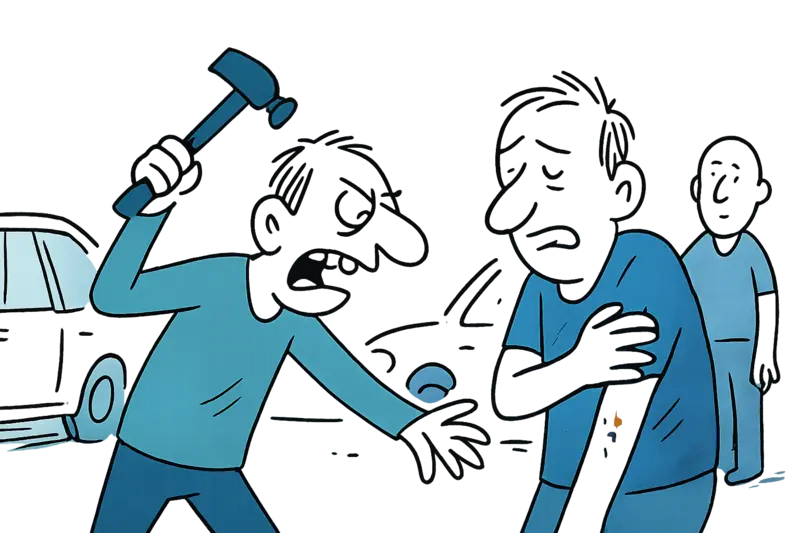
On October 1 at around 2:15 p.m., a brief but loud incident in road traffic occurred in the Bons Aires neighborhood of Palma. Three people got out of two vehicles, the confrontation escalated, and according to investigators one of the drivers pulled a hammer out of the car. The other person involved suffered injuries to the leg and shoulder that required medical treatment and stitches. The Spanish National Police identified the alleged attacker and arrested him together with his passenger; criminal investigations are ongoing.
Key question: Why does an ordinary dispute on the street escalate so quickly that a tool becomes a weapon — and how can Palma prevent this in the future?
The raw scene is easy to reconstruct in the mind: midday heat, honking, perhaps a risky overtaking maneuver, a cut-off at an intersection, three people jumping out of their cars and voices rising. In Bons Aires, where small shops and street cafés set the pace between residential streets, the sound of a loud argument is not uncommon (see Brawl at Playa de Palma: Why a verbal exchange could have ended fatally).
The facts are sparse but reliable: victim and perpetrator apparently did not know each other long-term; the injuries required medical stitches; the National Police have identified and arrested the attacker and his companion. That is where the chronicle of the violent act ends — but the reasons for the escalation, the role of aggressive patterns in traffic, and the question of whether prevention could have helped remain open.
My critical analysis highlights three areas for improvement: First, the everyday culture behind the wheel. Driving in Mallorca is often dense, tight and tense; many are on the move between appointments, shops and family obligations. When stress collides in a confined space, small triggers are enough (compare When a Dispute in Portopí Ended Up in the Harbor: Crash Without Driver's License Raises Questions). Second, the accessibility of potential weapons. Tools such as hammers are common in everyday life but become weapons if they are immediately at hand. Third, the gap in conflict prevention and routine de-escalation — the topic is insufficiently anchored neither in driving schools nor in municipal awareness campaigns.
What is missing so far from the public debate is a sober discussion about concrete prevention measures. This is not about moralizing, but about practical questions: Should there be awareness campaigns about aggressive driving behavior, more visible presence at known hot spots, a culture of reporting dangerous situations in traffic? And who pays for this — the municipality, the island council or the police authorities?
An everyday scene from Palma that illustrates this: late morning on the way to the Plaça, you hear delivery vans, scooters and a bicycle bell; a parked transporter narrows the street, two cars squeeze past each other, the air crackles. No one wants to give way. That is exactly where a spark is enough.
Concrete solutions that can be implemented here and now:
- Communication campaigns: Short, clear messages at traffic lights and parking areas as well as on social channels that urge consideration and show how to de-escalate disputes (e.g. keep distance, drive away, inform the police via emergency number).
- Increase police presence at specific times: Not to punish, but to prevent escalations. Visible patrols during time windows of high traffic tension often have a calming effect.
- Reporting centers for accidents and aggression: A simple, low-threshold reporting function for risky traffic situations — by phone or via an app — could extinguish fires at an early stage.
- Driving school modules: De-escalation training as part of driver education: short exercises, psychological pointers and legal boundaries so that new drivers know which reactions are dangerous.
- Public awareness on securing loads: Reminders to store tools safely in the vehicle. A small measure, big effect: a hammer in the trunk is a different matter than one on the passenger seat.
All of this costs time and money — but it is about the ratio of effort to human safety. Above all: it is about attitude. If neighbors, shopkeepers and road users begin to see disputes not as personal honor battles but as incidents the community can defuse, the risk of violent acts will decrease.
Conclusion: The hammer attack in Bons Aires is not an isolated, mysterious crime but a symptom (see also Arrest after knife attack in Pere Garau: How safe is Palma's neighborhood? and Nighttime Attack on the Paseo Marítimo: How Safe Is Palma’s Party Mile Really?). It shows how quickly everyday frictions on Mallorca can turn into physical violence when neither tools nor aggression are safely contained. Instead of only calling for culprits to be locked up, we must ask: How do we change the small habits — in the car, at the traffic light, in our minds — that make such escalations possible in the first place? That would be the more practical, less noisy way to ensure that a midday quarrel does not end with stitches in a hospital.
Frequently asked questions
What happened in the Bons Aires neighborhood of Palma on Oct 1 involving a hammer attack?
What prevention ideas are being discussed to stop traffic violence in Palma after the Bons Aires incident?
How can residents or shopkeepers in Bons Aires help reduce street quarrels and improve safety?
What is the broader takeaway from the hammer attack for Mallorca's road safety culture?
Why do street disputes on Mallorca sometimes escalate to violence, and what triggers them?
What practical steps can Mallorca implement to reduce traffic-related aggression?
How can drivers de-escalate conflicts when behind the wheel in Mallorca?
Where can people report dangerous traffic situations in Mallorca?
Similar News
Luxury Trade Fair in Santa Ponsa: Who Benefits, Who Pays?
At the end of October Calvià is hosting top buyers from the luxury travel sector in Santa Ponsa. The guiding question: D...
Viking Mira docks in Palma for the first time – a new chapter for luxury travel
An elegant five-star ocean liner, built by Fincantieri, berthed at Moll Vell on Tuesday. The "Viking Mira" brings a quie...
When the Real Estate Agent Turned Rambo: Violence Instead of the Courts — What the Blanquerna Incident Reveals About Mallorca
A real estate agent allegedly stormed a Palma apartment in June, smashing walls and furniture with a hammer and was arre...
Seizure in the Sea at El Arenal: How Safe Are Our Beaches?
A minor suffered a seizure in the water near El Arenal. Lifeguards cared for her for about 20 minutes before emergency s...
Rafa Nadal enters the wine business: 'El Tenista' aims to give Mallorca a new flavor
Rafa Nadal is investing with the Gil family in the wine project 'El Tenista'. For Mallorca it could be more than a celeb...
More to explore
Discover more interesting content

Can Cap de Bou

Townhouse Lleo 72
