
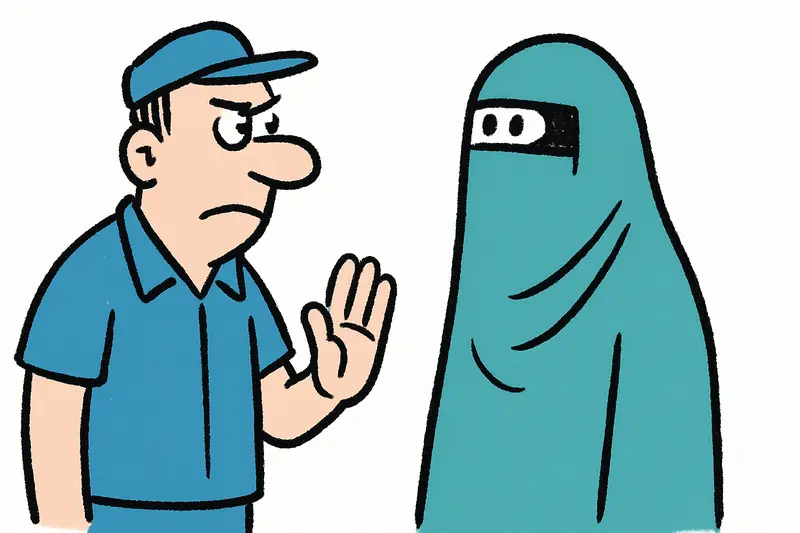
Palma passes burqa ban: symbolic politics or protection?
Palma passes burqa ban: symbolic politics or protection?
Palma's city council has banned the burqa and niqab in town halls and city buses. What remains unexamined — and what consequences might women on the ground face?
Palma passes burqa ban: symbolic politics or protection?
Key question: Does the ban protect women — or does the city shift a social problem into everyday life?
In the early morning, when the first EMT bus leaves Plaça d'Espanya and the driver looks through the window at the thick fog over the bay, the city council's decision feels far removed from many people's daily lives. Yet the new rule, which prohibits wearing the burqa and niqab in municipal buildings and on city buses, meets busy stops, markets and school routes here — and raises questions that have been barely heard in the debate (see Palma Tightens Controls: More Security — or a New Punitive Culture?).
The majority in the town hall, carried by PP and Vox, pushed the initiative through (see Why Palma's 'Persona non grata' Resolution Raises More Questions Than Impact). The ban is justified with security concerns and a vision of integration that relies on visibility: show your face, confirm identity. On the other side, the left warns that political opponents are using the issue for migration policy aims and that affected women will be further pushed out of public space.
This is where the discussion stalls: there is a clear statement — "ban" — but hardly any reliable figures or voices of those affected. How many women in Palma wear the burqa or niqab? What role do family pressures, economic dependence or information gaps play? The decision answers none of these questions; it rather produces rules for situations that can be complicated in practice.
Legally the situation is not trivial. In Spain, freedom of religion, equality and public safety stand side by side. A municipality can set rules for its premises, but local measures must be compatible with the constitution and national legislation. Whether a local ban will stand up in court depends on how well the measure is justified and proportionate; courts have previously ruled on municipal bans such as the Court Confirms Tuk‑Tuk Ban in Palma – Opportunities, Problems and Solutions. Such proceedings are complex and burden everyone involved — women, authorities, bus staff.
What is missing from the public discourse is an honest description of the practical consequences: bus drivers, inspectors, social workers and police officers suddenly face decisions they cannot make uniformly. Will a woman be forced to leave the bus if she refuses to uncover? Are fines threatened? Should the municipal public order office intervene or only the national police? The administration must provide answers, otherwise arbitrary enforcement and uncertainty will arise on the streets.
An image from Palma: At the Mercado del Olivar market sellers discuss over a café cortado. An older woman who often shops wearing a headscarf hears the news on the radio. She shakes her head because she knows people who might feel watched or threatened by this. An EMT driver nearby braces himself: he wants to avoid conflict, not become an enforcer (coverage of recent EMT measures and related protests is available in International Day Against Violence Against Women: Two Rallies in Palma and New Night Rule at EMT). Tensions decided in the council chamber are thus played out on the streets.
Concrete proposals that would enrich the public debate:
1) Legal review before emergency measures: The city should obtain an independent legal assessment before sanctions are enforced. Clarity protects administrations and those affected.
2) Practical instructions for bus staff: No arbitrary confrontations. De-escalation training, clear identification procedures (for example in the presence of police officers or social workers) and designated contact persons for complaints.
3) Social offers instead of exclusion: Counseling centers, accessible women's shelters, more budget for integration projects and initiatives that work directly with local Muslim communities. Those who want change need dialogue, not only bans.
4) Transparency and data: The city should publish how often violations are recorded, how procedures proceed and what consequences sanctions have. Without data the measure remains symbolic.
5) Involvement of those affected: Women affected by the regulations must be heard. Without their perspective every rule remains fragile and potentially counterproductive.
Those who know Palma know: on Passeig Mallorca you don't hear the tram clattering at night, but you hear families, neighbors and sometimes the distant honk of EMT buses. Politics that are decided in council chambers often end up as debates at kiosks or cafés. The crucial question is whether what is sold as a clear message in the town hall creates practical solutions in the real world or fuels new conflicts.
Conclusion: The ban is more symbolic than substantive as long as no accompanying measures exist. If Palma truly wants to achieve safety and equality, it needs a combination of legal caution, social work and, above all, a voice for those affected. Otherwise the new rule will remain a municipal fanfare without music.
Frequently asked questions
What does Palma’s burqa ban actually apply to?
Why is Palma banning the burqa and niqab?
Is Palma’s burqa ban legal under Spanish law?
How will Palma enforce the burqa ban on buses and in public buildings?
Could Palma’s burqa ban push affected women out of public life?
What support measures does Palma need if the burqa ban is enforced?
What should visitors and residents in Mallorca know about face-covering rules in Palma?
Why is Palma’s burqa ban being called symbolic politics?
Similar News
Bendinat as a meeting place: Padel Cup brings together nearly 120 players
Three days of padel at the Bendinat Urban Country Club: organized by El Económico and Borbalán, with around 120 particip...
Large-scale Anti-Tourism Graffiti at Cala Mendia: Protest or Vandalism?
On the morning walkers discovered an approximately 50-meter-long slogan against tourism on the wall above Cala Mendia. W...
Bomb threat before Jet2 flight in Tenerife: A reality check for security protocols
A passenger reported a bomb in luggage shortly before departure in Tenerife. Evacuation, baggage checks, delays — and ma...
Who is stripping Mallorca's coast bare? Why entire slopes are being removed for villas
On Mallorca steep slopes are again being removed to make way for luxury construction sites. Who bears the responsibility...
Robber Falls While Fleeing in Sant Agustí: Who Takes Responsibility?
During a purse-snatching in Sant Agustí, a non-commissioned officer chased the suspect; the man jumped from a bridge and...
More to explore
Discover more interesting content

Can Cap de Bou

Townhouse Lleo 72
