
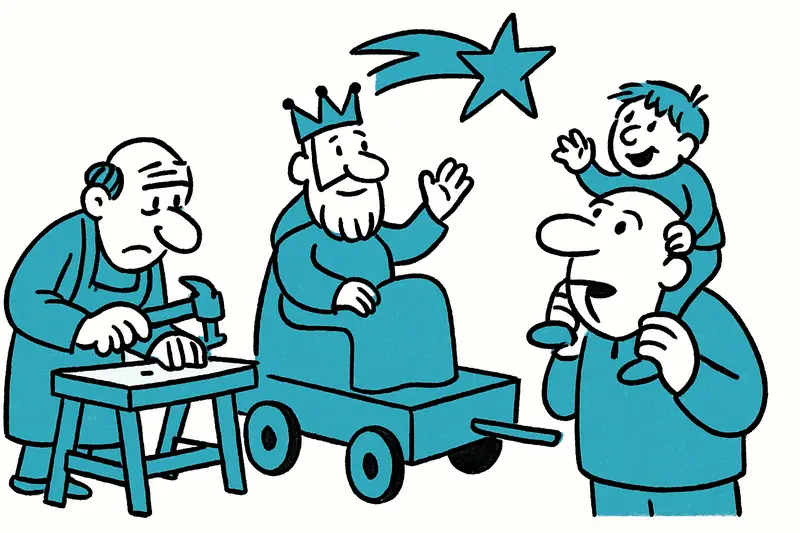
Palma brings the Cabalgata 2026 back to the streets: Craft, light and 22 floats
Palma brings the Cabalgata 2026 back to the streets: Craft, light and 22 floats
The city of Palma has unveiled the program for the Three Kings parade on January 5. New is an artistic concept that links Mallorcan craftsmanship with a multi-year narrative.
Palma brings the Cabalgata 2026 back to the streets: Craft, light and 22 floats
The Kings arrive on January 5 at Moll Vell – a multi-year project puts local crafts in the spotlight
When on the evening of January 5 the lights at Port of Palma (Moll Vell) flicker and the ships glide into the harbour, one of the year's biggest street celebrations will begin in Palma once again. The city has announced the exact route of the Cabalgata de los Reyes Magos for 2026: the start is the pier, then the procession moves through the Old Town via Avinguda de Antoni Maura, Passeig del Born, past Plaça del Rei Joan Carles I, along Carrer de la Unió to the Rambla and further along the main ring roads to Plaça de Cort.
What is new about this edition is not a cosmetic makeover but an artistic plan that thinks beyond a single year. Under the Catalan title La llum d’Orient i els oficis d’arrel the project connects the story of the Three Kings with traditional Mallorcan crafts. The 2026 edition carries the subtitle L’inici del camí: pa, sobrassada, fang i fils and places trades and materials at the centre — those that play a role in the island's nativity landscape.
The production is large: 22 specially designed floats will be presented, complemented by municipal service vehicles and discussed in More Floats, More Questions: Palma's Three Kings Parade Redesigned. Designers and artists have constructed elements that deliberately draw on local shapes and textiles. The largest construction, a carriage with the Star of Bethlehem, reaches 4.55 metres in height. In total, about 400 participants are planned; in recent months 14 specialists from carpentry, blacksmithing, painting, sculpture and tailoring have worked on the implementation.
Artistic director Daniel Puig leads the project; designer Anabel Gomar is responsible for at least one of the central figures. The city is organising barriers, safety zones and designated areas for families and people with reduced mobility. Police, emergency services and civil protection will be present so that the evening proceeds in an orderly fashion. Organisers recommend arriving early on the route — finding a spot on Passeig del Born or near Plaça de Cort late in the evening will be difficult.
A small but charming prelude already takes place on January 3: the royal pages will be expected at midday at the town hall square to receive children's letters. For many families this is a cosy moment in itself — a piece of anticipation among shop windows, street lamps and the scent of sobrassada that will hang in the air at some stalls.
According to the city administration, they want to give the procession something lasting: the new line is conceived as a three‑year narrative in which historical research and studies on traditional clothing and architecture will play a role. The aim is not only a beautiful evening spectacle but also to make local crafts visible and bring them back into public awareness.
For Palma this means several small gains: first, a celebration that attracts families and enlivens the city centre. Second, the chance to publicly showcase traditional trades — carpenters, blacksmiths and textile craftsmen thus gain a stage. And third, a cultural offering that emphasises materiality and regional identity rather than mere showmanship. At a time when many city festivals feel interchangeable, Palma is focusing on what is unique to it.
Those present on the evening will not only see floats but also scenes: children with warm jackets on their parents' shoulders, the sparse lamps along Passeig del Born, faint church bells and artisans proudly standing next to their creations. Such images linger — beyond social‑media hits, as lasting memories of community.
The new Cabalgata is not a finished work of art but an open promise: three years in which stories will be continued, craft techniques will be revived and the connection between tradition and city life can be deepened. For Palma it is an occasion to celebrate and to pay attention to what is made here. And for everyone standing along the route on January 5, an invitation to experience an evening full of lights, craft and shared memory.
Frequently asked questions
When does the Three Kings parade take place in Palma?
Where does the Cabalgata route go in Palma?
Is it worth arriving early for the Three Kings parade in Palma?
How many floats are in Palma’s 2026 Three Kings parade?
What is new about the 2026 Three Kings parade in Palma?
What should families know before going to the Cabalgata in Palma?
What happens on January 3 in Palma before the Three Kings parade?
Why is Palma highlighting local crafts in the 2026 Cabalgata?
Similar News
Injured captain, big plans: Germania Mallorca before the away match in Consell
The newly founded FC Germania Mallorca travels to Consell on Saturday. Captain Bastian Müller is out injured, but coach ...
Palma, Palma de Mallorca, Palma‑Mallorca: What is it really about?
The debate over the city's name is more than grammar: it concerns identity, law and branding policy. A sober reality che...
Warning to Bathers: Nipping Fish in Cala Major and Other Coves — a Reality Check
In Cala Major and several beaches around Mallorca, bathers report painful “nips”. Who are the animals, why are they gett...
Rental Car Theft in El Arenal: What This Incident Reveals About Our Gaps
A teenager steals a running rental car in El Arenal, flees on foot, climbs over walls and is caught by the Guardia Civil...
Red Rope in Palma's Library: What Helps Against Selfie Tourism — and What's Missing
Palma's city library cordoned off an area with a red rope to keep selfie tourism away from reading and working activitie...
More to explore
Discover more interesting content

Can Cap de Bou

Townhouse Lleo 72
