
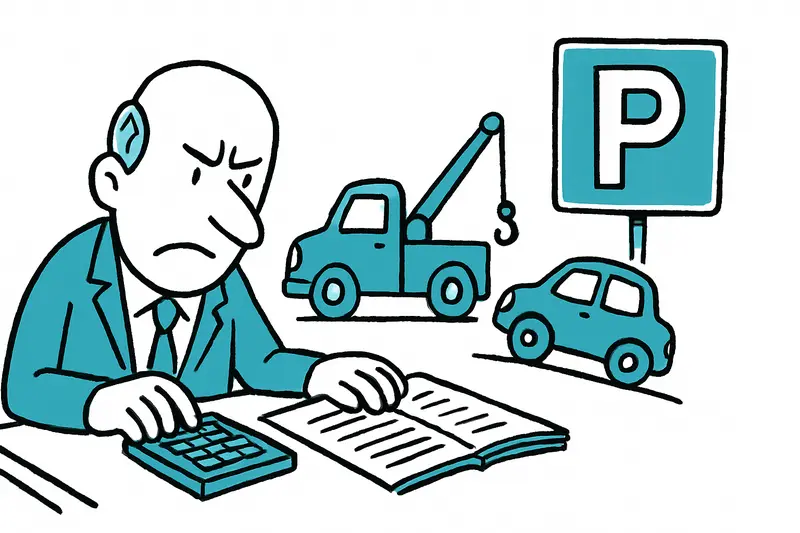
Palma expects lower revenue from parking fines — City relies on towing and ORA expansion
The city of Palma plans about €29 million from fines for 2026 — €3.6 million less than in 2025. Instead of relying on higher parking ticket revenues, the budget now leans more on towing fees and the expansion of ORA parking zones. A look behind the numbers.
Palma expects lower revenue from parking fines — City relies on towing and ORA expansion
Key question: Can Palma compensate the decline in fines in a socially acceptable way?
On December 1, 2025 the financial plan made it clear: for 2026 Palma has budgeted around €29 million from penalty notices — about €3.6 million less than the previous year, a drop of roughly eleven percent. At the same time the city anticipates additional income from increased towing of improperly parked vehicles, a practice documented in Police clear parking chaos in Palma industrial areas — checks, towing, open questions, and from expanding the ORA parking zones, an issue discussed in No more blue stickers: Palma opts for digital parking permits – Are the city and seniors ready?. And in the middle of the old town, just below the cathedral, two new speed cameras have recently been installed.
It sounds like an internal redistribution: fewer parking ticket revenues, but more money from parking management and towing fees. Yet behind the dry numbers lie questions that are often neglected in budget debates.
Critical analysis: first, it is unclear how sustainable the forecasts for towing fees are. Towing is costly — for residents as well as for small businesses struggling with delivery times. In the short term it boosts revenues, but in the long term frustration grows, which can weaken local businesses. Second, the shift reveals a fiscal problem: municipalities should not rely on fines to close structural revenue gaps. Fines are a sanctioning tool, not a stable source of income.
Third, the public debate often lacks the question of fairness. Who ends up paying the bill? Visitors who park without precise knowledge of ORA boundaries, or locals looking for an evening parking spot for their children? And how much money is really invested in preventive traffic planning versus collecting from parking violators?
What is missing from the budget documents are exact figures on appeals, reimbursements and the administrative costs of managing the parking zones. How many appeals succeed? What are the operating costs for the expanded ORA systems? Without these data the budget calculation remains incomplete.
An everyday scene from Palma: Friday evening in the old town, Passeig del Born fills up, cafés set tables on the pavement, delivery scooters weave between parked cars. Two parking tickets hang from a rearview mirror, a tow truck rumbles at the edge of the plaza — interchangeable, but palpable for the person who urgently needs their car. Such scenes tell more about the measures' effects than any table.
Concrete solutions: Palma should make budget projections more transparent and supplement them with key performance indicators: number of expected tows, average fees, appeal rate, cost per parked hour. An open dashboard approach would help politicians and citizens weigh revenues and side effects.
Instead of reflexively treating towing as a revenue source, a package of measures is more advisable: better signage, digital parking apps with clear boundaries, time‑based parking prices, more short‑term delivery zones and additional night controls. For residents, expanded resident parking permits with reasonable quotas and clear price transparency could be introduced, similar to Palma will in future tie resident parking to license plates: The blue ORA stickers will disappear..
In the long run the city should consider earmarking revenues from parking management and fines for traffic calming and alternatives: additional bus services, secure bicycle parking in the old town, better lighting for pedestrian routes — measures that reduce parking pressure while improving quality of life.
What is often missing from public debate is discussion of obstacles to humane traffic management: personnel resources, political priorities and the risk of preferring short‑term revenues over sustainable solutions. Anyone reading the budget must also ask: does the city promote a liveable urban environment or only short‑term revenue gains?
My conclusion: the planned reduction in fine income and the shift to towing and ORA revenues is more than a line in the budget. It is a political decision space that influences traffic behavior, social equity and urban climate. Palma can close the gap — but not at the expense of residents' daily mobility. Transparency, targeted investments and above all a plan that protects people from short‑term fiscal reflexes would be the better way.
If you stroll past the Mercat de l'Olivar on a Saturday and overhear the discussion, you quickly notice: it is not just about budget figures. It is about how Palma lives together — and whether the city administration shapes its revenue plans so that the streets remain not only orderly but also fair.
Frequently asked questions
Why is Palma expecting less money from parking fines in 2026?
How does parking work in Palma’s ORA zones?
Can my car be towed for parking illegally in Palma?
What should I know about parking in Palma’s old town?
Are parking fines in Palma a reliable source of city income?
What happens if I get a parking ticket in Palma?
What parking changes is Palma considering besides fines?
How can residents avoid parking problems in Palma?
Similar News
The End of the Cheap Ride? Why Mallorca Is Hit Harder by the Fuel-Price Shock
Gasoline and diesel average close to two euros per liter. What this means for commuters, supply chains and renters in Ma...
Relaxed liquid rules in Munich: What Mallorca travelers will notice
At Munich Airport the 100-milliliter rule will be lifted at all checkpoint lanes — thanks to new CT scanners passengers ...
For 45 Years on Mallorca — and Then This: How a Market Visit in Santa Ponsa Became a Lesson
A woman who has lived on the island for decades lost money and important documents at the Mercat Setmanal in Santa Ponsa...
10 percent surcharge on the beach: How legal and transparent is the extra charge at Playa de Muro?
A German part-time resident noticed days after a restaurant visit in Playa de Muro that the bill included a flat ten per...
Body near the Llevant Market: What this death says about our city
A man was found dead on Sunday afternoon near the Llevant Market. Police say the death appears natural. The scene raises...
More to explore
Discover more interesting content

Can Cap de Bou

Townhouse Lleo 72
