
Too little space for everyone: How parking meters in Pere Garau block sidewalks
Too little space for everyone: How parking meters in Pere Garau block sidewalks
New ORA parking meters in Pere Garau narrow sidewalks so much that strollers, walkers and wheelchairs can hardly pass. An architect speaks of breaches of the requirements – the city must make adjustments.
Too little space for everyone: How parking meters in Pere Garau block sidewalks
Key question
Can the city administration achieve the goal of distributing parking spaces more fairly without excluding people with prams, wheelchairs or walkers?
Critical analysis
In recent weeks new parking meters have been installed in parts of the Pere Garau neighborhood as part of the expansion of the ORA parking zone. On the narrow sidewalks, especially on sections near the market, as described in Pere Garau: Market and delivery traffic — why the coexistence became dangerous, these machines have been placed so that the free passage is noticeably reduced. An architect working on site points out that the relevant accessibility guidelines require a distance of around 180 centimetres between a wall and an obstacle; in exceptional cases 90 centimetres are acceptable. On site, however, significantly smaller passage widths are measured – in some places only about 85 centimetres remain. That means: two people with prams or a wheelchair and a pedestrian bump into each other.
What is missing in the public debate
The debate has so far focused on two camps: those who welcome the ORA as a means of order and relief from parking chaos, as reported in Beyond the Parking Lottery: Son Espases and the Daily Parking Chaos, and those who lament the loss of convenience. Little has been said about the targeted inspection of installation sites based on measurement reports or about clear responsibilities for complying with accessibility rules. Also underexposed is the question of whether the purchased machines are technically and spatially suitable for historic, narrow streets at all – instead of rigid devices, more flexible solutions would be conceivable.
Everyday scene from Pere Garau
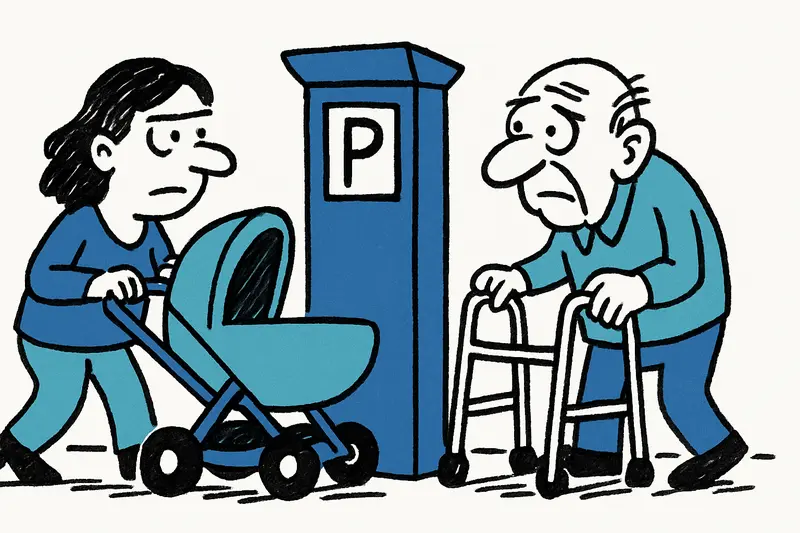
It is a Wednesday morning, the market stalls next to the Mercat de Pere Garau rattle, suppliers push crates, a bus brakes at the corner. A young mother pushes her pram past the meter, the front wheel gets briefly stuck, she coordinates with an older gentleman coming the other way with his walker. The mother forces a smile, the man sighs. Such small manoeuvres repeat hourly – for people with limited mobility they are not only annoying but tiring and potentially dangerous.
Concrete solutions
- Immediate measurement: The city should start a surveying campaign to record all new meters and document the remaining passage width. Where the minimum is undercut, adjustments must be made.
- Move to the edge: Where possible, place the meters flush with the curb or attach them to lampposts to increase usable sidewalk width.
- Alternative technology: Consider wall-mounted QR/NFC solutions, parking by app, or more compact devices instead of freestanding columns; this reduces the number of physical obstacles.
- Selection criteria for installations: No standard placement along entire streets; conduct an on-site inspection in advance with representatives of the neighborhood and the disability association.
- Transitional solutions: Temporary markings that indicate accessible side strips and clear deadlines for adjustments.
- Communication and sanctions: Public mapping of problematic locations, a clear timetable from the city and sanctions for faulty installations or cases that need quick correction.
Why small interventions help a lot
Small changes – a few centimetres closer to the curb, using existing poles, reducing visible devices – cost little but have a big effect on the usability of the sidewalk. At the same time the city can get closer to its goals: regulated parking, as in Sóller wants to tame the parking chaos: Three parking lots and 300 resident spaces — is that enough?, without it coming at the cost of accessibility.
Pointed conclusion
The ORA expansion can bring benefits for residents, but it must not result in another group of people being excluded. The city administration is now obliged to measure, move, digitize – and to do so quickly. Those who walk Pere Garau's bumpy sidewalks in the morning do not expect grand theories, but that someone will take care of the few centimetres that decide between passing through and being blocked.
Frequently asked questions
Why are the new parking meters in Pere Garau causing problems for pedestrians?
What does Mallorca’s accessibility rule say about space on sidewalks?
Is it still possible to walk through Pere Garau with a pram or wheelchair?
Why is the area near Mercat de Pere Garau particularly sensitive?
What could Mallorca city officials do to fix the sidewalk problem in Pere Garau?
Can ORA parking zones in Mallorca work in historic neighbourhoods with narrow streets?
What should residents in Pere Garau do if a parking meter blocks the pavement?
Does parking regulation in Mallorca always improve daily life for residents?
Similar News

Four goals, heart-stopping moments, a message: Germania Mallorca takes three points in Consell — questions remain
The new German club on the island won its first away game in Consell 4:3. Celebration, a 4:0 lead, then a nervous finish...

Mueller continues expanding in Mallorca: Artà in 2026, Can Picafort in early summer 2027
The drugstore chain Mueller is opening two new stores in Mallorca: a 1,400 m² shop in Artà on 5 November 2026 and a bran...
The Painter Who Lived Mallorca: Franz Taussig and His Century-Old Secret
A hundred years ago a young Viennese arrived in El Terreno, sketched the island and called himself Francis Caron. Today ...

Airport dispute: Bridge, forecasts and the question of responsibility
A video by the Spanish transport minister has ignited the dispute over DORA figures, capacities and local governance pow...

The Painter Who Invented Himself: How a Young Viennese Drew Mallorca
A hundred years ago a 19-year-old draftsman arrived in El Terreno. His diary and sheets, long known under the pseudonym ...
More to explore
Discover more interesting content

Can Cap de Bou

Townhouse Lleo 72
